书单
百科
这个词条暂时没有中文维基百科条目,下面是英文维基百科的内容(英文原文):
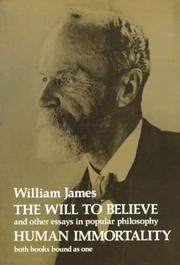
"The Will to Believe" is a lecture by William James, first published in 1896, which defends, in certain cases, the adoption of a belief without sufficient evidence of its truth. In particular, James is concerned in this lecture about defending the rationality of religious faith even lacking sufficient evidence of religious truth. James states in his introduction: "I have brought with me tonight ... an essay in justification of faith, a defense of our right to adopt a believing attitude in religious matters, in spite of the fact that our merely logical intellect may not have been coerced. 'The Will to Believe,' accordingly, is the title of my paper."
James' central argument in "The Will to Believe" hinges on the idea that access to the evidence for whether certain beliefs are true depends crucially upon first adopting those beliefs without evidence. As an example, James argues that it can be rational to have unsupported faith in one's own ability to accomplish tasks that require confidence. Importantly, James points out that this is the case even for pursuing scientific inquiry. James then argues that like belief in one's own ability to accomplish a difficult task, religious faith can also be rational even if one at the time lacks evidence for the truth of one's religious belief.
The lecture
James' "The Will to Believe" and William K. Clifford's essay "The Ethics of Belief" are touchstones for many contemporary debates over evidentialism, faith, and overbelief. James' "The Will to Believe" consists of introductory remarks followed by ten numbered but not titled sections. In his introductory remarks, James characterizes his lecture by stating that he had "brought with me tonight ... an essay in justification of faith, a defence of our right to adopt a believing attitude in religious matters, in spite of the fact that our merely logical intellect may not have been coerced. "The Will to Believe", accordingly, is the title of my paper." At the end of his introductory remarks, James leads into his first section by stating that he "must begin by setting up some technical distinctions."
Sections I–III: Preliminaries
In section I, James embarks upon the task of defining a number of important terms he will be relying upon throughout the lecture:
Live and dead hypotheses – "deadness and liveness ... are measured by [a thinker's] willingness to act. The maximum of liveness in a hypothesis means willingness to act irrevocably"
Option – "the decision between two hypotheses"
Living and dead option – "a living option is one in which both hypotheses are live ones"
Forced and avoidable option – an option for which there is "no possibility of not choosing"
Momentous and trivial option – an "option is trivial when the opportunity is not unique, when the stake is insignificant, or when the decision is reversible if it later proves unwise"
Genuine option – "we may call an option a genuine option when it is of the forced, living, and momentous kind"
Belief – "A chemist finds a hypothesis live enough to spend a year in its verification: he believes in it to that extent."
In section II, James begins by saying he will then consider "the actual psychology of human opinion." Here James considers and largely agrees with the criticism of Pascal's Wager that we either should not or are unable to believe or disbelieve at will. That is, James here seems to reject doxastic voluntarism, "the philosophical doctrine according to which people have voluntary control over their beliefs." In section III, however, James qualifies his endorsement of this criticism of Pascal's Wager by arguing that "it is only our already dead hypotheses that our willing nature is unable to bring to life again." By which James means that it is only things we already disbelieve that we are unable to believe at will.
Section IV: Thesis
In his very brief section IV, James introduces the main thesis of the work:
Our passional nature not only lawfully may, but must, decide an option between propositions, whenever it is a genuine option that cannot by its nature be decided on intellectual grounds; for to say under such circumstances, "Do not decide, but leave the question open," is itself a passional decision—just like deciding yes or not—and is attended with the same risk of losing truth.
Before providing an argument for this thesis, James ends this section by stating that he must still "indulge in a bit more of preliminary work."
Sections V–VII: More preliminaries
In section V, James makes a distinction between a skepticism about truth and its attainment and what he calls "dogmatism": "that truth exists, and that our minds can find it." Concerning dogmatism, James states that it has two forms; that there is an "absolutist way" and an "empiricist way" of believing in truth. James states: "The absolutists in this matter say that we not only can attain to knowing truth, but we can know when we have attained to knowing it, while the empiricists think that although we may attain it, we cannot infallibly know when." James then goes on to state that "the empiricist tendency has largely prevailed in science, while in philosophy the absolutist tendency has had everything its own way."
James ends section V by arguing that empiricists are really no more tentative about their beliefs and conclusions than the absolutists: "The greatest empiricists among us are only empiricists on reflection: when left to their instincts, they dogmatize like infallible popes. When the Cliffords tell us how sinful it is to be Christians on such "insufficient evidence", insufficiency is really the last thing they have in mind. For them the evidence is absolutely sufficient, only it makes the other way. They believe so completely in an anti-Christian order of the universe that there is no living option: Christianity is a dead hypothesis from the start."
以上文字摘自英文维基百科「The Will to Believe」(有删节,去掉了参考文献等尾部小节),按 CC BY-SA 4.0 使用,作者为维基百科的各位编者。