 书单
百科
这个词条暂时没有中文维基百科条目,下面是英文维基百科的内容(英文原文):
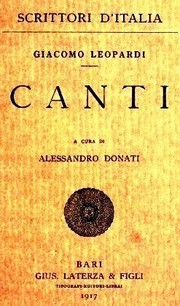
Canti is a collection of poems by Giacomo Leopardi written in 1835. The Canti is generally considered one of the most significant works of Italian poetry.
List of poems
The first poems of the Canti
All'Italia and Sopra il monumento di Dante marked the beginning of the series of major works. In the two canti, the concept of "excessive" or "over-civilization" which is deleterious for life and beauty first makes it appearance. In the poem All'Italia, Leopardi laments the fallen at the Battle of Thermopylae (480 BC, fought between the Greeks under Leonidas and the Persians under Xerxes), and evokes the greatness of the past. In the second canto, he asks for pity from Dante for the pathetic state of his fatherland. In the great canti which follow (forty-one, including fragments), there is a gradual abandonment of the reminiscences, of literary allusions and of conventionalisms.
In 1819, the poet attempted to escape from his oppressive domestic situation, travelling to Rome. But he was caught by his father. In this period, his personal pessimism evolves into the peculiar intellectual philosophical pessimism of Leopardi.
Le Rimembranze and L'appressamento della morte also belong to this early period of the art of Leopardi.
L'Infinito
The highest expression of poetry is reached in Leopardi in L'Infinito, which is at once philosophy and art, since in the brief harmony of the verses are concentrated the conclusions of long philosophical meditations. The theme is a concept, which mind can only with extreme difficulty conceive. The poet narrates an experience he often has when he sits in a secluded place on a hill. His eyes cannot reach the horizon, because of a hedge surrounding the site; his thought, instead, is able to imagine spaces without limits. The silence is deep; when a breath of wind comes, this voice sounds like the voice of present time, and by contrast it evokes all times past, and eternity. Thus, the poet's thought is overwhelmed by new and unknown suggestions, but "il naufragar m'è dolce in questo mare" ("shipwreck / seems sweet to me in this sea." English translation by A. S. Kline).
The Canzoni (1820–1823)
Leopardi returns to the evocation of ancient eras and exhorts his contemporaries to seek in the writings of the classics the noble ancient virtues.
Ad Angelo Mai
In occasion of the discovery of the De Republica of Cicero on the part of Mai, Leopardi wrote the poem Ad Angelo Mai ("To Angelo Mai") in which he invokes the figure of Tasso to which he felt so attached.
Nelle nozze della sorella Paolina
In the lyrical Nelle nozze ("On the marriage of my sister Paolina"), which were never celebrated, in the course of wishing happiness for his sister, the poet uses the opportunity to exalt the strength and the virtue of the women of antiquity and to denigrate his own time because it did not allow one to be virtuous and happy, since only after death are those who have lived a morally good life praised.
Ad un vincitor di pallone
The canto Ad un vincitor di pallone ("To the winner of a game of football") expresses disdain for the tedium of a life that is nothing but a monotonous repetition of human affairs and to which only danger can restore value: only he who has been near the gates of death is able to find sweetness in life.
Bruto minore
In Bruto minore ("Brutus the Younger"), Brutus the assassin of Caesar is depicted as a man who has always believed in honor, virtue and liberty and who has ultimately sacrificed everything for these ideals. He has come to the realization, too late to change things, that everything was done in vain, that everything has been pointless, that he will even die dishonoured and disgraced for his well-intentioned actions.
His meditations bring him to the conclusion that morality is meaningless; Jove rewards only the selfish and plays arbitrary games with hapless mankind. Man is more unhappy than the rest of the animal kingdom because the latter do not know that they are unhappy and therefore do not meditate on the question of suicide and, even if they could, nothing would prevent them from carrying out the act without hesitation.
Ultimo canto di Saffo
Saffo (Sappho) is also a tragic figure. In fact, she is a great and generous spirit, an exceptional mind and a sublime character trapped in a miserable body. Saffo loved the light (Faone) but her life was made of shadow; she loved nature and beauty, but nature has been like an evil stepmother to her and she, who is sensitive, cultured and refined, is closed in the prison of a deformed body. Nor can the greatness of her genius help to release her from this horror.
In Saffo, Leopardi sees himself reflected, but in reality the poetess of Lesbos was neither deformed nor unhappy as she is depicted by Leopardi, who based his depiction on a false traditional belief of the time. Saffo knew, tasted, and sang of beauty and love more than was possible for Leopardi. But the resignation to unhappiness, to pain and to solitude, and the renunciation of the joys of life, sounds in the verses of Leopardi like the sincere sigh of a feminine soul.
The canto is a sweet apostrophe to the placid nights, once dear to the serene poetess, but the words turn rapidly to a violent evocation of nature in tempest which echoes her inner turmoil. The anguishing and accusative questions which Leopardi poses to a destiny which has denied beauty to the miserable Saffo are cut short by the thought of death. After having wished to the man she has loved in vain that little bit of happiness which is possible to attain on this earth, Saffo concludes by affirming that of all the hopes for joy, of all the illusions, there remains to await her only Tartarus.
Alla primavera and Al conte Carlo Pepoli
The canti Alla primavera ("To Spring") and Al conte Carlo Pepoli ("To Count Carlo Pepoli") emerge from the same spiritual situation. The first laments the fall of the great illusions ("gli ameni inganni") and the imaginary mythological worlds of the past, which embellished and enriched the fantasy of man. The second decries the loss of happiness that has resulted.
以上文字摘自英文维基百科「Canti (poetry collection)」(有删节,去掉了参考文献等尾部小节),按 CC BY-SA 4.0 使用,作者为维基百科的各位编者。
资料卡
- 原题
- Canti
- 原作语言
- 意大利语
- 首次出版
- 1831 年
- 作品形式
- 诗集
资料卡来自 Wikidata Q3655711(CC0),众包数据,个别字段可能不全。