书单
百科
这个词条暂时没有中文维基百科条目,下面是英文维基百科的内容(英文原文):
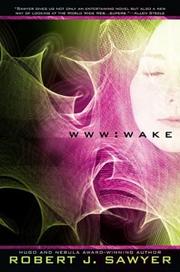
Wake, also called WWW: Wake, is a 2009 novel written by Canadian novelist Robert J. Sawyer and the first book in his WWW Trilogy. It was first serialized in four parts in Analog Science Fiction and Fact from November 2008 to March 2009, was first published in book form on April 8, 2009, and was followed by Watch in 2010 and by Wonder in 2011 (both novels are not serialized in Analog). The novel details the spontaneous emergence of an intelligence on the World Wide Web, called Webmind, and its friendship with a blind teenager named Caitlin.
Sawyer developed the initial idea for Wake in January 2003 when he wrote in his diary about the emergence of consciousness on the World Wide Web. The novel was named a 2010 Hugo Award nominee in the category for Best Novel and won a 2009 Aurora Award.
Plot
Wake is set in 2012. Fifteen-year-old Caitlin Decter has been blind from birth. The Decter family recently moved from Austin, Texas to Waterloo, Ontario after Caitlin's father, Malcolm, received a job at the Perimeter Institute. Caitlin is emailed by Dr. Masayuki Kuroda, a scientist specializing in "signal processing related to V1." He believes that her blindness is caused by her retinas miscoding the visual information and offers to install a signal processor behind her left eye to unscramble the data. The device sends the data to a miniature computer, or "eyePod", which reprocesses the signals and returns them. The correct data is sent to her optic nerve, theoretically granting her sight. In duplex mode it sends and receives the signals, and in simplex mode it only sends them. Caitlin and her mother, Barbara, fly to Tokyo for the procedure. Although her pupils now react to light, Caitlin still cannot see. They return to Canada while Dr. Kuroda works on updating the software.
A bird-flu epidemic with a mortality rate of at least 90% has begun in China. Dr. Quan Li, a senior member of the Communist Party, recommends the President order a culling of ten to eleven thousand people in the infected area with an airborne chemical. The President agrees and launches the Changcheng Strategy, cutting off all telephone, satellite, and wireless communication with the rest of the world, so that word of the culling does not spread beyond China's borders. Wong Wai-Jeng, a freedom blogger who is known online as Sinanthropus, attempts to circumvent Internet censorship in China along with many other hackers. Collectively they learn about the bird flu outbreak. Many days after enacting the Changcheng Strategy, Zhang Bo, the Minister of Communications, convinces the President to restore communications. The moment they are back up, Sinanthropus posts a blog, informing the world of the bird flu outbreak and the culling. He is tracked down by the police and, while attempting to flee, breaks his leg and is captured.
The first software update Kuroda attempts is a partial success. Although Caitlin can still not see the outside world, it enables her to visualize the World Wide Web while the update downloads when the eyePod is in duplex mode. Dr. Kuroda speculates that the data being transmitted between the eyePod and his server in Tokyo is being interpreted by her optic nerve, allowing her to see this. He decides to travel to Waterloo to work with Caitlin on the implant more directly. In the interim, he suggests sending the retinal feed from her eyePod to his Tokyo server through Jagster, a fictional search engine, so that he can monitor how she reacts to different inputs. He dubs her ability to visualize the internet "websight". Caitlin notes that, along with websites and links, she can visualize a background in websight that looks like a chess board. Dr. Kuroda speculates that the background is made up of cellular automata, which Caitlin suggests is caused by corrupted packet loss. Several Zipf plots are run of the cellular automata, which has a negative one slope. The Decters, Dr. Kuroda, and Anna Bloom, a network cartographer, realize that means the cellular automata contain intelligent content, which Anna suggests is secret communications from the National Security Agency. They decide to keep investigating the cellular automata discreetly.
In San Diego, California, Shoshana Glick, an ape-language researcher and graduate student, works at the Marcuse Institute, a primate research centre. Hobo, a chimpanzee-bonobo hybrid, communicates by sign language. Doctor Harl Marcuse, the owner of the Institute, sets up a connection with the Miami Zoo. Hobo communicates with an orangutan named Virgil in the first interspecies webcam call. The Marcuse Institute and Miami Zoo agree to announce the chat jointly, but the Miami Zoo leaks word of it to New Scientist, who go to the Georgia Zoo – Hobo's birthplace – for information on him. Georgia Zoo, fearing about the contamination between the captive chimpanzee and bonobo bloodlines, demand Hobo be returned to them so that he can be sterilized. Hobo paints a portrait of Shoshana, surprising everyone at the Institute as it had been believed that chimpanzees could only paint abstractly. Dr. Marcuse theorizes that the communication with Virgil had shown Hobo "how three-dimensional objects could be reduced to two dimensions." The Marcuse Institute decide to record Hobo painting a second time and then go public, believing that the outcry over sterilizing him would force the Georgia Zoo to back down from their plans. The Georgia Zoo issues a lawsuit, planning to castrate Hobo.
以上文字摘自英文维基百科「Wake (Sawyer novel)」(有删节,去掉了参考文献等尾部小节),按 CC BY-SA 4.0 使用,作者为维基百科的各位编者。
资料卡
- 原题
- Wake
- 原作语言
- 英语
- 首次出版
- 2008 年 11 月
- 作品形式
- 长篇小说
- 体裁
- 科学幻想
- 首版出版社
- 维京出版社
- 所属系列
- WWW Trilogy
- 续作
- Watch
资料卡来自 Wikidata Q7960897(CC0),众包数据,个别字段可能不全。