书单
百科
这个词条暂时没有中文维基百科条目,下面是英文维基百科的内容(英文原文):
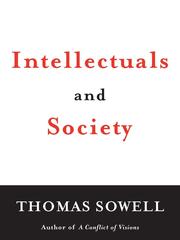
Intellectuals and Society is a non-fiction book by Thomas Sowell. The book was initially published on January 5, 2010, by Basic Books.
Intellectuals are defined as "idea workers" who exercise profound influence on policy makers and public opinion, but are often not directly accountable for the results. Intellectuals and Society examines the record of these idea workers and the conditions, methods and incentives driving their points of view that, according to Sowell, have often resulted in disaster for societies where intellectuals have been allowed "undue influence".
Undue influence of intellectuals
Sowell explained undue influence of intellectuals as follows:
"Those whose careers are built on the creation and dissemination of ideas — the intellectuals — have played a role in many societies out of all proportion to their numbers. Whether that role has, on balance, made those around them better off or worse off is one of the key questions of our times.
The quick answer is that intellectuals have done both. But certainly, during the 20th century, it is hard to escape the conclusion that intellectuals have on balance made the world a worse and more dangerous place. Scarcely a mass-murdering dictator of the 20th century was without his supporters, admirers, or apologists among the leading intellectuals — not only within his own country, but in foreign democracies, where intellectuals were free to say whatever they wanted.
...intellectuals are people whose end products are intangible ideas, and they are usually judged by whether those ideas sound good to other intellectuals or resonate with the public. Whether their ideas turn out to work — whether they make life better or worse for others — is another question entirely."
Summary
Sowell argues that intellectuals, whom he defines as people whose occupations deal primarily with ideas (writers, historians, academics, etc.), usually consider themselves as "anointed", or as endowed with superior intellect or insight with which to guide the masses and those who have authority over them. Sowell contends that several characteristics mark such intellectuals.
Working with ideas
An intellectual's work begins and ends with ideas, not the practical application of ideas to real world problems. These purveyors of ideas may be at all points of the political and ideological spectrum, although Sowell generally reserves his sharpest criticisms for those on the left. Certain common patterns in intellectuals, he argues, cut across specific political ideologies. He argues that intellectuals like to work outside the established power structures and apply what is presumed to be superior insight in order to control the resources and decision-making processes of the masses and their official leaders. For example, both National Socialism and Stalinism attempted to micro-manage the lives of their citizens; both implemented sweeping propaganda campaigns to reframe reality, and both resulted in leadership by an elite outside group.
Lack of real accountability
The work of intellectuals is ultimately not subject to external (real world) verifiability, as compared to those engaged in more practical pursuits with readily observable results. An intellectual, for example, can condemn a military operation for "excessive force" but has no accountability in regards to the actual outcome of that operation. By contrast, a military commander who fails to deploy sufficient force at the appropriate time can pay with his own life and that of his men. The acclaim given to intellectuals, despite their predictions having failed, is a prime example of the lack of ultimate accountability, Sowell maintains.
Narrow and specialized knowledge
Intellectuals usually have thorough knowledge in their areas of expertise. Outside these fields, however, they may be as uninformed as the average person. Too often, Sowell argues, this does not stop them from attempting to influence public opinion in areas where they are not fully qualified. Sowell lists several examples that he argues support his thesis.
Intellectual climate of distortion and misinformation
Sowell states that intellectuals often assume that their specialized knowledge qualifies them to guide others, as do experts in any field of endeavor, practical or otherwise. Sowell argues that what is crucial is their influence on the people who wield decision-making power. The presumption of insight often creates a climate that influences the way events are reported by the media, and may make politicians hesitant to take certain approaches to problem-solving. Before World War II, for example, British intellectuals played a large role in the process of creating the opposition to re-armament, which proved to be a deadly mistake.
Verbal virtuosity (rhetoric) versus evidence or logic
Sowell suggests that intellectuals rely heavily on what he calls "verbal virtuosity" (clever phrasing, vague euphemisms, witty quotes, deceptive labeling, name-calling and sneering asides) to substitute for evidence, logic and analysis. Other tactics of "verbal virtuosity" include dismissing opposing ideas as simplistic, portraying those making opposing arguments as morally unworthy, invoking "rights" which have no legal basis, vague calls for "change", reliance on the abstract versus the concrete, and a constant "filtering of reality".
Ego-involvement and personalization
The presumption of wisdom and/or virtue causes intellectuals to personalize situations where contending ideas are involved. This often results in: (a) the demonization of opponents, and (b) personal fulfillment serving as a substitute for debate and evidence. Sowell does not make it clear if intellectuals acquired these traits from politicians, or the other way around.
Reception
In 2010, American libertarian philosopher David Gordon wrote a positive review of the book for the Independent Institute. He states that Sowell has written an excellent book as a whole.
以上文字摘自英文维基百科「Intellectuals and Society」(有删节,去掉了参考文献等尾部小节),按 CC BY-SA 4.0 使用,作者为维基百科的各位编者。
资料卡
- 原题
- Intellectuals and Society
- 原作语言
- 英语
- 首次出版
- 2010 年 1 月 5 日
- 体裁
- 非虚构作品
- 首版出版社
- 基础书籍出版社
- 前作
- The Housing Boom and Bust
资料卡来自 Wikidata Q6043758(CC0),众包数据,个别字段可能不全。