书单
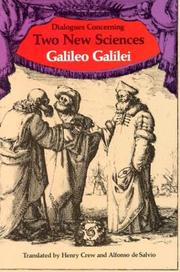
关于两门新科学的对话 (1638)
百科
《关于力学和定域运动两门新科学的谈话及其数学证明》,简称《关于两门新科学的对话》或《对话》(意大利语:Discorsi e dimostrazioni matematiche intorno a due nuove scienze)是伽利略·伽利莱所著的书籍。书中详细的阐述了伽利略对材料力学和动力学的研究。本书与《关于托勒密和哥白尼两大世界体系的对话》类似,均以对话形式写成。共有3人参与了书中的对话:萨尔维阿蒂(Salviati,伽利略自己的化身),沙格列陀(Sagredo,中立的旁观者)和辛普利邱(Simplicio,旧学说支持者)。
鉴于伽利略事件,罗马宗教裁判所将《关于托勒密和哥白尼两大世界体系的对话》列为禁书并将伽利略软禁于家中。然而,《对话》的出版并未遭到过大的阻力。本书于荷兰莱顿出版,这里教会的影响力相对更弱。
内容
本书以对话形式展开,对话分为为4天。伽利略曾计划再多写一天关于冲击力的讨论,并且在前四天的讨论中频繁的提及到。然而由于并不能满足自己对内容的要求,最终并没有被出版。有关内容在1718年第一次出现。
第一天
在第一天的对话中,伽利略首先介绍了参加对话的三人。随后探讨了亚里士多德《物理学》和《力学》中探讨的问题,并简单的介绍了动力学和材料力学这两门新兴的科学。
第二天
在第二天的谈话中,伽利略探讨了物体强度的问题。
第三、四天
在第三天的谈话中,重心转移到了运动学。第三天中,伽利略探讨了匀速和加速运动。书中,伽利略定义“匀速运动”为“对于任意一段时间,物体移动的距离均相等的运动”。这里“任意”的使用使得匀速运动更加精确。第四天,伽利略探讨了抛体运动。
以上文字摘自维基百科「关于两门新科学的对话」(去掉了参考文献等尾部小节),按 CC BY-SA 4.0 使用,作者为维基百科的各位编者。
中文维基百科的条目比较短,下面附上英文维基百科的内容(英文原文):
The Discourses and Mathematical Demonstrations Relating to Two New Sciences (Italian: Discorsi e dimostrazioni matematiche intorno a due nuove scienze pronounced [diˈskorsi e ddimostratˈtsjoːni mateˈmaːtike inˈtorno a dˈduːe ˈnwɔːve ʃˈʃɛntse]) published in 1638 was Galileo Galilei's final book and a scientific testament covering much of his work in physics over the preceding thirty years. It was written partly in Italian and partly in Latin.
After his Dialogue Concerning the Two Chief World Systems, the Roman Inquisition had banned the publication of any of Galileo's works, including any he might write in the future. After the failure of his initial attempts to publish Two New Sciences in France, Germany, and Poland, it was published by Lodewijk Elzevir who was working in Leiden, South Holland, where the writ of the Inquisition was of less consequence (see House of Elzevir). Fra Fulgenzio Micanzio, the official theologian of the Republic of Venice, had initially offered to help Galileo publish the new work there, but he pointed out that publishing the Two New Sciences in Venice might cause Galileo unnecessary trouble; thus, the book was eventually published in Holland. Galileo did not seem to suffer any harm from the Inquisition for publishing this book since in January 1639, the book reached Rome's bookstores, and all available copies (about fifty) were quickly sold.
Discourses was written in a style similar to Dialogues, in which three men (Simplicio, Sagredo, and Salviati) discuss and debate the various questions Galileo is seeking to answer. There is a notable change in the men, however; Simplicio, in particular, is no longer quite as simple-minded, stubborn and Aristotelian as his name implies. His arguments are representative of Galileo's own early beliefs, as Sagredo represents his middle period, and Salviati proposes Galileo's newest models.
Introduction
The book is divided into four days, each addressing different areas of physics. Galileo dedicates Two New Sciences to Lord Count of Noailles.
In the First Day, Galileo addressed topics that were discussed in Aristotle's Physics and the Aristotelian school's Mechanics. It also provides an introduction to the discussion of both of the new sciences. The likeness between the topics discussed, specific questions that are hypothesized, and the style and sources throughout give Galileo the backbone to his First Day. The First Day introduces the speakers in the dialogue: Salviati, Sagredo, and Simplicio, the same as in the Dialogue. These three people are all Galileo just at different stages of his life, Simplicio the youngest and Salviati, Galileo's closest counterpart. The Second Day addresses the question of the strength of materials.
The Third and Fourth days address the science of motion. The Third day discusses uniform and naturally accelerated motion, the issue of terminal velocity having been addressed in the First day. The Fourth day discusses projectile motion.
In Two Sciences uniform motion is defined as a motion that, over any equal periods of time, covers equal distance. With the use of the quantifier ″any″, uniformity is introduced and expressed more explicitly than in previous definitions.
Galileo had started an additional day on the force of percussion, but was not able to complete it to his own satisfaction. This section was referenced frequently in the first four days of discussion. It finally appeared only in the 1718 edition of Galilei's works. and it is often quoted as "Sixth Day" following the numbering in the 1898 edition. During this additional day Simplicio was replaced by Aproino, a former scholar and assistant of Galileo in Padua.
Summary
Page numbers at the start of each paragraph are from the 1898 version, presently adopted as standard, and are found in the Crew and Drake translations.
Day one: Resistance of bodies to separation
Preliminary discussions.
以上文字摘自英文维基百科「Two New Sciences」(有删节,去掉了参考文献等尾部小节),按 CC BY-SA 4.0 使用,作者为维基百科的各位编者。
资料卡
- 原题
- Discorsi e dimostrazioni matematiche, intorno à due nuoue ſcienze attenenti alla mecanica & i movimenti locali
- 原作语言
- 意大利语、拉丁语
- 首次出版
- 1638 年
资料卡来自 Wikidata Q575461(CC0),众包数据,个别字段可能不全。