书单
百科
这个词条暂时没有中文维基百科条目,下面是英文维基百科的内容(英文原文):
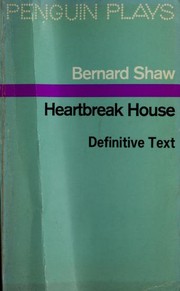
Heartbreak House: A Fantasia in the Russian Manner on English Themes is a play written by Bernard Shaw during the First World War, published in 1919 and first performed in November 1920 at the Garrick Theatre, New York, followed by a West End production the following year.
The play reflects Shaw's disillusion with post-war Britain. It contrasts cultured but self-absorbed and politically irresponsible people on the one hand and aggressive philistines on the other. Heartbreak House contains a self-mocking depiction of Shaw himself in the central character, Captain Shotover.
Background
By 1920, Shaw was in his sixties and had been writing for the theatre for nearly thirty years. His plays included Arms and the Man, The Devil's Disciple, Man and Superman, Major Barbara and Androcles and the Lion. His last play before the First World War had been the highly successful Pygmalion. He was internationally famous, and commented "I have advertized myself so well that I find myself, whilst still in middle life, almost as legendary a person as the Flying Dutchman". He had little regard for London theatre managements, and chose to have some of his plays premiered overseas, including The Devil's Disciple (1897, New York), and Pygmalion (1913, Vienna); Caesar and Cleopatra was staged in Berlin and New York (both 1906) before being seen in London.
In 1920 the New-York based Theatre Guild asked Shaw for the rights to revive The Devil's Disciple, but instead he offered the Guild the premiere of Heartbreak House, though warning them that instead of pleasing the public for two hours, the play would "put the utmost strain upon their attention for three and send them home exhausted but impressed".
Shaw, generally a quick writer, had taken an uncharacteristically long time to write Heartbreak House (originally entitled The Studio in the Clouds). He wrote in the preface to the published play that he had begun writing it before the First World war, although his biographer Michael Holroyd dates the writing to 1916.
Premieres
The play was first performed in New York by the Theatre Guild company at the Garrick Theatre in November 1920. It was well received and ran for 125 performances over five months. It was first presented in England on 18 October 1921, at the Court Theatre, London, running for 63 performances. Between the two English-language productions the play had been seen in Vienna in German translation.
Plot summary
Ellie Dunn, her father, and her fiancé are invited to one of Hesione Hushabye’s infamous dinner parties, to be held at the house of her father, the eccentric Captain Shotover, an inventor in his late eighties who is trying to create a "psychic ray" that will destroy dynamite. The house is built in the shape of the stern of a ship. Ariadne, Lady Utterword, Shotover's other daughter, arrives from Australia, but he pretends not to recognise her. Hesione says they are running out of money. Shotover needs to invent a weapon of mass destruction. His last invention, a lifeboat, did not bring in much cash. Ellie intends to marry a businessman, Boss Mangan, but she really loves a man she met in the National Gallery. Her fiancé is a ruthless scoundrel, her father is a bumbling prig, and it turns out that the man she is in love with is Hector, Hesione's husband, who spends his time telling romantic lies to women. Marriage to Mangan will be the sensible choice.
A burglar is captured. They say they do not want to prosecute him, but he insists he will turn himself in unless they pay him not to. It turns out that the burglar is one of Shotover's old crewmen. He confesses that he is not a real burglar. He deliberately gets himself captured to get charitable assistance from his victims. Shotover laments that the younger generation have lost their romance. Ellie suggests that she should marry Shotover, but he says he is already married to a black Jamaican wife, though it is possible she is now dead.
Ariadne says that everything will be put to rights if only they get some horses. Every English family should have horses. Mangan announces that the prime minister has asked him to join the Government "without even going through the nonsense of an election, as the dictator of a great public department". Ellie suddenly declares that she cannot marry him as she is now Shotover's "white wife". Shotover predicts that the ship of England will founder, as the captain is incapable and the crew are irresponsible:
A servant enters with news that an air-raid is about to happen. The lights are switched off, but Hector switches them back on to demonstrate his lack of concern about the threat. A bomb lands in the garden, blowing up Shotover's store of dynamite and killing Mangan and the burglar who were hiding there. When it is over everyone says how bored they are. They hope the bombs will come again tomorrow.
Reception
In his preface to the play, published in 1919, before the first production, Shaw wrote, "Heartbreak House is not merely the name of the play which follows this preface. It is cultured, leisured Europe before the war." The writer John Sutherland describes the play as:
Sutherland calls Captain Shotover "a self-mocking portrait of Shaw himself", delivering "the key warning about the future of the ship of state".
In the preface to the play Shaw explains the subtitle, "A Fantasia in the Russian Manner", and acknowledges his debt to Chekhov, in particular to The Cherry Orchard. He writes that in comparison to another great Russian writer, Tolstoy, Chekhov was "more of a fatalist, had no faith in these charming people extricating themselves. They would, he thought, be sold up and sent adrift by the bailiffs; therefore he had no scruple in exploiting and even flattering their charm".
以上文字摘自英文维基百科「Heartbreak House」(有删节,去掉了参考文献等尾部小节),按 CC BY-SA 4.0 使用,作者为维基百科的各位编者。
资料卡
- 原题
- Heartbreak House
- 原作语言
- 英语
- 首次出版
- 1919 年
- 作品形式
- 剧作
- 故事发生地
- 英格兰
资料卡来自 Wikidata Q5692683(CC0),众包数据,个别字段可能不全。