书单
百科
这个词条暂时没有中文维基百科条目,下面是英文维基百科的内容(英文原文):
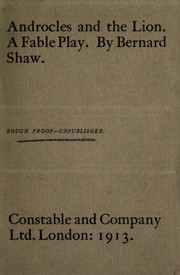
Androcles and the Lion (Shavian: ·𐑨𐑯𐑛𐑮𐑩𐑒𐑤𐑰𐑟 𐑯 𐑞 𐑤𐑲𐑩𐑯) is a 1912 play by Bernard Shaw. The play is Shaw's retelling of the tale of Androcles, a slave who is saved by the requiting mercy of a lion. In the play, Shaw portrays Androcles as one of many Christians being led to the Colosseum to die but surviving because the lion who was intended to tear him apart recognised him as the man who once extracted an agonising thorn from his paw.
Background and first production
Shaw wrote Androcles and the Lion as a counterblast to two plays of which he disapproved: Wilson Barrett's The Sign of the Cross – written in 1895 but still highly popular nearly twenty years later – and J. M. Barrie's Peter Pan. Shaw disliked the religious melodrama of the first, and thought the second appealed greatly to adults but bored children to sleep. He said he wanted "to show Barrie how a play for children should be handled". He based the plot of his play on a fable written by the Roman writer Aulus Gellius in the second century AD.
The play, directed by Harley Granville-Barker, opened at the St James's Theatre, London, on 1 September 1913. It ran for 66 performances.
Characters and original cast
The Emperor – Leon Quartermaine
The Captain – Ben Webster
Androcles – O. P. Heggie
The Lion – Edward Sillward
Lentulus – Donald Calthrop
Metellus – Hesketh Pearson
Ferrovius – Alfred Brydone
Spintho – J. P. Outram
Centurion – H. O. Nicholson
The Editor – Herbert Hewetson
The Call Boy – Neville Gartside
Secutor – Allan Jeayes
Retiarius – J. P. Turnbull
The Menagerie Keeper – Baliol Holloway
The Slave Driver – Ralph Hutton
Magaera – Clare Greet
Lavinia – Lillah McCarthy
Plot
Androcles, a fugitive Christian tailor, accompanied by his nagging wife, Magaera, is on the run from his Roman persecutors. While hiding in the forest he comes upon a wild lion who approaches him with a wounded paw. His wife runs off. Androcles sees that the cause of the animal's distress is a large thorn embedded in its paw, which he draws out while soothing the lion in baby language.
Androcles is captured and is sent to the Colosseum to be executed with other Christians in gladiatorial combat. They are joined by a new Christian convert called Ferrovius, who struggles to reconcile his Christian principles with his violent inclinations. The Roman captain guarding them is attracted to the genteel convert Lavinia. Eventually the Christians are sent into the arena, but Ferrovius kills all the gladiators before they can harm any Christians. He is offered a job in the Praetorian Guard, which he takes. The Christians are to be released, but the crowd demands blood. To satisfy them, Androcles offers himself to be savaged by lions. But the lion that is supposed to kill him turns out to be the one that Androcles saved, and the two dance around the arena to the delight of the crowd. The emperor comes into the arena to get a closer look, and the lion attacks him. Androcles calls him off and the emperor is saved. He then declares an end to the persecution of Christians. Androcles and his new 'pet' depart together.
Revivals
Harley Granville-Barker directed the first Broadway production of the play in 1915 with two of the original West End cast – Heggie and McCarthy – reprising their roles.
The Theatre Guild presented the play at the Klaw Theatre in 1925 with Henry Travers as Androcles and Edward G. Robinson as Caesar.
At the Old Vic in 1930 Richard Riddle played Androcles and John Gielgud the Emperor.
The Regent's Park Open Air Theatre staged the play in July 1934. The production transferred to the West End in September. Andrew Leigh played Androcles and Oscar Asche played Caesar.
A 1938 production by the Federal Theatre Project in New York featured Dooley Wilson as Androcles and Maurice Ellis as Caesar.
At the Arts Theatre in 1943 Denys Blakelock was Androcles and Geoffrey Dunn as Caesar.
In 1946 the American Repertory Theatre company staged the work in New York, with Ernest Truex as Androcles and Philip Bourneuf as Caesar.
A revival at the Mermaid Theatre in 1961 Davy Kaye played Androcles and Ronald Fraser played the Emperor.
A second Regent's Park production, in August 1980 featured Chris Harris as Androcles and James Cairncross as Caesar.
Adaptations
Radio
1941: with Ivor Barnard as Androcles and Frederick Lloyd as Caesar
1942: with Ivor Barnard and Bruce Wilton
1946: with Andrew Leigh and Francis L. Sullivan
1967: with Leslie French and Heron Carvic
Television
1946: with Andrew Leigh and Ernest Thesiger
1951: with Toke Townley and Raymond Lovell
1960: with Roderick Cook and Peter Bull
1984: with Billy Connolly and Peter Copley
Cinema
A film version, Androcles and the Lion, was made of the play in 1952, produced by Gabriel Pascal.
Musical
Richard Rodgers wrote the music and lyrics for a televised 1967 musical adaptation, with Norman Wisdom as Androcles and Noël Coward as Caesar.
以上文字摘自英文维基百科「Androcles and the Lion (play)」(去掉了参考文献等尾部小节),按 CC BY-SA 4.0 使用,作者为维基百科的各位编者。
资料卡
- 原题
- Androcles and the Lion
- 原作语言
- 英语
- 首次出版
- 1914 年
- 作品形式
- 剧作
- 体裁
- 喜剧
- 续作
- 卖花女
- 改编自 / 取材于
- The Lion and the Shepherd
资料卡来自 Wikidata Q4759428(CC0),众包数据,个别字段可能不全。
改编作品
电影1
名单来自 Wikidata(CC0):只列条目里写明「改编自 / 取材于」这本书的作品,不按名字猜;众包数据,可能不全。