 书单
百科
这个词条暂时没有中文维基百科条目,下面是英文维基百科的内容(英文原文):
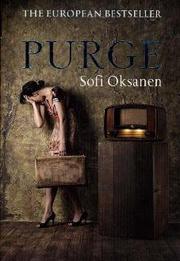
Purge (Finnish: Puhdistus) is a novel by Finnish-Estonian writer Sofi Oksanen, which has been translated into thirty-eight languages. Oksanen's third Finnish-language novel, Purge was published in 2008 and is based upon her original play of the same name, staged at the Finnish National Theatre in 2007.
Purge is a story of two women forced to confront their own dark pasts, of collusion and resistance, of rape and sexual slavery set against the backdrop of the Soviet occupation of Estonia.
Conception
The novel was originally conceived as a play. The play was written in 2007 and produced at the National Theatre of Finland. In writing the novel, Oksanen chose for the plot to diverge from its original ending and focus on different themes.
Background
After existing as an independent country for twenty-one years, Estonia was occupied and annexed by the Soviet Union in June 1940 during World War II. In 1941–1944, Estonia was occupied by Nazi Germany. From February to November 1944, the German forces were expelled by the Red Army. The Soviet rule was re-established by force, and sovietisation followed, mostly carried out in 1944–1950. The forced collectivisation of agriculture began in 1947, and was completed after the mass deportation in March 1949. The Soviet authorities confiscated private farms and forced peasants to join collective farms. An armed resistance movement of forest brothers was active until the mass deportations. A total of 30,000 participated in or supported the movement; 2,000 were killed. The Soviet authorities fighting the forest brothers also suffered hundreds of casualties. Some innocent civilians were killed on both sides. In addition, a number of underground nationalist schoolchildren's groups were active. Most of their members were sentenced to long terms of imprisonment. The punitive actions decreased rapidly after Joseph Stalin's death in 1953; from 1956 to 1958, a large part of the deportees and political prisoners were allowed to return. Political arrests and numerous other kinds of crimes against humanity were committed during the occupation period until the late 1980s. In the end, the attempt to integrate the Estonian society into the Soviet system failed. Although the armed resistance was defeated, the population remained anti-Soviet. This helped Estonians to organise a new resistance movement in the late 1980s, regain their independence in 1991, and then rapidly develop a modern society.
Plot
The plot begins in 1992 with an elderly woman, Aliide Truu, who lives in a remote portion of Estonia. The woman had isolated herself from the surrounding society and watches the youth of her nation, including her daughter, leaving the countryside for the more urban regions and Finland. One day while looking out the kitchen window, she discovers Zara, the granddaughter of her sister Ingel. Zara had been forced into sex trade by the Russian mafia, but has escaped from them. The only guide she had to finding help is a photograph from her grandmother with Aliide's name on it. The story then continues with a series of flashbacks, which develops the relationship between Aliide and her sister, which hinged upon their competition for the love of Hans Pekk during World War II. The story ends as Aliide begins to reconcile herself with her jealousy of her sister, and Zara's redemption from her disenchantment with the world caused by her sexual subjugation.
Characters
The plot of Purge focuses on two main female characters, on both of whom reviewers have commented as being complex and integral to the understanding of the themes of the book. The novel begins with Aliide Truu, an elderly woman who has survived many horrors of the Soviet occupation of Estonia. The Aliide whom the reader first meets has alienated herself from the local people, and is strongly self-reliant. Though cloaked in a rough exterior, she represents a woman who has weathered considerable hardship. She has hardly anything in the way of motherly instinct, especially in regard to the other main character, Zara.
Zara is the grandniece of Aliide, and at the beginning of the book she is subjected to sex trafficking by the Russian mafia. Her interaction with her great-aunt eventually forces Aliide to reconstruct and confront the history of her past. Ultimately, Aliide is responsible for delivering Zara from the torments caused by the sexual violence perpetrated against her.
Themes
Sexual violence and its manifestation in the sex trade becomes one of the central themes in the book. Both of the main characters lose control of their bodies as they are abused. Though each women perseveres through the disgrace and purges herself of this disgrace by burning their clothes. However, sexual violence and terror recurs when Tallinn gets a sex shop that is staffed by ex-KGB, who had perpetuated the violence earlier in the novel. Ultimately, Oksanen successfully captures the horrors inflicted upon women by European military conflicts as well as exploring contemporary sex trafficking.
Resistance also permeates the book, especially against the Russification of Estonia. In the entries in Hans' diary and other parts of the narrative the anti-Russification poet Paul-Eerik Rummo appear. Also, Zara's grandmother continues to hold on to native Estonian tongue, resisting a change in language.
The complexity of family history and the uncovering of tragedy in that history is fundamental to the book. However, the focus is increasingly upon the story of the protagonist, sometimes missing some of the more horrifying or interesting parts of Estonian History. Jacob Silverman in The New Republic points out that this perspective on history, which only carries the narrative up to 1992, offers a contemporary perspective on the issues that face modern Estonia and a "window... of understanding" into it and its past.
以上文字摘自英文维基百科「Purge (novel)」(有删节,去掉了参考文献等尾部小节),按 CC BY-SA 4.0 使用,作者为维基百科的各位编者。
资料卡
- 原题
- Puhdistus
- 原作语言
- 芬兰语
- 首次出版
- 2008 年 4 月
- 体裁
- 历史小说、犯罪文学
- 故事发生地
- 爱沙尼亚
- 获奖
- 芬兰文学奖、北欧理事会文学奖、鲁内贝里奖、卡莱维·延蒂奖;另有 2 项只有外文名
资料卡来自 Wikidata Q1401127(CC0),众包数据,个别字段可能不全。
改编作品
电影1
- 《清洗》Purge
名单来自 Wikidata(CC0):只列条目里写明「改编自 / 取材于」这本书的作品,不按名字猜;众包数据,可能不全。