书单
百科
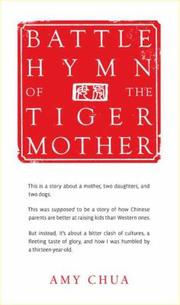
《虎妈战歌》(英语:Battle Hymn of the Tiger Mother)是耶鲁大学美籍华裔教授蔡美儿(Amy Chua)2011年出版的一本书,为蔡美儿出版的第三本书。书中比较了东西方教育的差异,并列出了自己严厉的教女方式。本书书名取自美国的爱国歌曲《共和国战歌》(Battle Hymn of the Republic)。
翻译版
(简体中文)《我在美国做妈妈:耶鲁法学院教授的育儿经》,张新华译,2011年1月 ISBN 9787508626116 中信出版社出版
(繁体中文)《虎妈的战歌》,钱基莲译,2011年3月 ISBN 9789862161517 天下文化出版
(简体中文)《虎妈战歌》,张新华译,2011年7月 ISBN 9780862611606 中信出版社出版
以上文字摘自维基百科「虎妈战歌」(去掉了参考文献等尾部小节),按 CC BY-SA 4.0 使用,作者为维基百科的各位编者。
中文维基百科的条目比较短,下面附上英文维基百科的内容(英文原文):
Battle Hymn of the Tiger Mother is a book by American author and law professor Amy Chua that was published in 2011. It quickly popularized the concept and term "tiger mother".
Summary
The complete blurb of the book reads: "This is a story about a mother, two daughters, and two dogs. This was supposed to be a story of how Chinese parents are better at raising kids than Western ones. But instead, it's about a bitter clash of cultures, a fleeting taste of glory, and how I was humbled by a thirteen-year-old."
An article published under the headline "Why Chinese Mothers Are Superior" in The Wall Street Journal on January 8, 2011, contained excerpts from her book in which Chua recounts her efforts to give her children what she describes as a traditional, strict, Chinese, Confucian-style upbringing. The piece was controversial, as many readers believed that Chua was advocating the superiority of a particular, very strict, ethnically defined approach to parenting. In response, Chua has stated that the book was not a "how-to" manual, but rather a self-mocking memoir. She defines "Chinese mother" loosely to include parents of other ethnic backgrounds who practice traditional, strict child-rearing while also acknowledging that "Western parents come in all varieties" and that not all ethnically Chinese parents necessarily practice strict child-rearing techniques.
Chua also reported that in one study of 48 Chinese immigrant mothers, the vast majority "said that they believe their children can be 'the best' students, the notion that 'academic achievement reflects successful parenting', and that if children did not excel in school, then there was 'a problem' in the household and the parents 'were not doing their job'." Chua contrasts them with the view she labels "Western" – that a child's self-esteem is paramount.
Chua employs the term "Tiger Mother" to describe a mother who is a strict disciplinarian. In one extreme example, Chua mentioned that she had called one of her children "garbage", a translation of a term her own father called her on occasion in her family's native Hokkien dialect. Particularly controversial was the "Little White Donkey" anecdote, where Chua described how she got her unwilling younger daughter to learn a very difficult piano song: "I hauled Lulu's dollhouse to the car and told her I'd donate it to the Salvation Army piece by piece if she didn't have 'The Little White Donkey' perfect by the next day. When Lulu said, 'I thought you were going to the Salvation Army, why are you still here?' I threatened her with no lunch, no dinner, no Christmas or Hanukkah presents, no birthday parties for two, three, four years. When she still kept playing it wrong, I told her she was purposely working herself into a frenzy because she was secretly afraid she couldn't do it. I told her to stop being lazy, cowardly, self-indulgent and pathetic." They then "work[ed] right through dinner" without letting her daughter "get up, not for water, not even for bathroom breaks". The anecdote concludes by describing how her daughter was "beaming" after she finally mastered the piece and "wanted to play [it] over and over".
以上文字摘自英文维基百科「Battle Hymn of the Tiger Mother」(有删节,去掉了参考文献等尾部小节),按 CC BY-SA 4.0 使用,作者为维基百科的各位编者。
资料卡
- 原题
- Battle Hymn of the Tiger Mother
- 原作语言
- 英语
- 首次出版
- 2011 年
- 首版出版社
- 企鹅出版
- 主题
- 老虎妈妈
资料卡来自 Wikidata Q1086713(CC0),众包数据,个别字段可能不全。