书单
百科
这个词条暂时没有中文维基百科条目,下面是英文维基百科的内容(英文原文):
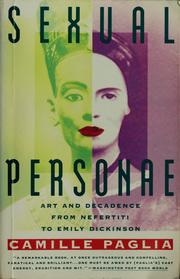
Sexual Personae: Art and Decadence from Nefertiti to Emily Dickinson is a 1990 work about sexual decadence in Western literature and the visual arts by scholar Camille Paglia, in which she addresses major artists and writers such as Donatello, Sandro Botticelli, Leonardo da Vinci, Edmund Spenser, William Shakespeare, Johann Wolfgang von Goethe, Samuel Taylor Coleridge, Lord Byron, Emily Brontë, and Oscar Wilde. Following Friedrich Nietzsche, Paglia argues that the primary conflict in Western culture is between the binary forces of the Apollonian and Dionysian, Apollo being associated with order, symmetry, culture, rationality, and sky, and Dionysus with disorder, chaos, nature, emotion, and earth. The book became a bestseller, and was praised by numerous literary critics, although it also received critical reviews from numerous feminist scholars.
Background
Paglia's discovery of Simone de Beauvoir's The Second Sex in 1963 inspired her to write a book larger in scope. Sexual Personae began to take shape in essays Paglia wrote in college between 1964 and 1968. The title was inspired by Ingmar Bergman's film Persona, which Paglia saw on its American release in 1968. The book was finished in 1981, but was rejected by seven major New York publishers before being released by Yale University Press in 1990. Paglia credits editor Ellen Graham with securing Yale's decision to publish the book. Sexual Personae's original preface was removed at the Yale editors' suggestion because of the book's extreme length, but was later published in Paglia's essay collection Sex, Art, and American Culture (1992).
Paglia describes Sexual Personae's method as psychoanalytic and acknowledges a debt to Sigmund Freud and Carl Jung. Her other major influences were Sir James George Frazer's The Golden Bough (1890), Jane Harrison's Prolegomena to the Study of Greek Religion (1903), Oswald Spengler's The Decline of the West (1918), D. H. Lawrence's Women in Love (1920), Sándor Ferenczi's Thalassa (1924), the works of literary critics G. Wilson Knight and Harold Bloom, Erich Neumann's The Great Mother (1955) and The Origins and History of Consciousness (1949), Kenneth Clark's The Nude (1956), Gaston Bachelard's The Poetics of Space (1958), Norman O. Brown's Life Against Death (1959) and Love's Body (1966), and Leslie Fiedler's Love and Death in the American Novel (1960). Paglia also acknowledges astrology as an influence.
Paglia said of the book, "It was intended to please no one and to offend everyone. The entire process of the book was to discover the repressed elements of contemporary culture, whatever they are, and palpate them. One of the main premises was to demonstrate that pornography is everywhere in major art. Art history as written is completely sex free, repressive and puritanical. I want precision and historical knowledge, but at the same time, I try to zap it with pornographic intensity."
Summary
Paglia seeks to demonstrate "the unity and continuity of western culture". Accepting the canonical Western tradition, she "rejects the modernist idea that culture has collapsed into meaningless fragments". Paglia argues that Christianity did not destroy paganism, and that paganism flourishes in art, eroticism, astrology, and popular culture. She examines antiquity, the Renaissance, and Romanticism from the late eighteenth century to 1900, contending that "Romanticism turns almost immediately into Decadence". She argues that the "amorality, aggression, sadism, voyeurism, and pornography in great art have been ignored or glossed over by most academic critics" and that sex and nature are "brutal pagan forces". She also stresses the truth in sexual stereotypes and the biological basis of sexual difference, noting that her stance is "sure to cause controversy". Paglia sees the mother as an overwhelming force who condemns men to lifelong sexual anxiety, from which they fleetingly escape through rationalism and physical achievement.
Portraying Western culture as a struggle between a phallic-oriented sky-religion ("Sky Cult") on the one hand and chthonic-oriented earth-religion ("Earth Cult") on the other, Paglia draws on the Greco-Roman polarity between the Apollonian and Dionysian. She associates Apollo with order, structure, and symmetry, and Dionysus with chaos, disorder, and nature. She analyzes literature and art on the premise that the primary conflict in Western culture has always been between these forces. In her view, the major patterns of continuity in Western culture originate in paganism. Other sources of the culture's continuity in her view include androgyny, sadism, and an aggressive "western eye", which seeks to refine and dominate nature's ceaseless hostility and has created our art and cinema. Paglia criticizes feminists for sentimentality or wishful thinking about the causes of rape, violence, and poor relations between the sexes.
Paglia asserts the importance of patriarchy in the development of civilization, and claims that "Athens became great not despite but because of its misogyny".
In one of the most controversial passages in the book, she grounds her claim in what effectively amounts to the variability hypothesis in evolutionary psychology:
Serial or sex murder, like fetishism, is a perversion of male intelligence. It is a criminal abstraction, masculine in its deranged egoism and orderliness. It is the asocial equivalent of philosophy, mathematics and music. There is no female Mozart because there is no female Jack the Ripper.
Another explanation for this asymmetry adopts a more conflicted tone:
以上文字摘自英文维基百科「Sexual Personae」(有删节,去掉了参考文献等尾部小节),按 CC BY-SA 4.0 使用,作者为维基百科的各位编者。
资料卡
- 原题
- Sexual Personae
- 原作语言
- 英语
- 首次出版
- 1990 年
- 体裁
- 文学批评、随笔
- 首版出版社
- 耶鲁大学出版社
- 主题
- 艺术
资料卡来自 Wikidata Q3958586(CC0),众包数据,个别字段可能不全。