 书单
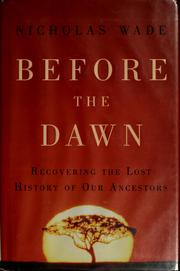
Before the Dawn: Recovering the Lost History of Our Ancestors (2006)
- 作者
- 尼古拉斯·韦德
- 首版
- 2006 年
- 国家/地区
- 美国
- Open Library
- 4 个版本
百科
这个词条暂时没有中文维基百科条目,下面是英文维基百科的内容(英文原文):
Before the Dawn: Recovering the Lost History of Our Ancestors is a non-fiction book by Nicholas Wade, a science reporter for The New York Times. It was published in 2006 by the Penguin Group. By drawing upon research on the human genome, the book attempts to piece together what Wade calls "two vanished periods": the five million years of human evolution from the development of bipedalism leading up to behavioural modernity around 50,000 years ago, and the 45,000 subsequent years of prehistory.
Wade asserts that there is a clear continuity from the earlier apes of five million years ago to the anatomically modern humans who diverged from them, citing the genetic and social similarities between humans and chimpanzees. He attributes the divergence of the two species from a common ancestor to a change in their ecological niche; the ancestors of chimpanzees remained in the forests of equatorial Africa, whereas the ancestors of humans moved to open woodland and were exposed to different evolutionary pressures. Although Wade posits that much of human evolution can be attributed to the physical environment, he also believes that one of the major forces shaping evolution has been the nature of human society itself.
After humans migrated out of their ancestral environment of eastern Africa, they were exposed to new climates and challenges. Thus, Wade argues, human evolution did not end with behavioural modernity, but continued to be shaped by the different environments and lifestyles of each continent. While many adaptations happened in parallel across human populations, Wade believes that genetic isolation – either because of geography or hostile tribalism – also facilitated a degree of independent evolution, leading to genetic and cultural differentiation from the ancestral population and giving rise to different human races and languages.
The book received generally positive reviews, with the main criticisms centering on the work's use of the value-laden terminology of "race" over other, more neutral alternatives. In 2007, it won the Science in Society Journalism Award from the National Association of Science Writers.
Summary
Nicholas Wade divides Before the Dawn into twelve chapters, which are roughly in the chronological order of the human past. The first chapter, Genetics & Genesis, gives a general overview of the themes that are explored in the book. The central theme is that the human genome provides a record of the human past, including what Wade calls the "two vanished periods" of human evolution and prehistory. Through information from the human genome, Wade proclaims, it is possible to determine when humans lost their body hair and began to wear clothes, to track their migration out of Africa, to discover if they interbred with Neanderthals, and even to reconstruct the evolution of language.
Origin of humans and language
The second chapter, Metamorphosis, focuses on the evolutionary origins of humans around 5 million years ago in equatorial Africa. Wade suggests that the last common ancestor of humans and chimpanzees lived in forests. Some of them, due to a global climate change between 5 and 10 million years ago, left the shrinking forests and moved to open woodland, and this new ecological niche gave rise to the human lineage. A change in food availability led to an adaptation for the ability to eat meat, and this nutrition facilitated the evolution of a larger brain. The knuckle-walking of the common ancestor gave way to bipedalism, which is more efficient over longer distances. A larger brain in combination with freed-up hands culminated in the evolution of Homo habilis and the first use of tools around 2.5 million years ago, and the more humanlike and larger brained Homo ergaster about 1.7 million years ago. The adaptations of H. ergaster to hot, dry climates included an external nose to condense air and minimise water loss, and the loss of body hair to allow sweating to cool the body and larger brain. Wade writes that a mutation in the melanocortin receptor gene created an advantageous darkening of the pale, hairless skin. The close descendants of H. ergaster, Homo erectus and Homo heidelbergensis, migrated out of Africa and to Asia (around 1 to 1.66 million years ago) and Europe (around 500,000 years ago), respectively. In Europe, the glacial conditions around 300,000 to 400,000 years ago pressured H. heidelbergensis to evolve into Neanderthals.
The human lineage that remained in Africa eventually evolved into anatomically modern humans with modern-sized brains by about 200,000 years ago, and became common about 100,000 years ago, but did not become behaviourally modern until about 50,000 years ago. Citing the paleoanthropologist Richard Klein, Wade posits that such a great change must have been because of a neurological change, and was therefore genetic. This "genetic revolution", as Wade calls it, facilitated the emergence of language and thus the ability to share thoughts and innovations. Wade discusses the evolutionary origins of language in chapter three, First Words. He references Noam Chomsky's theory of "universal grammar" – which refers to both the hard-wiring of the brain that allows children to learn grammatical rules, and the underlying grammatical similarities of all human languages. Wade cites a number of evolutionary psychologists for an explanation, including Robin Dunbar, who argues that language evolved because it was a more efficient way of establishing social bonds than grooming; Geoffrey Miller, who suggests that speech was a signal of intelligence and thus evolved through sexual selection; and Steven Pinker, who thinks that the ecological niche of humans required the sharing of knowledge. Wade writes that the genetic basis of language is linked to the FOXP2 gene, as it shows signs of significant change in humans but not in chimpanzees, and that mutations of it cause severe speech disorders.
以上文字摘自英文维基百科「Before the Dawn (Wade book)」(有删节,去掉了参考文献等尾部小节),按 CC BY-SA 4.0 使用,作者为维基百科的各位编者。
资料卡
- 原题
- Before the Dawn: Recovering the Lost History of Our Ancestors
- 原作语言
- 英语
- 首次出版
- 2006 年
- 体裁
- 非虚构作品
- 首版出版社
- 企鹅出版
- 主题
- 人类演化
资料卡来自 Wikidata Q4880339(CC0),众包数据,个别字段可能不全。