书单
百科
这个词条暂时没有中文维基百科条目,下面是英文维基百科的内容(英文原文):
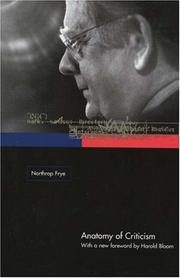
Anatomy of Criticism: Four Essays (Princeton University Press, 1957) is a book by Canadian literary critic and theorist Northrop Frye that attempts to formulate an overall view of the scope, theory, principles, and techniques of literary criticism derived exclusively from literature. Frye consciously omits all specific and practical criticism, instead offering classically inspired theories of modes, symbols, myths and genres, in what he termed "an interconnected group of suggestions." The literary approach proposed by Frye in Anatomy was highly influential in the decades before deconstructivist criticism and other expressions of postmodernism came to prominence in American academia in the 1980s.
Frye's four essays are sandwiched between a "Polemical Introduction" and a "Tentative Conclusion." The four essays are titled "Historical Criticism: Theory of Modes", "Ethical Criticism: Theory of Symbols", "Archetypal Criticism: A Theory of Myths", and "Rhetorical Criticism: Theory of Genres."
Contents
Polemical introduction
The purpose of the introduction is to defend the need for literary criticism, to distinguish the nature of genuine literary criticism from other forms of criticism, and to clarify the difference between direct experience of literature and the systematic study of literary criticism.
There are a number of reasons why the introduction is labeled as a "polemic". In defending the need for literary criticism, Frye opposes a notion common to Tolstoy and Romantic thought that "natural taste" is superior to scholarly learning (and by extension, criticism). Frye also accuses a number of methods of criticism (e.g. Marxist, Freudian, Jungian, Neo-classical, etc.) as being embodiments of the deterministic fallacy. He is not opposed to these ideologies in particular, but sees the application of any external, ready-made ideology to literature as a departure from genuine criticism. This results in subjecting a work of literature to an individual's pet philosophy and an elevation or demotion of authors according to their conformity to the pet philosophy.
Another point is to distinguish the difference between personal taste and genuine criticism. Personal taste is too easily swayed by the prevailing morals, values and tastes of the critic's society at that point in history. If taste succumbs entirely to such social forces, the result is the same as that of consciously adopting an external ideology described above. Yet even if there is a consensus among critics that the works of John Milton are more fruitful than Richard Blackmore (to use Frye's example), a critic contributes little by saying so. In other words, value judgments contribute little to meaningful criticism.
In place of meaningless criticism, Frye proposes a genuine literary criticism which draws its method from the body of literature itself. Literary criticism ought to be a systematic study of works of literature, just as physics is of nature and history is of human action. Frye makes the explicit assumption that in order for systematic study to be possible, the body of literature must already possess a systematic nature. Frye claims that we know very little about this system as yet and that the systematic study of literature has progressed little since Aristotle.
Frye concludes his introduction by addressing the weaknesses of his argument. He mentions that the introduction is a polemic, but written in first person to acknowledge the individual nature of his views. He concedes that the following essays can only give a preliminary, and likely inexact, glimpse of the system of literature. He admits to making sweeping generalities that will often prove false in light of particular examples. Finally, he stresses that while many feel an "emotional repugnance" to schematization of poetry, the schematization should be regarded as an aspect of criticism, not the vibrant, personal, direct experience of the work itself—much as the geologist turns away from his or her systematic work to enjoy the beauty of the mountains.
"Historical Criticism: Theory of Modes"
Frye's systemization of literature begins with three aspects of poetry given by Aristotle in his Poetics: mythos (plot), ethos (characterization/setting), and dianoia (theme/idea). Frye sees works of literature as lying somewhere on a continuum between being plot driven, as in most fiction, and idea driven, as in essays and lyrical poetry. The first essay begins by exploring the different aspects of fiction (subdivided into tragic and comic) in each mode and ends with a similar discussion of thematic literature.
Frye divides his study of tragic, comic, and thematic literature into five "modes", each identified with a specific literary epoch: mythic, romantic, high mimetic, low mimetic, and ironic. This categorization is a representation of ethos, or characterization, and relates to how the protagonist is portrayed in respect to the rest of humanity and the protagonist's environment. Frye suggests that Classical civilizations progressed historically through the development of these modes, and that something similar happened in Western civilization during medieval and modern times. He speculates that contemporary fiction may be undergoing a return to myth, completing a full circle through the five modes. Frye argues that when irony is pushed to extremes, it returns to the mode of myth; this concept of the recursion of historical cycles is familiar from Giambattista Vico and Oswald Spengler.
Tragedy is concerned with the hero's separation from society.
Mythic tragedy deals with the death of gods.
Romantic tragedy features elegies mourning the death of heroes such as Arthur or Beowulf.
High mimetic tragedy presents the death of a noble human such as Othello or Oedipus.
Low mimetic tragedy shows the death or sacrifice of an ordinary human being and evokes pathos, as with Thomas Hardy's Tess or Henry James's Daisy Miller.
以上文字摘自英文维基百科「Anatomy of Criticism」(有删节,去掉了参考文献等尾部小节),按 CC BY-SA 4.0 使用,作者为维基百科的各位编者。
资料卡
- 原题
- Anatomy of Criticism
- 原作语言
- 英语
- 首次出版
- 1957 年
- 首版出版社
- 普林斯顿大学出版社
- 主题
- 文学批评
资料卡来自 Wikidata Q4752295(CC0),众包数据,个别字段可能不全。