 书单
百科
这个词条暂时没有中文维基百科条目,下面是英文维基百科的内容(英文原文):
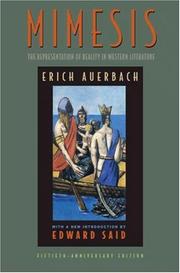
Mimesis: The Representation of Reality in Western Literature (German: Mimesis: Dargestellte Wirklichkeit in der abendländischen Literatur) is a book of literary criticism by Erich Auerbach and his best-known work. It was written in German between 1942 and 1945, while Auerbach was teaching in Istanbul, Turkey, where he fled after being ousted from his professorship in Romance Philology at the University of Marburg by the Nazis in 1935. It was first published in Switzerland in 1946 by A. Francke Verlag, with an English translation by Princeton University Press following in 1953, since when it has remained in print.
Mimesis is arranged in twenty sections, in chronological order. Each section analyses one to three works from the particular period, often beginning with a lengthy extract from the work, given in the original language and English translation. Nearly all the passages selected are narratives of some sort (# 12, covering an essay by Michel de Montaigne is one exception). The literary forms covered include epic poetry, novels, plays, memoir, and letters.
The book opens with a comparison between the way the world is represented in Homer’s Odyssey and the way it appears in the biblical Book of Genesis's account of the Sacrifice of Isaac, and ends with analysis of a passage from To the Lighthouse by Virginia Woolf (1927). From his analyses, Auerbach attempts to make the foundation for a unified theory of representation that spans the entire history of Western literature, including even the Modernist novelists writing at the time Auerbach began his study.
Overview
Mimesis gives an account of the way in which everyday life in its seriousness has been represented by many Western writers, from ancient Greek and Roman writers such as Petronius and Tacitus, early Christian writers such as Augustine, Medieval writers such as Chretien de Troyes, Dante, and Boccaccio, Renaissance writers such as Montaigne, Rabelais, Shakespeare, and Cervantes, 17th-century writers such as Molière and Racine, Enlightenment writers such as Voltaire, 19th-century writers such as Stendhal, Balzac, Flaubert, and Zola, and 20th-century writers such as Proust and Woolf. Despite his treatment of the many major works, Auerbach apparently did not think he was comprehensive enough, and apologized in the original publication in 1946 explaining that he had access only to the 'insufficient' resources available in the library at Istanbul University where he worked; Auerbach did not know Turkish and so could not use locally available sources, and did not have access to non-Turkish secondary sources.
The mode of literary criticism in which Mimesis operates is often referred to among contemporary critics as historicism, since Auerbach largely regarded the way reality was represented in the literature of various periods to be intimately bound up with social and intellectual conventions of the time in which they were written. In this he followed Giambattista Vico. Auerbach considered himself a historical perspectivist in the German tradition (he mentioned Hegel in this respect) and interpreted specific features of style, grammar, syntax, and diction to make much broader claims about cultural and historical questions. Of Mimesis, Auerbach wrote that his "purpose is always to write history".
Auerbach is in the same German tradition of philology as Ernst Curtius, Leo Spitzer, and Karl Vossler, having a mastery of many languages and epochs and all-inclusive in its approach, incorporating just about any intellectual endeavor into the discipline of literary criticism. Auerbach was a Romance language specialist, which explains his admitted bias towards treating texts from French compared to other languages.
Position and evaluation of rhetoric
To the consternation of his colleague Ernst Curtius, Auerbach's work is marked by an openly anti-rhetorical position. Auerbach criticizes classical writers such as Homer, Tacitus, and Petronius, as well as medieval theologians (except St. Augustine) and writers of the 17th century, like Racine, for their adherence to the rhetorical doctrine of "styles" with their corresponding subject matters: the low style's association with the comedic and the popular classes, and the elevated style's association with the tragic, the historic, and the heroic. Auerbach sees the Bible as opposing this rhetorical doctrine in its serious and poignant portrayals of common folk and their encounter with the divine. As Auerbach notes in Chapter 2 when discussing the New Testament:
But the spirit of rhetoric — a spirit which classified subjects in genera and invested every subject with a specific form of style as one garment becoming it in virtue of its nature [i.e. lower classes with the farcical low-style, upper classes with the tragic, the historic and the sublime elevated-style] — could not extend its dominion to them [the Bible writers] for the simple reason that their subject would not fit into any of the known genres. A scene like Peter's denial fits into no antique genre. It is too serious for comedy, too contemporary and everyday for tragedy, politically too insignificant for history — and the form which was given it is one of such immediacy that its like does not exist in the literature of antiquity.
The Bible will ultimately be responsible for the "mixed style" of Christian rhetoric, a style that is described by Auerbach in Chapter 7 as the "antithetical fusion" or "merging" of the high and low style. The model is Christ's Incarnation as both sublimitas and humilitas. This mixture ultimately leads to a "popular realism" seen in the religious plays and sermons of the 12th century. Auerbach also discusses the development of an intermediate or middle style due to medieval influences from the Bible and courtly love (see chapters 9 and 15 on Boccaccio and Molière). This development of an intermediate and then ultimately another "mixed style" (Shakespeare, Hugo) leads to what Auerbach calls the "modern realism" of the 19th century (see Chapter 18 on Flaubert).
以上文字摘自英文维基百科「Mimesis: The Representation of Reality in Western Literature」(有删节,去掉了参考文献等尾部小节),按 CC BY-SA 4.0 使用,作者为维基百科的各位编者。
资料卡
- 原题
- Mimesis
- 原作语言
- 德语
- 首次出版
- 1946 年
- 体裁
- 随笔
资料卡来自 Wikidata Q2523375(CC0),众包数据,个别字段可能不全。