书单
百科
这个词条暂时没有中文维基百科条目,下面是英文维基百科的内容(英文原文):
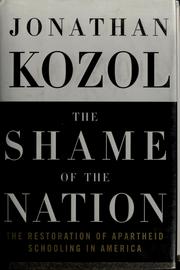
The Shame of the Nation: The Restoration of Apartheid Schooling in America is a 2005 book by educator and author Jonathan Kozol. It describes how, in the United States, black and Hispanic students tend to be concentrated in schools where they make up almost the entire student body.
Kozol visited nearly 60 public schools in preparation for writing the book. He found that conditions had grown worse for inner-city children in the 50 years since the Supreme Court in the landmark ruling of Brown v. Board of Education dismantled the previous policy of de jure segregated schools and their concept of "separate but equal". In many cities, wealthier white families continued to leave the city to settle in suburbs, with minorities comprising most of the families left in the public school system. In the book Kozol quotes Gary Orfield of the Harvard Graduate School of Education, who says, "American public schools are now 12 years into the process of continuous resegregation. ... During the 1990s, the proportion of black students in majority white schools has decreased ... to a level lower than in any year since 1968." In a separate quote from Gary Orfield in a letter to AllArtsAllKids.org, he mentions that, "the country clearly has had enough of the drill, kill, test & punish, and learn only two subjects style of NCLB reform...".
In his earlier books, like Amazing Grace, Kozol wrote that the schools of the South Bronx were stunningly segregated. But in the last five years, Kozol said that he "... realized how sweeping this change has been throughout the nation, and how reluctant the media is to speak of it." Newspapers he says "... refuse to see what is in their own front yard ... in a description of a 98 percent black and Latino school, the newspaper won't say what would seem to be the most obvious starting point: This is a deeply segregated school. They won't use the word 'segregated.'"
In the book, Kozol attacks the disparity in expenditures on education between central cities and well-to-do suburbs, and the system of property taxes which most school systems and states rely on for funding. He expresses outrage at inequities in expenditure, pointing out that New York City in 2002-3 spent $11,627 on the education of each child, while in Nassau County, the town of Manhasset spent $22,311, and Great Neck $19,705. He found that there are comparable disparities in other metropolitan areas, since most funding is locally based. Kozol describes schools that are separated by a 15-minute drive but that offer vastly different educational opportunities. In one example, a primarily white school offers drama club and AP classes, and the nearby primarily black school requires classes like hairdressing.
Chapter summaries
Chapter 1: Dishonoring the Dead
In the first chapter of this text, Kozol examines the current state of segregation within the urban school system. He begins with a discussion on the irony stated in the above quote: schools named after leaders of the integration struggle are some of the most segregated schools, such as the Thurgood Marshall Elementary School in Seattle, Washington (95% minority) or a school named after Rosa Parks in San Diego, California (80% minority). Kozol notes that most of the students within these schools are unfamiliar with the actions of the minority leaders their schools are named after. Kozol goes on to point out the lack of segregation within the urban communities that surround these schools, specifically mentioning the residential segregation on New York City, which matches levels from the 1960s.
Chapter 2: Hitting Them Hardest When They're Small
In chapter 2, Kozol describes the hardships students of color experience in segregated schools. Students of color have limited resources and support from the educational system. Students concerns were devalued and little consideration is given to help fund their schools. As opposed to affluent families they were able to provide an education for their children. Programs were available for those who could afford to pay children education. Baby Ivy is a private educational program that taught children of early age to receive the proper education they need. Children who had a head start in school had more positive educational outcomes than disadvantage children.
Chapter 3: The Ordering Regime
Kozol examines the strategy of "one size fits all" within urban public schools. Scripted programs such as 'Success for All' drive curriculum changes, using models adapted from industrial efficiency and Taylorism. In addition, Kozol discusses the naming ritual that permeates the formality of each course taught by the school. Such examples include 'Authentic Writing', 'Active Listening', 'Accountable Talk', and 'Zero Noise'. Teachers in urban school are strongly encouraged to follow these scripted lessons to bring formality and structure to the learning environment. This order is driven by state testing, which leads to anxiety among schoolchildren when their reading level is announced. Students are scored from Level One (lowest) to Level Four (highest), which places them into categories for further instruction. However, these placement scores are used as descriptive terms among students; 'He's a level one', or 'She's gone down to a level two'.
以上文字摘自英文维基百科「The Shame of the Nation」(有删节,去掉了参考文献等尾部小节),按 CC BY-SA 4.0 使用,作者为维基百科的各位编者。
资料卡
- 原题
- The Shame of the Nation
- 原作语言
- 英语
- 首次出版
- 2005 年 9 月 13 日
- 体裁
- 非虚构作品
- 首版出版社
- 兰登书屋
资料卡来自 Wikidata Q7763634(CC0),众包数据,个别字段可能不全。