 书单
百科
这个词条暂时没有中文维基百科条目,下面是英文维基百科的内容(英文原文):
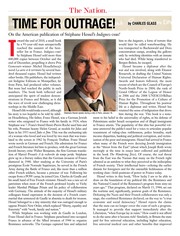
Time for Outrage! is the English translation of the bestselling tract Indignez-vous ! by the French diplomat, member of the French Resistance and concentration camp survivor Stéphane Hessel. Published in France in 2010, it has sold nearly 1.5 million copies in France and has been translated into numerous other languages.
Content
In this essay, Stéphane Hessel calls, drawing on the “Sartrean” idea of personal commitment, for resistance to wealth inequality. He criticizes the immigration policies of the Fillon governments, denounces the influence of the financial world on political decision-making, and condemns the weakening of the social legacy of the National Council of the Resistance (notably social security and the pension system). A section entitled “My indignation concerning Palestine” addresses the situation imposed by the State of Israel on the Palestinian territories, particularly the Gaza Strip.
Origins of the work
The writing of the book was proposed to Stéphane Hessel by Sylvie Crossman and Jean-Pierre Barou, two politically engaged journalists, founders of the publishing house Indigène, after they heard the speech he delivered on the Glières Plateau, a site of remembrance of the French Resistance, in which he denounced what he described as a betrayal of the principles of the National Council of the Resistance, for which he blamed President Nicolas Sarkozy.
The speech that Sarkozy, then a candidate in the presidential election, delivered between the two rounds of voting on May 4, 2007, on the Glières Plateau had indeed provoked the indignation of former deportee Walter Bassan and his friends. This indignation was shared by a number of other former resistance fighters, who organized an annual counter-commemoration at Glières. They drew on the spirit of the Appeal commemorating the sixtieth anniversary of the Programme of the National Council of the Resistance of March 15, 1944, signed three years earlier, on March 8, 2004, by major surviving figures of the French Resistance, including Lucie Aubrac, Raymond Aubrac, Henri Bartoli, Daniel Cordier, Philippe Dechartre, Georges Guingouin, Stéphane Hessel, Maurice Kriegel-Valrimont, Lise London, Georges Séguy, Germaine Tillion, Jean-Pierre Vernant, and Maurice Voutey.
In 2008, Walter Bassan’s friends formed an association, Citoyens Résistants d’Hier et d’Aujourd’hui, of which Stéphane Hessel was one of the patrons, alongside Raymond Aubrac and John Berger. The appeal of March 8, 2004 (already read at the first gathering on May 13, 2007) was broadcast again on May 17, 2009, at Glières, and was followed by a speech delivered in the presence of Raymond Aubrac and four thousand supporters, in which Stéphane Hessel called for a duty of indignation.
These positions, initiated by the same former resistance fighters during the affairs involving undocumented immigrants at Saint-Ambroise and Saint-Bernard, and reaffirmed since 2004, formed the basis for the writing of the book. The text was developed through three interviews conducted in the spring of 2010. Edited by Sylvie Crossman, it was approved by Stéphane Hessel.
Reception
Published by a small Montpellier-based publishing house, Indigène éditions, the book initially received no media promotion. Nevertheless, the 32-page volume, sold for €3.10, quickly became a publishing phenomenon, selling more than 300,000 copies within three months, and reaching 950,000 copies sold within ten months.
The success is partly attributed to the figure of its author, Stéphane Hessel, born in Germany in 1917 to a Jewish father (who later converted to Christianity), a member of the French Resistance against Nazism, a deportee to Buchenwald, and secretary of the United Nations Commission on Human Rights when it drafted the Universal Declaration of Human Rights, and later a diplomat aligned with the political left. The format itself, a short text sold at a very low price, also likely facilitated its wide dissemination.
The book’s success also stems from the parallels drawn by Hessel between the ideas promoted by the authors of the Program of the National Council of the Resistance, such as civic political engagement, the primacy of the public interest over financial interests, trade unionism, and intergenerational solidarity, and the issues that provoked his indignation in the contemporary world: the existence of undocumented immigrants, environmental degradation, and global wealth inequality. Published on the same day that the 2010 French pension reform was passed, the book appeared to resonate with a broader climate of discontent and unease in French society. According to Edgar Morin, it represented a “public awakening of a people who had until then been very passive,” and this literary enthusiasm was seen as embodying a renewed form of civic engagement outside traditional political parties.
Criticism of the work in France
Following strong public enthusiasm and extensive, largely favorable media coverage, criticism began to appear in the French media in December 2010 and January 2011. These critiques denounced the status of an untouchable icon attributed to the author.
The first major criticism directed at Stéphane Hessel concerned the passage of his text devoted to the situation in the Gaza Strip. On the website of the Representative Council of French Jewish Institutions, Marc Knobel wrote that “Stéphane Hessel attempts to justify, if not legitimize, terrorism.”
Others criticized him for not being as subversive as the title suggests, pointing to his proximity to social democracy as embodied in France by figures such as Michel Rocard, Dominique Strauss-Kahn, or Martine Aubry.
For Boris Cyrulnik, indignation also has an instinctive and non-rational character. This weakness of reasoning was likewise criticized by Luc Ferry, who argued that it reflects a politics of emotion rather than a “politics of justice.”
以上文字摘自英文维基百科「Time for Outrage!」(有删节,去掉了参考文献等尾部小节),按 CC BY-SA 4.0 使用,作者为维基百科的各位编者。
资料卡
- 原题
- Indignez-vous !
- 原作语言
- 法语
- 首次出版
- 2010 年 10 月 21 日
- 体裁
- 随笔
- 续作
- Get involved!
- 故事发生地
- 法国
资料卡来自 Wikidata Q255529(CC0),众包数据,个别字段可能不全。