书单
百科
这个词条暂时没有中文维基百科条目,下面是英文维基百科的内容(英文原文):
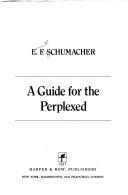
A Guide for the Perplexed is a short book by E. F. Schumacher, published in 1977. The title is a reference to Maimonides's The Guide for the Perplexed. Schumacher himself considered A Guide for the Perplexed to be his most important achievement, although he was better known for his 1973 environmental economics bestseller Small Is Beautiful, which made him a leading figure within the ecology movement. His daughter wrote that her father handed her the book on his deathbed, five days before he died and he told her "this is what my life has been leading to". As the Chicago Tribune wrote, "A Guide for the Perplexed is really a statement of the philosophical underpinnings that inform Small Is Beautiful".
Schumacher describes his book as being concerned with how humans live in the world. It is also a treatise on the nature and organisation of knowledge and is something of an attack on what Schumacher calls "materialistic scientism". Schumacher argues that the current philosophical "maps" that dominate western thought and science are both overly narrow and based on some false premises. However, this book is only in small part a critique.
Four Great Truths
Schumacher put forward what he considers to be the four great truths of philosophy:
The world is a hierarchical structure with at least four "levels of being".
The "Principle of Adequateness" determines human ability to accurately perceive the world.
Human learning relates to four "fields of knowledge".
The art of living requires an understanding of two types of problem: "convergent" and "divergent".
Critique of materialistic scientism
Schumacher was very much in favor of the scientific spirit, but felt that the dominant methodology within science, which he called materialistic scientism, was flawed and stood in the way of achieving knowledge in any other arena than inanimate nature. Schumacher believed that this flaw originated in the writings of Descartes and Francis Bacon, when modern science was first established.
He makes a distinction between the descriptive and instructional sciences. According to Schumacher the descriptive sciences are primarily concerned with what can be seen or otherwise experienced, e.g. botany and sociology, while the instructional sciences are concerned with how certain systems work and can be manipulated to produce certain results, e.g. biology and chemistry. Instructional science is primarily based on evidence gained from experimentation.
Materialistic scientism is based on the methodology of the latter, which developed to study and experiment with inanimate matter. According to Schumacher many philosophers of science fail to recognize the difference between descriptive and instructional science, or ascribe this difference to stages in the evolution of a specific science, which for these philosophers means that the instructional sciences are seen as being the most advanced variety of science.
He is particularly offended by the view that instructional science is the most advanced form of science, because for Schumacher, it is the study of the low hanging fruit of inanimate matter, or less metaphorically the study of the lowest and least complex level of being. As Schumacher sees it, knowledge gained about the higher levels of being, while far harder to get and far less certain, is all the more valuable.
He argues that applying the standards and procedures of instructional science to descriptive sciences is erroneous, because in the descriptive fields it is simply not possible to use the experimental techniques of instructional sciences. Experimentation is an appropriate method when dealing with inanimate matter, but applying it to the living world is liable to destroy or damage living things and systems, and is therefore inappropriate.
He uses the term scientism because he argues that many people, including some philosophers of science, have misunderstood the theory behind instructional science and instead believe that it produces truth. But the instructional sciences are based on induction; and as David Hume famously points out induction is not the same as truth. Furthermore, according to Schumacher, instructional sciences are primarily concerned only with the parts of truth that are useful for manipulation, i.e. they focus on those instructions which are necessary to reliably produce certain results. For Schumacher, instructional sciences therefore produce theories which are useful: pragmatic truths. By contrast, Schumacher argues that the descriptive sciences are interested in the truth in the wider sense of the word.
He argues that materialistic scientism follows a policy of leaving something out if it is in doubt. Consequently, the maps of western science fail to show large 'unorthodox' parts of both theory and practice of science and social science, and reveal a complete disregard for art and many other high level humanistic qualities. Such an approach, Schumacher argues, provides a grey, limited, utilitarian worldview without room for vitally important phenomena like beauty and meaning.
He observes that the mere mention of spirituality and spiritual phenomena in academic discussion is seen among scientists as a sign of 'mental deficiency' . Schumacher argues that where there is near total agreement a subject becomes effectively dead; it is therefore the subjects where there is doubt that deserve the most intense research. Schumacher believes in contrast to materialistic science that what is in doubt should be shown prominently, not hidden away or ignored.
以上文字摘自英文维基百科「A Guide for the Perplexed」(有删节,去掉了参考文献等尾部小节),按 CC BY-SA 4.0 使用,作者为维基百科的各位编者。
资料卡
- 原题
- A Guide for the Perplexed
- 原作语言
- 英语
- 首次出版
- 1977 年
- 体裁
- 非虚构作品
资料卡来自 Wikidata Q17110363(CC0),众包数据,个别字段可能不全。