书单
百科
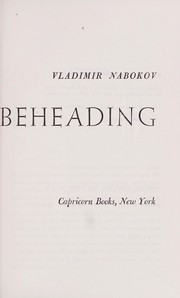
《斩首之邀》(俄语:Приглашение на казнь,直译:“Invitation to an execution”;英语:Invitation to a Beheading)是作家弗拉基米尔·纳博科夫的一部小说。 它最初于1935年至1936年,以俄语连载在巴黎的白俄流亡分子杂志《当代》(Sovremennye zapiski)上。1938年,全书在巴黎出版,英语译本于1959年出版。这部小说由纳博科夫的儿子德米特里·纳博科夫在作者的监督下翻译成英语。
这部小说经常被描述为卡夫卡风格的,但纳博科夫声称,在写这本书的时候,他不熟悉德语,对弗朗茨·卡夫卡的作品“一无所知”。纳博科夫中断了《天赋》的写作,来写作《斩首之邀》,描述在写作初稿时“持续两周美妙的兴奋和持续的灵感”。一些学者认为《斩首之邀》的中心情节植根于《天赋》中的人物车尔尼雪夫斯基。另一种观点认为,这部小说的功能使小说锁定(roman à clef),以柏拉图式的苏格拉底为目标.
纳博科夫在接受采访时说,在他所有的小说中,他最喜爱的是《洛丽塔》,但是最尊重的是《斩首之邀》。
情节
这部小说发生在一个监狱里,讲述了辛纳图斯(Cinnatus C.)的最后二十天,他是一个虚构国家的公民,因“诺斯底主义沦丧” 而被监禁并被判处死刑。
虽然判了刑,但没有告诉辛金纳图斯何时会被处决。这让他很烦恼,因为他想通过写作来表达自己,“无视世界上所有的沉默”,但不知道他要完成这项任务需要多长时间,感觉做不到。辛金纳图斯对周围的荒谬和粗俗漠不关心。他努力在他的写作中找到他真正的自我,在那里他创造了一个理想的世界。就要被处死前,他拒绝相信死亡或行刑者。当斧头落下时,在他周围虚假的存在消失,
以上文字摘自维基百科「斩首之邀」(去掉了参考文献等尾部小节),按 CC BY-SA 4.0 使用,作者为维基百科的各位编者。
中文维基百科的条目比较短,下面附上英文维基百科的内容(英文原文):
Invitation to a Beheading (Russian: Приглашение на казнь, lit. 'Invitation to an execution') is a novel by Russian American author Vladimir Nabokov. It was originally published in Russian from 1935 to 1936 as a serial in Sovremennye zapiski, a Russian émigré magazine. In 1938, the work was published in Paris, with an English translation following in 1959. The novel was translated into English by Nabokov's son, Dmitri Nabokov, under the author's supervision.
The novel is often described as Kafkaesque, but Nabokov claimed that at the time he wrote the book, he was unfamiliar with German and "completely ignorant" of Franz Kafka's work. Nabokov interrupted his work on The Gift in order to write Invitation to a Beheading, describing the creation of the first draft as "one fortnight of wonderful excitement and sustained inspiration." Some scholars have argued that the central plot of Invitation to a Beheading has its roots in Chernyshevski, a character from The Gift. Another view is that the novel functions as a roman à clef with the Platonic Socrates as its target.
Nabokov stated in an interview that, although, of all his novels, he had the greatest affection for Lolita, it was for Invitation to a Beheading that he had the greatest "esteem".
Plot introduction
The novel takes place in a prison and relates the final nineteen days of Cincinnatus C., a citizen of a fictitious country, who is imprisoned and sentenced to death for "gnostical turpitude." Unable to blend in and become part of the world around him, Cincinnatus is described as having a "certain peculiarity" that makes him "impervious to the rays of others, and therefore produces when off his guard a bizarre impression, as of a lone dark obstacle in this world of souls transparent to one another." Although he tries to hide his condition and "feign translucence," people are uncomfortable with his existence, and feel there is something wrong with him. In this way, Cincinnatus fails to become part of his society.
While confined, Cincinnatus is not told when his execution will occur. This troubles him, as he wants to express himself through writing "in defiance of all the world's muteness," but feels unable to do so without knowledge of how long he has to complete this task. Indifferent to the absurdity and vulgarity around him, Cincinnatus strives to find his true self in his writing, where he creates an ideal world. Taken to be executed, he refuses to believe in either death or his executioners, and as the axe falls the false existence dissolves around him as he joins the spirits of his fellow visionaries in "reality."
Plot summary
Narrated omnisciently, the novel opens with Cincinnatus C., a thirty-year-old teacher and the protagonist, being sentenced to death by beheading for the crime "gnostical turpitude" in twenty days' time (though this timescale is undisclosed to Cincinnatus). After being taken back to a "fortress" by the cheerful jailer Rodion, Cincinnatus talks to his lawyer and dances with Rodion, before inscribing his thoughts on paper, as a spider dangles from the ceiling. Throughout the plot, Cincinnatus repeatedly inquires of various characters about the date of his execution, but to no avail. Cincinnatus is displeased to learn from the prison director, Rodrig, that he will be getting a cellmate. Cincinnatus soon meets Emmie, Rodrig's young daughter, and then reads the foolish prisoner's rules etched into the wall, flips through a book catalogue, and is brought by Rodrig down the hall to observe his incoming cellmate through a peephole.
以上文字摘自英文维基百科「Invitation to a Beheading」(有删节,去掉了参考文献等尾部小节),按 CC BY-SA 4.0 使用,作者为维基百科的各位编者。
资料卡
- 原题
- Приглашение на казнь
- 译者
- 德米特里·纳博科夫
- 原作语言
- 俄语
- 首次出版
- 1935 年
- 作品形式
- 长篇小说
- 首版出版社
- Sovremennye zapiski
资料卡来自 Wikidata Q2332901(CC0),众包数据,个别字段可能不全。