 书单
百科
这个词条暂时没有中文维基百科条目,下面是英文维基百科的内容(英文原文):
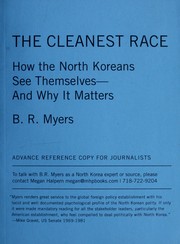
The Cleanest Race: How North Koreans See Themselves and Why it Matters is a 2010 book by Brian Reynolds Myers. Based on a study of the propaganda produced in North Korea for internal consumption, Myers argues that the guiding ideology of North Korea is a combination of Japanese fascism rooted in State Shinto and race-based nationalism derived from minzoku (民族), rather than Stalinism or any other form of communism. The book is based on author's study of the material in the Information Center on North Korea.
Author
Brian Reynolds Myers was born in the U.S. and was educated on the graduate level in Germany. He is an editor of The Atlantic magazine and the author of A Reader's Manifesto, as well as of Han Sorya and North Korea Literature (1994), which was the only book in English about North Korean literature until Tatiana Gabroussenko's literary history Soldiers on the Cultural Front (2010). Myers has studied North Korea for twenty years and is fluent in Korean. He holds an assistant professorship in international studies at Dongseo University in South Korea.
For the book, Myers studied North Korean mass culture with reference to domestically published novels, films, and serials available at the Ministry of Unification in Seoul. Myers claims his analysis differs from that of conventional North Korea watchers, because he focuses on internal Korean-language propaganda, rather than on Korean Central News Agency (KCNA) external broadcasts and English-language reports from South Korea.
Contents
The Cleanest Race is divided into two sections: the first covers North Korean history through its propaganda, from Korea under Japanese rule to the 2009 imprisonment of American journalists by North Korea. The second section analyzes themes in the propaganda, including chapters such as "Mother Korea", Kim Il Sung, Kim Jong Il, perceptions of foreigners, and South Korea.
Techniques of propaganda analysis by Myers include translation of poems, discussion of metaphors and monumental architecture, and description of racist tropes. The book also contains sixteen separate pages of color illustrations, including reprints of posters that ethnically caricature Japanese and White Americans and which portray the late leaders Kim Il Sung and Kim Jong Il as paternal figures.
Racial identity
The Cleanest Race argues that the overarching ideology of the North Korean government is founded on far-right politics rather than far-left politics. It notes that the North Korean government is racist, xenophobic, and militaristic. It cites a report of a mob attack on Afro-Cuban diplomats and the forcing of female Koreans to abort multi-ethnic children. It mentions that the 2009 North Korean constitution omits all mention of communism. The author argues that Juche is not the leading ideology of North Korea. Rather, he surmises, it was designed in order to trick foreigners.
Myers says North Korea's government does not base its ideology on Marxism–Leninism or Neo-Confucianism. He instead links it to Japanese state nationalism and racial nationalism. He states that the government's racist criteria for national identity paints its genetically Korean citizens as innocent and morally virtuous (as opposed to foreigners) but militarily weak, requiring Kim Il Sung's charismatic guidance and protection. The author supposes that this may be a strategy by the government to decrease the amount of repression and surveillance needed to control that public.
Implications for the North Korean government's foreign policy
According to Myers, the North Korean government's propaganda portrays South Korea as a land which has been polluted by foreign domination, particularly by the permanent presence of U.S. soldiers. Anti-Americanism is the cornerstone of North Korean foreign policy.
Similarly, internal propaganda within North Korea portrays U.S. humanitarian efforts such as food aid as signs of U.S. cowardice and makes no distinction "between 'good' American workers and 'bad' American capitalists" as the Soviet Union's regime in the Cold War did. He laments that North Koreans openly flout the "dictates of an impure world" as inapplicable to the pure Korean race.
Reception
Press reviews
Upon its release, The Cleanest Race received a significant amount of attention from the media and it also received "rave reviews" in the United States press. The journalist Christopher Hitchens (who had visited North Korea at the beginning of the 21st century) recounted that after he read the book, he concluded that his earlier belief that the country was Stalinist was simplistic and incorrect. Some reviewers confirmed anecdotal instances of North Korean Xenophobia and alarm due to the high rate of interracial marriage in South Korea. Hitchens also found some "obscene corollaries" from Myers' conclusions, including the observation that many South Koreans believe that the North Korean regime is more "'authentically' Korean" than their own government.
The New York Times characterized the book as "often counterintuitive" and its arguments as "wily and complex". Bradley K. Martin of The New Republic, however, warned that the book could "[play down] the Stalinist, Maoist, and traditional East Asian contributions" to North Korean ideology. Martin argues that North Korean ideology can be understood in the terms of Japanese pre-fascist psychology, including amae (dependence on parents) and banzai (wishing long life for the ruler).
Journals
Charles K. Armstrong in The Journal of Asian Studies states that the conclusions of the book are "not news". He explains that historian Bruce Cumings, who Myers excoriates, addresses the influence of "Japanese colonial militarism" on North Korea. Armstrong faults Myers for exaggerating the Japanese angle and he also suggests that the North Korean government is "actually closer to European fascism" rather than Imperial Japanese fascism, because Imperial Japan lacked a charismatic leader and it also lacked a mass-mobilizing party.
以上文字摘自英文维基百科「The Cleanest Race」(有删节,去掉了参考文献等尾部小节),按 CC BY-SA 4.0 使用,作者为维基百科的各位编者。
资料卡
- 原题
- The Cleanest Race
- 原作语言
- 英语
- 首次出版
- 2010 年
- 体裁
- 非虚构作品
资料卡来自 Wikidata Q7723341(CC0),众包数据,个别字段可能不全。