书单
百科
这个词条暂时没有中文维基百科条目,下面是英文维基百科的内容(英文原文):
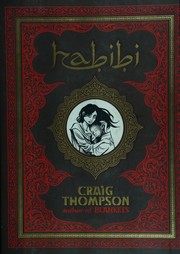
Habibi is a black-and-white graphic novel by Craig Thompson published by Pantheon in September 2011. The 672-page book is set in a fictional Islamic landscape with "fairy-tale imagery", and depicts the relationship between Dodola and Zam, two escaped child slaves, who are torn apart and undergo many transformations as they grow into new names and new bodies, which prove to be obstacles to their love when they later reunite. The book's website describes its concept as a love story and a parable about humanity's relationship to the natural world that explores themes such as the cultural divide between first world countries and third world countries, and the commonality between Christianity and Islam.
While it has been lauded by publications such as Time, Elle, Salon, NPR and reviewers for the beauty of its visual design and epic setting, it has also been criticized for misrepresenting various elements such as sexuality and its depiction of Arabic culture.
Publication history
Thompson began working on Habibi at the end of 2004 due to the widespread attention given towards the Middle East by the American society after the 9/11 attacks. Although the book is preceded by his previous work, Blankets, which autobiographically explored Thompson's Christian upbringing and beliefs, Thompson conceived Habibi in an effort to better understand and humanize Islam, and focus on the beauty of Arabic and Islamic cultures, in contrast to their vilification after the events of 9/11. In the course of producing the story, Thompson was inspired by Arabic calligraphy, interpreting that form of writing as cursive shorthand for an idea, which Thompson says, is the "origin of cartooning". After having worked on the piece for nearly 6 years, Thompson finally published the work in 2011 under Pantheon Books. The graphic novel has been produced in both paperback and hardcover editions since its initial publication.
Plot summary
Habibi takes place in the present day, albeit in a fictional "Orientalist landscape" named Wanatolia. The story begins with Dodola, a nine-year old girl who is sold into marriage by her poverty-stricken parents. Her husband, a much older man, rapes her on her wedding night, but vaguely pities her for being "just a child". He teaches her how to read and write, which allows Dodola to understand and find appreciation for the Qur'an. However, one day, their home is broken into by thieves who murder Dodola's husband and kidnap her to be sold as a slave. During this captured period, Dodola witnesses the thieves preparing to kill a young African boy - who she saves by claiming him to be her brother despite their evident ethnic differences. She begins to call the boy "Zam".
Before they can be sold, Dodola and Zam escape from their captors and find refuge within an abandoned boat in the desert. However, in order to survive and earn money towards food and clothing, Dodola scavenges the desert and prostitutes herself to passing travelers who will in exchange give her goods with which to live, which eventually earns her the title of “phantom courtesan of the desert”, with many supernatural myths about her presence. In an attempt to contribute, Zam goes off to search for water at a reservoir, but witnesses Dodola being raped by one of the customers before she can leave, which traumatizes him. He does not reveal what he saw to her, and being somewhat attracted to her, he feels guilty over that attraction.
While Zam is out searching for water, Dodola is found alone in the boat by a group of men who kidnap her for the Sultan of Wanatolia's harem. The Sultan, aware of her reputation and allure, makes a deal with Dodola claiming that he would grant her one wish if she is able to please him for seventy nights - otherwise, he would execute her. Dodola takes upon the conditions of the agreement and is bound to sexual servitude for seventy nights. However, on the very last night, the Sultan claims that he is not pleased by her and imprisons Dodola.
While Dodola manages to manipulate the Sultan into letting her out of prison, Zam, in the reservoir still attempting to find water, is attacked. Zam befriends a eunuch in the nearby village and begins to undertake random tasks and jobs in order to survive. He becomes a eunuch for the Sultan's court, taking on a more female persona and having his first relationship with a fellow eunuch (which he breaks off after learning she is a prostitute due to his trauma). When he finally goes to the Sultan's palace, he manages to see Dodola again, and her manipulations wear thin and she is to be executed, but Zam rescues her and they escape.
Zam and Dodola come across their abandoned boat in a garbage dump. Rather than live in the garbage dump, they decide to move to another place upon seeing the impoverished conditions of the individuals scavenging the garbage dump for survival. They sneak onto a garbage truck, which takes them into the city of Wanatolia - an area that is extremely developed and filled with high-rise buildings. They feign being a married couple and Zam finds work within the city as a factory worker. Despite their ameliorated condition, Zam's conscience is disturbed by Dodola's previous treatment and his status as a eunuch to the point where he contemplates suicide; after Dodola admits she has fallen in love with Zam but he tells her of his trauma and how that lead him to become an eunuch, and he runs away to kill himself, but decides to return, and they begin a relationship. The novel concludes with Dodola and Zam saving and adopting a slave girl to protect her from the same fate Dodola suffered, and making plans to move out of the city.
以上文字摘自英文维基百科「Habibi (graphic novel)」(有删节,去掉了参考文献等尾部小节),按 CC BY-SA 4.0 使用,作者为维基百科的各位编者。
资料卡
- 原题
- Habibi
- 原作语言
- 英语
- 首次出版
- 2011 年 9 月
- 体裁
- 漫画
资料卡来自 Wikidata Q645531(CC0),众包数据,个别字段可能不全。
更多资料与书评
在哪读
克雷格·汤普森 的其他作品
作者页 ›
相似的书