书单
百科
这个词条暂时没有中文维基百科条目,下面是英文维基百科的内容(英文原文):
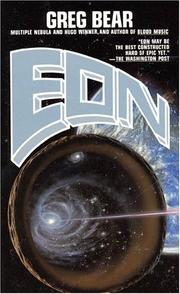
Eon is a science fiction novel by American author Greg Bear published by Bluejay Books in 1985. Eon was nominated for an Arthur C. Clarke Award in 1987. It is the first novel in The Way series; followed by Eternity.
Plot
In the early 21st century, NATO and the Soviet Union are on the verge of a second nuclear war. As the book opens, a 290 km prolate spheroid has been detected following an anomalous energy burst just outside the Solar System. It is found to be duplicate of the asteroid Juno. It moves into an eccentric near-Earth orbit where the rival polities of Earth each try to claim this mysterious object.
The duplicate Juno has been hollowed out along its long axis, subdivided into seven cylindrical chambers, and rotates to provide artificial gravity. The chambers are terraformed, with the second and third containing cities that have been maintained by automatic systems for centuries. This small world is dubbed "the Stone" by the Americans, "the Potato" by the Soviets, and "the Whale" (鲸) by the Chinese; data recovered from the libraries of its absent makers refers to "the Thistledown". Explorers of its interior discover that the end of the Stone's seventh chamber opens into "the Way", a corridor that extends to apparent infinity. The Stone’s original inhabitants evacuated into the Way at some time in its past, which is the explorers’ future.
At the opening of the novel in 2005, Judith Hoffmann, head of the commission that coordinates the exploration of the Stone, recruits theoretical physicist Patricia Vasquez, who arrives at the Stone and receives clearance for all the information discovered by the existing science teams, including the description of a nuclear holocaust—"the Death"—taking place in 2005. Only some NATO science teams are privy to this information; Chinese and Russian science teams are present, but politically restricted.
Since the Stone appears before the recorded date of the Death and there is no record of the Stone's appearance in its libraries, the scientists reason that the Stone may come from an alternate future and have the goal of preventing the war. However, the USSR, angered by the restrictions placed on its scientists, sends space-assault teams to attack the Stone, triggering retaliation on Earth by other governments and a war that isolates survivors from all factions on the Stone.
After the war it is found that the descendants of the Stone's creators live a million kilometers into the Way and 1,200 years into Vasquez's future, in a society called the Hexamon. They have been secretly observing the explorers. Olmy, a humanoid agent of the Hexamon, and his nameless alien Frant colleague, kidnap Vasquez as she begins to discover secrets of the Stone and the Way. They take her to Axis City, their main settlement. Four of her colleagues search for her using a specially-modified V/STOL craft connected to a "tuberider", a device that allows the craft to be hitched to the tubular singularity that runs through the center of the Way.
The rescuers are intercepted when they near Axis City and reunited with Vasquez, who is caught up in the politics of the Hexamon. It is presided over by a governing body, the Nexus, loosely divided into two social groups: The progressive Geshels, who embrace body-swapping and life-extending technologies, and the conservative Naderites. The latter are named after Ralph Nader, who has become identified with empathy and opposition to nuclear war in the centuries since his death. The Hexamon control traffic through spacetime “gates” in the Way’s surface that lead to other worlds, and are threatened by unseen alien invaders called the Jart, who are more adapted to the physics of the Way and live beyond its 2x10^9 kilometer (2 billion kilometer) point.
The Jart attempt to destroy the Hexamon by opening a gate into the heart of a star, allowing superheated plasma to enter the Way. To counter the attack, a coalition within the Hexamon seizes control of the Nexus. The first part of their plan involves accelerating a section of Axis City along the tube to near lightspeed, generating a shockwave that will protect the rest of the city from the blast of stellar plasma while simultaneously sealing any open gates along the Way and destroying the Jart. The second half of their plan requires the separation of the Stone from the now-uninhabitable Way. When this is done, the remains of Axis City and its inhabitants join the Stone (which they call "the Thistledown") in orbit around an Earth that is suffering from nuclear winter in the war's aftermath.
Major themes
The high technology of the Hexamon civilization, with their control over genetic engineering, human augmentation (including post-symbolic communication), the concept of parallel universes, alternate timelines and the manipulation of space-time itself are major themes in the latter half of the novel. The Way itself cuts across space and time: "gates" may be opened through its surface at regular intervals, which lead to space and worlds occupying other timelines, including alternate timelines for the Earth. As a result of commerce through the gates, several alien species have come to be partners of the Hexamon as well.
以上文字摘自英文维基百科「Eon (novel)」(有删节,去掉了参考文献等尾部小节),按 CC BY-SA 4.0 使用,作者为维基百科的各位编者。
资料卡
- 原题
- Eon
- 原作语言
- 英语
- 首次出版
- 1985 年 8 月
- 作品形式
- 长篇小说
- 体裁
- 科学幻想
- 所属系列
- The Way
- 续作
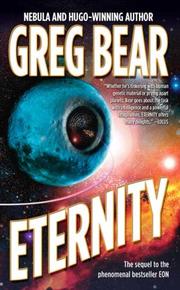
- Eternity
资料卡来自 Wikidata Q1055813(CC0),众包数据,个别字段可能不全。