书单
百科
这个词条暂时没有中文维基百科条目,下面是英文维基百科的内容(英文原文):
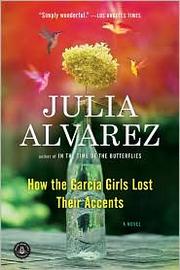
How the García Girls Lost Their Accents is a 1991 novel written by Dominican-American poet, novelist, and essayist Julia Alvarez. Told in reverse chronological order and narrated from shifting perspectives, the story spans more than thirty years in the lives of four sisters, beginning with their adult lives in the United States and ending with their childhood in the Dominican Republic, a country from which their family was forced to flee due to the father's opposition to Rafael Leónidas Trujillo's dictatorship.
The novel's major themes include acculturation and coming of age. It deals with the myriad hardships of immigration, painting a vivid picture of the struggle to assimilate, the sense of displacement, and the confusion of identity suffered by the García family, as they are uprooted from familiarity and forced to begin a new life in New York City. The text consists of fifteen interconnected short stories, each of which focuses on one of the four daughters, and in a few instances, the García family as a whole. Although it is told from alternating perspectives there is particular focus throughout the text on the character of Yolanda, who is said to be both the protagonist and the author's alter ego.
Background and historical context
The years between 1956 and 1970 were a period of oppression and instability in the Dominican Republic as the dictatorship of Rafael Trujillo came to an end with his assassination in 1961, only to be followed by military rule, revolution, intervention by the United States, and further dictatorship. Central control over the military, the economy, and the people meant that only a select few were allowed to leave the island. Critic William Luis describes the situation of immigrants from the Dominican Republic to the United States during the revolution: "The displacement of Caribbean people from their islands to the United States, for political or economical reasons, has produced a tension between the culture of the country of origin and that of the adopted homeland, one representing the past and the other future of the immigrant".
The García family is an example of this phenomenon. In How the García Girls Lost Their Accents, Alvarez succeeds in altering the events of her own life to create fiction. The family is displaced to the United States after living an established, upper-class life in the Dominican Republic, and is forced to face the challenges which come along with being an immigrant family in a foreign land. Julia Alvarez herself was not born in the Dominican Republic, but in the United States. After her parents' failed attempt at a life in America, she returned to the Dominican Republic at the age of three months as her parents preferred the dictatorship of Trujillo to the US. Clearly in the novel, this is not the case, however throughout, the reader witnesses the Garcia family assimilate into American society. Although their Hispanic roots are reflected in their personalities, it is evident that the stories which focus on the four daughters depict many problems that normal North American girls do.
Even though How the García Girls Lost Their Accents was written in the United States, there are significant historical ties between the novel and the author's country of origin. Alvarez wrote an essay entitled "An American Childhood in the Dominican Republic", in which she reveals some information about her own life. This is evidence that it may have served as the basis for the novel. For example, she mentions that it was Mr. Victor, of the US embassy and a member of the Central Intelligence Agency (CIA), who persuaded Carlos García to join the resistance against Trujillo, and later helped him in leaving the country, and obtaining a job with an international cardiovascular team. This is a parallel to the novel in which Carlos Garcia obtains work as a doctor in New York. Julia Alvarez emigrated to the United States at the age of 10 with her parents and three sisters as political refugees from the Dominican Republic. The novel is a variation of her real-life experiences, which have perhaps been slightly altered. The majority of her literature is constructed from multiple viewpoints and a strongly concealed political undercurrent is present in her literature. In this case, that undercurrent is her family fleeing the Trujillo revolution, something she did as a child. The novel encompasses the impact living under a regime can have on a family, and the way it shaped the four girls' upbringing. It is also an attempt to understand memory, the past, and a time before the sisters lost their innocence and accents.
Plot summary
The novel is written episodically and in reverse-chronological order. It consists of fifteen chapters in three parts: Part I (1989–1972), Part II (1970–1960), and Part III (1960–1956). Part I is centered on the adult lives of the García sisters; Part II describes their immigration to the United States and their adolescence, and Part III recollects their early childhood on the island, in the Dominican Republic.
The Garcías are one of the Dominican Republic's prominent and wealthy families, tracing their roots back to the Conquistadores. Carlos García, a physician and the head of the family, is the youngest of 35 children his father sired during his lifetime, both in and out of wedlock. Laura, Carlos's wife, also comes from an important family: her father is a factory owner and a diplomat with the United Nations. Many members of the extended family live as neighbours in large houses on an expansive compound with numerous servants. In the early 1950s the García girls are born. Carla, Sandra, Yolanda and Sofía enjoy a happy, protected childhood and are brought up by their parents, aunts and uncles to preserve the family traditions. Their countless cousins serve them as playmates.
以上文字摘自英文维基百科「How the García Girls Lost Their Accents」(有删节,去掉了参考文献等尾部小节),按 CC BY-SA 4.0 使用,作者为维基百科的各位编者。
资料卡
- 原题
- How the García Girls Lost Their Accents
- 原作语言
- 英语
- 首次出版
- 1991 年
- 作品形式
- 长篇小说
资料卡来自 Wikidata Q16386134(CC0),众包数据,个别字段可能不全。