书单
百科
这个词条暂时没有中文维基百科条目,下面是英文维基百科的内容(英文原文):
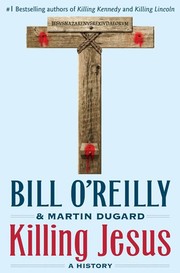
Killing Jesus: A History is a 2013 book by Bill O'Reilly and Martin Dugard about the life and crucifixion of Jesus, referred to in the book as Jesus of Nazareth. It is the follow-up to Killing Kennedy and Killing Lincoln. Killing Jesus was released September 24, 2013, through Henry Holt and Company.
The book was a commercial success, debuting at number one on The New York Times bestseller list and remaining on the list for 52 weeks. Popular reviews of the book were mixed, with both Christian and non-Christian reviewers faulting the book for its tedious writing and its claims of historical objectivity. Scholars and historians have criticized the book for its inaccurate, politically-motivated portrayal of Jesus as a "Tea Party Son of God", its uncritical approach to primary sources, its omission of some of Jesus's teachings, and its oversimplified, sensationalist portrayal of history.
Like both its predecessors, the book was adapted into a television film with the same name for National Geographic Channel.
Writing and research
According to The Washington Times, while writing Killing Jesus, O'Reilly and Dugard found that sources were far less plentiful than for the previous books in their Killing... series. They stated that the Internet was "a treasure", but complained that the information on various websites was "contradictory", that "hearsay was often quoted as truth", and that information from one website was frequently shown to be unreliable when checked against information from more reliable sources. Bill O'Reilly stated that he believes the book was inspired by the Holy Spirit.
Synopsis
The book begins with "A Note to Readers" by Bill O'Reilly, which promises, "...this is not a religious book. We do not address Jesus the Messiah, only as a man who galvanized a remote area of the Roman Empire and made very powerful enemies while preaching a philosophy of peace and love." After a lengthy quotation from the conservative journalist Vermont C. Royster, the introduction concludes: "But the incredible story behind the lethal struggle between good and evil has not been fully told. Until now." The first chapter begins with a novelistic description of the Massacre of the Innocents from Matthew 2 (Matthew 2:16–18). The remaining portion of the chapter focusses on Herod the Great, the king of Judaea, the politics of his reign, the visit of the Magi, and the birth of Jesus. A lengthy footnote at the end of the chapter defends the historical accuracy of the canonical gospels and their traditional attributions to Matthew the Apostle, John Mark, Luke the Evangelist, and John the Apostle.
The second chapter describes the life of the Roman general and dictator Julius Caesar, his conquests, his seduction by the Egyptian Ptolemaic queen Cleopatra, and his eventual assassination. Chapter Three summarizes the aftermath of Caesar's murder, the Battle of Philippi, the Second Triumvirate, Octavian's defeat of Mark Antony and Cleopatra in the Battle of Actium, and Octavian's ascension to the title of emperor. The fourth chapter returns to the life of Jesus, describing his worried parents looking for him after he has gone missing during a trip to Jerusalem for the Passover. It describes some of the politics of Roman Judaea, heavily emphasizing the idea that the Jews were victims of Roman totalitarian oppression. Chapter Five describes the finding in the Temple from Luke 2 (Luke 2:41–52), the architecture of the Temple in Jerusalem, Nazareth, and the government and political background of Galilee.
Chapter Six describes the preaching of John the Baptist, the arrival of Pontius Pilate in Judaea, the baptism of Jesus, and John the Baptist's arrest. Chapter Seven describes the alleged debaucheries of the Roman emperor Tiberius at Capri, described by the Roman historian Seutonius, accepting all of them as historical. Chapter Eight narrates the Cleansing of the Temple from John 2 (John 2:13–16), Jesus's meeting with Nicodemus from John 3 (John 3:1–21), and the beginning of his ministry. Chapter Nine details the calling of the apostles, the Sermon on the Mount, and the anointing of Jesus from Luke 7 (Luke 7:36–50). Following Catholic tradition rather than the gospels, the authors identify the unnamed "sinful woman" in this passage as Mary Magdalene. The chapter concludes with the beheading of John the Baptist. Chapter Ten entails Jesus's conflicts with the Pharisees and Sadducees and concludes with a characterization of Judas Iscariot.
Chapter Eleven describes Pontius Pilate's governance of Judaea and Chapter Twelve Jesus's entry to Jerusalem. In Chapter Thirteen, Jesus cleanses the Temple again and curses the fig tree. In Chapter Fourteen, he goes to the house of Mary and Martha, proclaims the Golden Rule, tells the Pharisees to "Render unto Caesar", weeps over Jerusalem, and predicts his own death. Chapter Fifteen has the betrayal of Judas and Chapter Sixteen has the Last Supper, the Agony in the Garden, and the arrest of Jesus. Chapters Seventeen through Nineteen describe Jesus's trial, crucifixion, and burial. Chapter Twenty-One has the account of the women at the tomb. The "Afterword" describes non-Christian mentions of Jesus, the fates of the Apostles according to Catholic tradition, as well as what happened to Tiberius, Caligula, Caiaphas, Herod Antipas, Jerusalem, and the early Christian movement.
以上文字摘自英文维基百科「Killing Jesus」(有删节,去掉了参考文献等尾部小节),按 CC BY-SA 4.0 使用,作者为维基百科的各位编者。
资料卡
- 首次出版
- 2013 年 9 月 24 日
- 前作
- 刺杀林肯
- 续作
- Killing Patton
- 主题
- 耶稣受难
资料卡来自 Wikidata Q16158846(CC0),众包数据,个别字段可能不全。
改编作品
电影1
- 《杀死耶稣》Killing Jesus
名单来自 Wikidata(CC0):只列条目里写明「改编自 / 取材于」这本书的作品,不按名字猜;众包数据,可能不全。