 书单
百科
这个词条暂时没有中文维基百科条目,下面是英文维基百科的内容(英文原文):
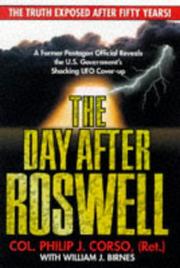
The Day After Roswell is a memoir that claims the U.S. government made use of extraterrestrial technology it recovered from the 1947 Roswell incident. It was ghostwritten by William J. Birnes and credited to Philip J. Corso. Published as Corso's tell-all autobiography by Pocket Books in 1997, the book spent three weeks on the New York Times bestseller list and received mixed reviews. Analysts have noted a large number of errors about basic, known facts in the text, as well as chronologically impossible feats the book attributes to Corso. The book has been alleged to be a hoax.
Background
At the time of publication, Philip J. Corso was a former United States Army intelligence officer who had briefly served as deputy chief of the Foreign Technology Division. Corso was born in California, Pennsylvania and was conscripted into the U.S. Army, but received a commission in 1942. In 1963, after holding the rank of lieutenant colonel for 10 years without further promotion and owning a heavily mortgaged home, he resigned to accept a job as a staff assistant to United States Senator Strom Thurmond. He later held a similar post with United States Representative Michael A. Feighan, who recommended him for a job as a professional committee staff member. His hiring was blocked by Rep. Emanuel Celler due to allegations published by Drew Pearson and Jack Anderson in the Washington Post that, according to Corso's own summary of the article in a later libel lawsuit, he was "guilty of misconduct in both military and civilian life, incompetency, unreliability, untruthfulness, and other odious personal traits". Corso's libel lawsuit against Pearson and Anderson was ultimately dismissed due to evolving defamation standards resulting from the contemporaneous U.S. Supreme Court decision in New York Times v. Sullivan. In the 1970s he again worked for Thurmond for a few years.
The Day After Roswell was ghostwritten by William J. Birnes — later editor of UFO Magazine and author of The Star Trek Cookbook — and credited to Corso. According to Birnes, he spent two years working on the book with Corso. Birnes also said they had initially wanted to do a memoir based on his military experiences, but when Corso referenced UFOs during their conversations, Birnes found what he said on that topic "compelling enough for its own book".
The book was publicized in interviews by Corso, including on Dateline NBC on June 24, 1997. The Dateline segment noted in its reporting that it was airing the same day the US Air Force released "The Roswell Report: Case Closed".
Synopsis
The Day After Roswell sets-out Corso's claims that the U.S. Government recovered an alien spaceship from the Roswell incident debris in 1947, and reverse engineered its technology for corporate and military use, matters which it kept secret and which Corso himself led. The book also puts forth Corso's claim to have seen the body of an extraterrestrial in a shipping crate at Fort Riley, Kansas in 1947, and recounts several other alleged exploits and adventures of Corso.
Reception
The Day After Roswell appeared on The New York Times Best Seller List for three weeks, peaking at number twelve.
It received mixed reviews. The Baltimore Sun referred to the book as "disturbing" while The Financial Post's review was titled "Book Reads Like Unidentified Lying Object." Writing for the Dayton Daily News, James Cummings opined "the believers will believe him, the skeptics will dismiss him, and the publishers will come out with a new series of books discussing him".
Karl T. Pflock — who met Corso in 1993 and was left with the impression that he was a "blowhard loony tune" — claimed that many persons who followed the subject of UFOs thought The Day After Roswell "is from far out of left field".
In 2001, The Guardian named The Day After Roswell to its list of "Top 10 literary hoaxes".
Controversies
When it was released, the book contained a foreword written by Strom Thurmond. Thurmond wrote, "He has many interesting stories to share with individuals interested in military history, espionage and the workings of our Government." The foreword did not mention anything about UFOs, since Thurmond had assumed the book was a straightforward memoir. When he learned about the book's contents, Thurmond stated, "I know of no such 'cover-up,' and do not believe one existed."
In 2011, the UK's National Archives declassified several decades worth of government files on the subject of UFOs, included in which was a 1997 internal memo dismissing the claims in The Day After Roswell due to Corso having a "previous track record of unreliable testimony".
Errors, omissions, and improbabilities
Analysts have identified numerous errors and omissions of basic, known facts described in The Day After Roswell, as well as feats attributed to Corso that are chronologically impossible.
Philip J. Klass challenged several claims made in the book as factually unbelievable, such as Corso's assertion that he was put in charge of alien wreckage from Roswell despite not even having "a bachelor's degree in science or engineering", Klass noting there were "many very competent scientists with Top Secret clearances then employed in Army research and development laboratories". Klass also identified several errors in the text, such as its misidentification of the 8th Air Force headquarters as being at Fort Bliss and not Fort Worth Army Air Field; its misdating of Walter Haut's Roswell crash press release; and its erroneous description of the MIM-23 Hawk as "heat-seeking" when it is, in fact, radar-guided.
以上文字摘自英文维基百科「The Day After Roswell」(有删节,去掉了参考文献等尾部小节),按 CC BY-SA 4.0 使用,作者为维基百科的各位编者。
资料卡
- 原题
- The Day After Roswell
- 原作语言
- 英语
- 首次出版
- 1997 年
- 首版出版社
- 口袋书店
- 主题
- 罗斯威尔飞碟坠毁事件、外星生命
资料卡来自 Wikidata Q7729150(CC0),众包数据,个别字段可能不全。