书单
百科
这个词条暂时没有中文维基百科条目,下面是英文维基百科的内容(英文原文):
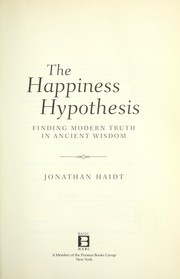
The Happiness Hypothesis: Finding Modern Truth in Ancient Wisdom is a 2006 book written by American social psychologist Jonathan Haidt. In it, Haidt poses several "Great Ideas" on happiness espoused by thinkers of the past—such as Plato, Buddha and Jesus—and examines them in the light of contemporary psychological research, extracting from them any lessons that still apply to our modern lives. Central to the book are the concepts of virtue, happiness, fulfillment, and meaning.
Summary of chapters
The introduction first explains that the author's goal is to reduce the infinite 'wisdom' accessible to modern people into 10 great ideas, one per chapter. The remainder of the Introduction provides a concise preview of those ten chapters as follows.
The first chapter describes how each person has two parts: the primitive part, which includes our basic instincts; and the highly evolved part, which tries to control the instincts. This effort to control our instincts is shown in chapter two to tend to cause us too much worry, but various techniques, such as meditation, might be employed to detach the worrier from his worries. The third chapter goes to the relationship of the individual to other individuals by beginning with the Golden Rule of doing unto others as you would have them do unto you. This leads in the fourth chapter to a description of the tendency that people have of seeing faults in others more readily than in themselves, which by simply realizing we might go to some length to rectify and thus come closer to living by the Golden Rule.
By the fifth chapter, at the halfway point of the book, Haidt introduces the notion of the Happiness Hypothesis. The Happiness Hypothesis could be that happiness comes from within, as Buddha said, or could be that happiness comes from outside. Haidt argues in Chapter Six that the truth might lie between the two extremes and contends that love depends on more than the self and is crucial to happiness. The seventh chapter asks whether adversity is essential to happiness and provides a nuanced answer which is that it depends on your stage in life. Achieving happiness is a complex process which includes acting virtuously, and Haidt claims in chapter eight that behaving virtuously means to do as Aristotle said and to develop your strengths and realize your native potential. Chapter nine extends the idea that a person's happiness benefits from living virtuously by noting that some feeling of divinity helps where divinity comes through a life-long practice of moral actions. Chapter ten takes this idea of a life-long practice yet further and contends that a happy life is one where you get the relationships right between yourself and others, yourself and your work, and between your work and something larger than yourself—you feel a sense of purpose.
Ch.1: The divided self
Haidt looks at a number of ways of dividing the self that have existed since ancient times:
mind vs. body left brain vs. right brain (lateralisation of brain function)
old brain vs. new brain (frontal cortex)
controlled vs. automatic
Haidt focuses on this last division, between the conscious/reasoned processes and automatic/implicit processes. His metaphor is a rider on the back of an elephant in which the conscious mind is the rider and the unconscious mind is the elephant. The rider is unable to control the elephant by force: this explains many puzzles about our mental life, particularly why we have such trouble with weakness of will. Learning how to train the elephant is the secret of self-improvement.
Ch.2: Changing your mind
The automatic emotional reactions of the "elephant" (affective priming) guide us throughout our lives. People even tend to choose mates, and professions, whose names resemble their own. Though there is a bias towards negativity, some people are optimists and others pessimists. Haidt discusses three ways of changing those automatic reactions: (1) meditation, (2) cognitive therapy, and (3) SSRI medications such as Prozac.
Ch.3: Reciprocity with a vengeance
Many species have a social life, but among mammals, only humans in particular are ultra-social—able to live in very large cooperative groups. The Golden Rule, supplemented with gossip, is the secret of our success. Calling on Robert Cialdini's "six weapons of influence," Haidt describes ways in which understanding the deep workings of reciprocity can help to solve problems in our social lives and guard against the many ways that we can be manipulated.
Ch.4: The faults of others
Part of our ultra-sociality is that we are constantly trying to manipulate others' perceptions of ourselves, without realizing that we are doing so.
Haidt looks at what social psychology has to say about this, beginning with the work of Daniel Batson on cheating and self-justification, mentioning Robert Wright's description of our "constitutional ignorance" of hypocrisy in The Moral Animal, and moving on to work by Deanna Kuhn and David Perkins on confirmation bias and Roy Baumeister's work on "The Myth of Pure Evil." Haidt then discusses ways of taking off "the moral glasses" and seeing the world as it really is.
Ch.5: The pursuit of happiness
It is a common idea that happiness comes from within and can't be found in external things. For a while in the 1990s, psychologists agreed with ancient sages (such as Buddha and Epictetus) that external conditions are not what matter. However, Haidt argues that we now know that some external circumstances do matter. He identifies ways of improving happiness by altering these, including being smart with money, and argues that the Western emphasis on action and striving has merit.
Ch.6: Love and attachments
There are many kinds of love, but, Haidt asserts, they all begin to make sense when you see where love comes from, and what it does. To do this he examines John Bowlby's World Health Organization-sponsored study and report, "Maternal Care and Mental Health" in 1950, and the subsequent work with monkeys by Harry Harlow. Understanding the different kinds of love, he writes, can help explain why people make so many mistakes with love, and why philosophers hate love and give us bad advice about it.
以上文字摘自英文维基百科「The Happiness Hypothesis」(有删节,去掉了参考文献等尾部小节),按 CC BY-SA 4.0 使用,作者为维基百科的各位编者。
资料卡
- 原题
- The Happiness Hypothesis
- 原作语言
- 英语
- 首次出版
- 2006 年
- 首版出版社
- 基础书籍出版社
- 页数
- 320
资料卡来自 Wikidata Q7738790(CC0),众包数据,个别字段可能不全。