书单
百科
这个词条暂时没有中文维基百科条目,下面是英文维基百科的内容(英文原文):
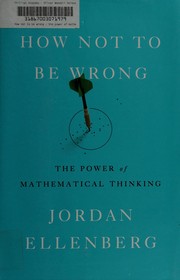
How Not to Be Wrong: The Power of Mathematical Thinking, written by Jordan Ellenberg, is a New York Times Bestselling book that connects various economic and societal philosophies with basic mathematics and statistical principles.
Summary
How Not to Be Wrong explains the mathematics behind some of simplest day-to-day thinking. It then goes into more complex decisions people make. For example, Ellenberg explains many misconceptions about lotteries and whether or not they can be mathematically beaten.
Ellenberg uses mathematics to examine real-world issues ranging from the loving of straight lines in the reporting of obesity to the game theory of missing flights, from the relevance to digestion of regression to the mean to the counter-intuitive Berkson's paradox.
Chapter summaries
Part 1: Linearity
Chapter 1, Less Like Sweden: Ellenberg encourages his readers to think nonlinearly, and know that "where you should go depends on where you are". To develop his thought, he relates this to Voodoo economics and the Laffer curve of taxation. Although there are few numbers in this chapter, the point is that the overall concept still ties back to mathematical thinking.
Chapter 2, Straight Locally, Curved Globally: This chapter puts an emphasis on recognizing that "not every curve is a straight line", and makes reference to multiple mathematical concepts including the Pythagorean theorem, the derivation of Pi, Zeno's paradox, and non-standard analysis.
Chapter 3, Everyone is Obese: Here, Ellenberg dissects some common statistics about Obesity trends in the United States. He ties it into linear regression, and points out basic contradictions made by the original arguments presented. He uses many examples, including the correlation between SAT scores and tuition rates, as well as the trajectory of missiles, to advise caution when using linear regression.
Chapter 4, How Many Is That In Dead Americans: Ellenberg analyzes statistics about the number of casualties around the world in different countries resulting from war. He notes that although proportion in these cases matters, it doesn't always necessarily make sense when relating them to American deaths. He uses examples of deaths due to brain cancer, the Binomial Theorem, and voting polls to reinforce his point.
Chapter 5, More Pie Than Plate: This chapter goes in depth with number percentages relating to employment rates, and references political allegations. He emphasizes that "actual numbers in these cases aren't important, but knowing what to divide by what is mathematics in its truest form", noting that mathematics in itself is in everything. He warns about how percentages can be misleading if it's not clear that they can go below 0% or above 100%.
Part 2: Inference
Chapter 6, The Baltimore Stockbroker and the Bible Code: Ellenberg tries to get across that mathematics is in every single thing that we do. To support this, he uses examples about hidden codes in the Torah determined by Equidistant Letter Sequence, a stockbroker parable, noting that "improbable things happen", and wiggle room attributes to that.
Chapter 7, Dead Fish Don't Read Minds: This chapter touches on a lot of things. The basis for this chapter are stories about a dead salmon's MRI, trial and error in algebra, birth control statistics, alliteration in Shakespeare, and basketball statistics (the "hot hand"). Additionally, he writes of a few other mathematical concepts, including the Null hypothesis and the Quartic function. He explains how underpowered statistical studies can lead to misleading results, especially when the result given by the null hypothesis is close to the result gotten by rejecting it.
Chapter 8, Reductio Ad Unlikely: This chapter focuses on the works and theorems/concepts of many famous mathematicians and philosophers. These include but aren't limited to the reductio ad absurdum method, a look into the constellation Taurus by John Mitchell, and Yitang "Tom" Zhang's "bounded gaps" proof. He also delves into explaining rational numbers, the prime number theorem, and makes up his own word, "flogarithms".
Chapter 9, The International Journal of Haruspicy: Ellenberg relates the practice of haruspicy, genes that affect schizophrenia, and the accuracy of published papers as well as other things to the "p-value" or statistical significance. He talks about p-hacking, which can arise when using a hard rule like "p<0.05," and how confidence intervals can help solve this problem. He also notes at the end that Jerzy Neyman and Egon Pearson claimed that statistics is about doing, not interpreting, and that R. A. Fisher believed scientists should not have a "fixed level of significance at which from year to year, and in all circumstances, he rejects hypotheses; he rather gives his mind to each particular case in the light of his evidence and his ideas".
Chapter 10, Are You There, God? It's Me, Bayesian Inference: This chapter relates algorithms to things ranging from God, to Netflix movie recommendations, and to terrorism on Facebook. Ellenberg goes through quite a few mathematical concepts in this chapter, which include conditional probabilities relating back to "p-value", posterior possibilities, Bayesian inference, and Bayes theorem as they correlate to radio psychics and probability. Additionally, he uses contingency tables and other methods to explore the probability of God's existence.
Part 3: Expectation
Chapter 11, What to Expect When You're Expecting to Win the Lottery: This chapter discusses the different probabilities of winning the lottery and expected value as it relates to lottery tickets, including the story of how MIT students managed to "win" the lottery every time in their town. Ellenberg also talks about the law of large numbers again, as well as introducing the Additivity of expected value and the games of Franc-Carreau or the "needle/noodle problem".
以上文字摘自英文维基百科「How Not to Be Wrong」(有删节,去掉了参考文献等尾部小节),按 CC BY-SA 4.0 使用,作者为维基百科的各位编者。
资料卡
- 原题
- How Not to Be Wrong
- 原作语言
- 英语
- 首次出版
- 2014 年
- 体裁
- 非虚构文学
- 首版出版社
- 企鹅出版
资料卡来自 Wikidata Q26966309(CC0),众包数据,个别字段可能不全。