书单
百科
这个词条暂时没有中文维基百科条目,下面是英文维基百科的内容(英文原文):
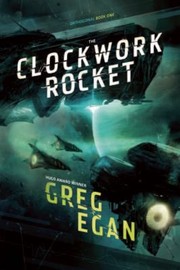
The Clockwork Rocket is a hard science-fiction novel by Australian author Greg Egan and the first part of the Orthogonal trilogy. The novel was published by Night Shade Books on 1 July 2011 with a cover art by Cody Tilson and by Gollancz on 15 September 2011 with a cover art by Greg Egan.
The novel describes an alien civilization being threatened by the appearance of hurtling meteors (which experience a totally different direction as time) entering their planetary system with an unprecedented speed and the implementation of an unusual plan: All the technology needed for an effective defense shall be developed on board of a generation ship launched into the void while only a few years pass back on the home world in the meantime due to time dilation. This is possible due to different laws for space and time in this universe, in which they have the same signature instead of different ones (meaning the sign of the signature for time is inverted), or which is alternatively described by a Riemannian instead of a Lorentzian manifold.
The consequences on some of the physical concepts needed in the novel including time dilation and radiation, are described by Greg Egan with diagrams in the novel and also his website. The story is continued in The Eternal Flame and The Arrows of Time.
Plot
When Yalda is three years old, she accompanies her grandfather Dario into the forest to convalesce, but he instead passes away. The following spring, she sees a shooting star in the sky. When Yalda is twelve years old, she joins school and learns about the basic laws of physics, including those of light, leading her to realize that space and time are exactly the same. The following summer, she observes multiple shooting stars hurtling across the sky. When Yalda has reached adulthood and embarked a career as a physicist, she begins to study light and in particular the strange phenomenon now known as the Hurtlers, which all enter the planetary system from the same spatial direction, but at different times. Yalda theorizes, that the roles are reversed for the Hurtlers, meaning for them an entire cluster spread over space arrives at the same time, hence the direction of time of this cluster and their own are orthogonal to each other. Now their home world is threatened by the arrival of the Hurtlers and might face complete destruction by an impending collision.
An unusual reaction to this crisis is brought up by Eusebio, a student of Yalda. Developing the technology necessary will take too much time, therefore a generation ship must be sent into the void to exploit relativistic effects to find the time elsewhere. While accelerating, deaccelerating as well as turning the ship around, time will pass on the home world. But the journey aligned with the orthogonal cluster and the velocity of the Hurtlers and as long as needed will be witnessed as being along a purely spatial dimension from the home world, hence in an orthogonal direction. Yalda remarks that the largest rockets build yet have a lot smaller size. Eusebio had taken this into account: Since the nearby Mount Peerless is made out of very hard sunstone, it can be turned into the rocket needed. The plan then includes blasting the whole mountain into the sky.
Eusebio conducts the first experiments of sending sunstone off their world on Mount Peerless and finally succeeds by launching a piece into orbit around their sun. Yalda receives a letter of her sister Lucia meanwhile, in which she informs her of changes on the farm and her decision of becoming a mother, resulting in the end of her own life due to their way of reproduction. Yalda and Eusebio travel around different cities to gather endorsement for their plan. Yalda meets Benedetta, with whom she has a conversation about that the course of the rocket points into its own past, which allows for the conclusion of determinism in their universe. The question arises, if their already predetermined actions are then even relevant at all. Yalda can convince Benedetta, who then decides to be the first passenger. At night, Yalda and Eusebio witness the destruction of the twin planets Gemma and Gemmo in their own system by one of the Hurtlers. This catastrophic event causes massive endorsement for their plan and the preparation of Mount Peerless begins.
Five years later, the work is almost done, but the Peerless still lacks a proper crew due to safety concerns or the restricted quality of life on board. Even for many working on the rocket, just waiting for four years on the home world for its return with incredibly advanced technology is the preferred option. Benedetta has send out space probes, which have examined the Hurtlers and determined their direction of time, which turns out to not be perfectly orthogonal to that of their home world. Luckily, the Peerless will first travel into the future of the orthogonal cluster, pushing certain problems with causality to the return journey into its past. Benedetta then plans to test a rocket made out of sunstone herself to persuade the workers of its safety, but instead dies pointlessly during the test. Eusebio tells Yalda, that he won't join the journey and stay behind on the home world to fight for launching another generation ship in case the Peerless will fail and won't return in four years.
以上文字摘自英文维基百科「The Clockwork Rocket」(有删节,去掉了参考文献等尾部小节),按 CC BY-SA 4.0 使用,作者为维基百科的各位编者。
资料卡
- 原题
- The Clockwork Rocket
- 原作语言
- 英语
- 首次出版
- 2011 年 7 月
- 作品形式
- 长篇小说
- 体裁
- 科学幻想
- 所属系列
- Orthogonal
资料卡来自 Wikidata Q44391460(CC0),众包数据,个别字段可能不全。