 书单
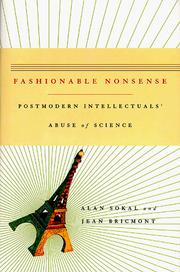
时髦的胡说:后现代知识分子对科学的糟蹋 (1997)
百科
这个词条暂时没有中文维基百科条目,下面是英文维基百科的内容(英文原文):
Fashionable Nonsense: Postmodern Intellectuals' Abuse of Science (UK: Intellectual Impostures), first published in French in 1997 as Impostures intellectuelles, is a book by physicists Alan Sokal and Jean Bricmont. As part of the so-called science wars, Sokal and Bricmont criticize postmodernism in academia for the misuse of scientific and mathematical concepts in postmodern writing.
The book was published in English in 1998, with revisions to the original French edition for greater relevance to debates in the English-speaking world. According to some reports, the response within the humanities was "polarized"; critics of Sokal and Bricmont charged that they lacked understanding of the writing they were scrutinizing. By contrast, responses from the scientific community were more supportive.
Similar to the subject matter of the book, Sokal is best known for his eponymous 1996 hoaxing affair, whereby he was able to get published a deliberately absurd article that he submitted to Social Text, a critical theory journal. The article itself is included in Fashionable Nonsense as an appendix.
Summary
Fashionable Nonsense examines two related topics:
the allegedly incompetent and pretentious usage of scientific concepts by a small group of influential philosophers and intellectuals; and the problems of cognitive relativism—the idea that "modern science is nothing more than a 'myth', a 'narration' or a 'social construction' among many others"—as found in the Strong programme in the sociology of science.
Incorrect use of scientific concepts versus scientific metaphors
The stated goal of the book is not to attack "philosophy, the humanities or the social sciences in general", but rather "to warn those who work in them (especially students) against some manifest cases of charlatanism." In particular, the authors aim to "deconstruct" the notion that some books and writers are difficult because they deal with profound and complicated ideas: "If the texts seem incomprehensible, it is for the excellent reason that they mean precisely nothing."
Set out to show how numerous key intellectuals have used concepts from the physical sciences and mathematics incorrectly, the authors intentionally provide considerably lengthy extracts in order to avoid accusations of taking sentences out of context. Such extracts pull from such works as those of Jacques Lacan, Julia Kristeva, Paul Virilio, Gilles Deleuze, Félix Guattari, Luce Irigaray, Bruno Latour, and Jean Baudrillard, who—in terms of the quantity of published works, invited presentations, and of citations received—were some of the leading academics of continental philosophy, critical theory, psychoanalysis, and/or the social sciences at the time of publication.
The book provides a chapter to each of the above-mentioned authors, "the tip of the iceberg" of a group of intellectual practices that can be described as "mystification, deliberately obscure language, confused thinking and the misuse of scientific concepts." For example, Irigaray is criticised for asserting that E=mc2 is a "sexed equation" because "it privileges the speed of light over other speeds that are vitally necessary to us"; and for asserting that fluid mechanics is unfairly neglected because it deals with "feminine" fluids in contrast to "masculine" rigid mechanics. Similarly, Lacan is criticized for drawing an analogy between topology and mental illness that, in Sokal and Bricmont's view, is unsupported by any argument and is "not just false: it is gibberish."
In a chapter excluded from the English translation, the authors attack Henri Bergson in the context of his debate with Einstein over the theory of relativity, placing the "historical origin" of the science wars in this dispute.
Sokal and Bricmont claim that they do not intend to analyze postmodernist thought in general. Rather, they aim to draw attention to the abuse of concepts from mathematics and physics, their areas of specialty. The authors define this abuse as any of the following behaviors:
Using scientific or pseudoscientific terminology without bothering much about technical meanings.
Importing concepts from the natural sciences into the humanities without justification for their use.
Displaying superficial erudition by using technical terms where they are irrelevant, presumably to impress and intimidate non-specialist readers.
Manipulating meaningless words and phrases.
Self-assurance on topics far beyond the competence of the author and exploiting the prestige of science to give discourses a veneer of rigor.
The postmodernist conception of science
Sokal and Bricmont highlight the rising tide of what they call cognitive relativism, the belief that there are no objective truths but only local beliefs. They argue that this view is held by a number of people, including people who the authors label "postmodernists" and the Strong programme in the sociology of science, and that it is illogical, impractical, and dangerous. Their aim is "not to criticize the left, but to help defend it from a trendy segment of itself." Quoting Michael Albert, [T]here is nothing truthful, wise, humane, or strategic about confusing hostility to injustice and oppression, which is leftist, with hostility to science and rationality, which is nonsense.
Reception
According to New York Review of Books editor Barbara Epstein, who was delighted by Sokal's hoax, the response to the book within the humanities was bitterly divided, with some delighted and some enraged; in some reading groups, reaction was polarized between impassioned supporters and equally impassioned opponents of Sokal.
Support
Philosopher Thomas Nagel has supported Sokal and Bricmont, describing their book as consisting largely of "extensive quotations of scientific gibberish from name-brand French intellectuals, together with eerily patient explanations of why it is gibberish," and agreeing that "there does seem to be something about the Parisian scene that is particularly hospitable to reckless verbosity."
以上文字摘自英文维基百科「Fashionable Nonsense」(有删节,去掉了参考文献等尾部小节),按 CC BY-SA 4.0 使用,作者为维基百科的各位编者。
资料卡
- 原题
- Impostures Intellectuelles
- 原作语言
- 法语、英语
- 首次出版
- 1997 年
- 体裁
- 科学哲学、批评
- 续作
- Beyond the Hoax
- 主题
- 哲学
资料卡来自 Wikidata Q2633985(CC0),众包数据,个别字段可能不全。