 书单
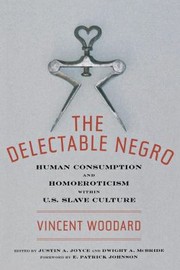
The Delectable Negro: Human Consumption and Homoeroticism within U.S. Slave Culture (2014)
- 作者
- Vincent Woodard
- 首版
- 2014 年
- Open Library
- 4 个版本
百科
这个词条暂时没有中文维基百科条目,下面是英文维基百科的内容(英文原文):
The Delectable Negro: Human Consumption and Homoeroticism within U.S. Slave Culture is a 2014 book by Vincent Woodard. The book explores the homoeroticism of both literal and figurative acts of human cannibalism that occurred during slavery in the United States.
Woodard examines the sexual nature of documented instances of flesh-eating and details the various manners of consumption whereby Black Americans were metaphorically or actually eaten. In the book, Woodard defines consumption as a range of parasitic practices, including institutionalized hunger, seasoning rituals, and sexual modes of consumption.
The Delectable Negro draws on Works Progress Administration interviews, advertisements for runaway slaves, and slave narratives. The book includes textual analyses of the works of Harriet Jacobs and Frederick Douglass as well as an examination of the treatment of Nat Turner, whose flesh was turned into "medicinal" grease.
Woodard died in 2008 and never saw The Delectable Negro published. It won the 2015 Lambda Literary Award for LGBT Studies.
Overview
The Delectable Negro explores the homoeroticism of literal and metaphorical acts of human cannibalism coincident with slavery in the United States. Woodard writes that the consumption of Black men by White male enslavers was a "natural by-product of their physical, emotional, and spiritual hunger" for the Black man. Woodard argues that homoeroticism was also part of how Black Americans experienced their own consumption and not an unidirectional phenomenon, as it "emanated from black men toward White men and toward each other."
The book approaches the concept of consumption literally with documented cases of cannibalism and figuratively as a spiritual and societal phenomenon. Woodard defines consumption as a spectrum of practices, including sexual modes of consumption, flesh-seasoning rituals, institutionalized hunger, and soul harvesting. Woodard argues that cultural aspects of U.S. plantations were "based in parasitism and a dynamic of human consumption," building on Orlando Patterson's notion of slavery as a parasitic institution in Slavery and Social Death: A Comparative Study. Woodard identifies practices such as the systemic starvation of enslaved people as parasitic relationships that use Black bodies to fuel the construction of Whiteness.
Contents
Woodard draws on various critical methodologies and texts, including Works Progress Administration interviews, advertisements for runaways, and slave narratives. He writes that when Black Americans described instances of cannibalism, they "tried to understand why and how they had become so delectable, so erotically appetizing, to a nation and White populace that, at least rhetorically, denied and despised their humanity."
Woodard begins The Delectable Negro at the intersection of the transatlantic slave trade and the consumptive appetites of White people. While White cannibalism was widely reported in accounts of enslaved Africans from the 16th century up through the 19th, previous scholarship largely dismissed the accounts as superstition or "unfounded indigenous terrors." Woodard validates Black accounts, offering evidence of punishment rituals, including an instance of a slaveholder forcing enslaved people to eat the broiled ear of a member of their community. Woodard writes how in the autobiography The Interesting Narrative of the Life of Olaudah Equiano, Equiano's recurring fears of being cannibalized by the Europeans who captured him were intertwined with his homoerotic attachments to White men.
Woodard then examines a series of historical incidents where the enslavers' culture of honor is bolstered by the consumption and sexualized brutalization of enslaved people.
The third and fourth chapters of The Delectable Negro include close textual analyses of the works of Frederick Douglass and Harriet Jacobs. Woodard writes that Douglass described slavery "more than anyone else has, as a cannibalistic institution" and suggests that Douglass may have been raped while he was enslaved. Turning his focus to Jacobs' Incidents in the Life of a Slave Girl, Woodard argues for a "more fluid conception of gender and black consumption." He offers an original interpretation of Jacobs' character of Luke, arguing that the variance and fluidity of Luke's desires and gender enables him "to survive within a culture of consumption." Woodard also explores White women's roles inside "economies of power, sexuality, and gender consumption."
The final chapters of The Delectable Negro trace the notions of consumption to the modern era. Woodard approaches the historical figure of Nat Turner, whose flesh was rendered into "medicinal" grease, through William Styron's fictionalized 1967 novel The Confessions of Nat Turner. Woodard addresses Black intellectual critiques of the book and James Baldwin's defense of it. He links the heteronormativity and anxiety around homoeroticism evident within 1960s Black radical movements to the legacy of the rape of Black men during slavery.
Woodard locates the Black male interior as a site of hunger and violation. In describing the "suppressed history and politics of the black, male orifice," Woodard writes how the mouth and anus should be decoupled from sexual practice and instead be used to theorize Black interiority. The Delectable Negro reviews 20th-century representations of the Black male erotic interior, including the chain gang oral sex scene from Toni Morrison's novel Beloved. Woodard also outlines a genealogy of the uses of Black people as figures for a "politics of interiority."
以上文字摘自英文维基百科「The Delectable Negro」(有删节,去掉了参考文献等尾部小节),按 CC BY-SA 4.0 使用,作者为维基百科的各位编者。
资料卡
- 原题
- The Delectable Negro: Human Consumption and Homoeroticism within U.S. Slave Culture
- 原作语言
- 英语
- 首次出版
- 2014 年 6 月 27 日
- 首版出版社
- 纽约大学出版社
- 主题
- 美国奴隶制度、食人、同性性欲
- 获奖
- 拉姆达文学奖(2015)
资料卡来自 Wikidata Q98119441(CC0),众包数据,个别字段可能不全。