 书单
百科
这个词条暂时没有中文维基百科条目,下面是英文维基百科的内容(英文原文):
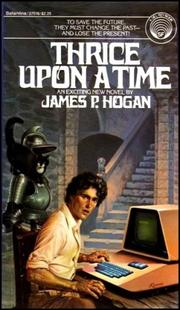
Thrice Upon A Time is a science fiction novel by British writer James P. Hogan, first published in 1980. Unlike most other time travel stories, Thrice Upon A Time considers the ramifications of sending messages into the past and/or receiving messages from the future, rather than the sending of physical objects through time.
Plot summary
In December 2009, Murdoch Ross and his friend Lee Francis Walker visit Murdoch's grandfather, Sir Charles Ross, in his castle in Storbannon, Scotland. Sir Charles is a Nobel Prize winner for his work in particle physics — more specifically the isolation of free quarks.
In this novel, when a nucleon decays into three quarks, the first two quarks appear immediately and the third quark appears on the order of a few millionths of an yoctosecond later. A widely accepted theory is that the original decay produces two quarks and also a third unknown particle, dubbed the "quason". This is subsequently transformed into a third quark.
Sir Charles offers a different and radical explanation: all three of the quarks are created at once, but the first two are "propagated back in time". Charles dubs the energy which had allowed the propagation through time as "tau waves". Although his theory is seemingly valid and consistent, the physicists of his time refuse to accept it because of its implications — namely the failure of some of the physical laws of conservation. Sir Charles then retreats to his family's castle in Scotland to continue his research in private. There, he succeeds in building a time machine capable of sending messages to the future and the past.
When the two young men arrive, Sir Charles takes them down into the basement, where the machine is found. As they enter the basement, a computer attached to the machine produces data on a sheet of paper, which Sir Charles hides from the other men. He asks Murdoch to type in a six-character random message into the computer. Sir Charles next activates his machine and transmits the message one minute back in time. Finally, he shows the paper printed out previously, and Murdoch and Lee are amazed: the printout contained exactly the same random characters that Murdoch typed, and these were printed before Murdoch had typed them in.
After Murdoch and Lee have gotten over their initial amazement, they decide to experiment with the machine. Murdoch tries to fool the machine into creating a causality paradox, by deliberately receiving a message from the future, and not sending the message back at the due time. Suddenly, the entire system turns bizarre, and they are flooded with messages from all over the ten-minute range of the machine. Then they abruptly turn off the machine and leave.
While outside, Murdoch and Lee talk about the implications of the machine's existence and how the space-time continuum could allow for time travel without introducing a paradox. They formulate theories similar to the many-worlds interpretation, finally deciding that none of the theories they discuss fit their previous observations.
The next day, Ted Cartland, a friend of Charles and a former Royal Air Force officer, arrives to examine the machine he had helped build. They repeat the experiment, and Ted is bewildered as well. Ted, however, has a trick up his sleeve. He writes a computer program to do what Murdoch had done the day before, to remove the human element from the experiment.
The machine picks up an unexpected message, telling the experimenters that a glass jar had been broken. True enough, Lee was on the verge of accidentally pushing a jar off a shelf. However, they are unable to contact their future selves with the broken jar, since they apparently no longer exist. Sir Charles decides that upon sending the message back, the copies of themselves in the future had changed their past and thus had been erased from existence. The altered timeline, with its unbroken jar, overwrote the old one rather like recording over an old TV program on a videotape. Thus causality had been preserved. The fear of being erased chills them, and so they quickly disable the machine again.
As time goes by, they establish an experimental protocol, and they set up automated tests to gain more information about the physics behind the machine. The machine is upgraded to allow for more data throughput and a time range of about 24 hours. Murdoch also meets a young woman named Anne Patterson when she trips over Sir Charles's kitten while she was out shopping in Kingussie.
They immediately fall in love. It turns out later that she is a physicist at the site of the new fusion reactor in Burghead. Elizabeth Muir, another close friend of Sir Charles, works there as well, and he invites her to his castle to investigate the peculiar machine.
Burghead and black holes
The (fictional) European Fusion Consortium (EFC) has commissioned a large thermonuclear fusion reactor in Burghead to compete with the technologies located in the United States and the Soviet Union. The colossal energy obtained from fusion meant that huge amounts of power might someday be available at low costs. All three parties used inertial confinement technology, with the EFC opting to use ion beams.
During this time, Murdoch and Lee get to tour the large Burghead facility through Elizabeth, who is a principal physicist there, and Murdoch builds a relationship with Anne. One day, while still in the testing phases of power production, the reactor is shut down when apparent erosion is detected in the fusion chamber. Two days before, the team at Storbannon had experienced an apparent failure in its time machine, with Lee asserting that the failure had to be due to interference.
Their time machine then suddenly resumes operation again, and they elect to ignore the problem. Shortly after the incident, strange events start occurring around the world, with so-called bugophants (a blend of bug and elephant) drilling tiny, long, straight holes through a myriad of objects, from human bodies to telescope mirrors.
以上文字摘自英文维基百科「Thrice Upon a Time」(有删节,去掉了参考文献等尾部小节),按 CC BY-SA 4.0 使用,作者为维基百科的各位编者。
资料卡
- 原题
- Thrice Upon a Time
- 原作语言
- 英语
- 首次出版
- 1980 年 3 月
- 作品形式
- 长篇小说
- 体裁
- 硬科幻、科学幻想
- 首版出版社
- 巴兰坦
- 主题
- 时间旅行
资料卡来自 Wikidata Q7798123(CC0),众包数据,个别字段可能不全。