书单
百科
这个词条暂时没有中文维基百科条目,下面是英文维基百科的内容(英文原文):
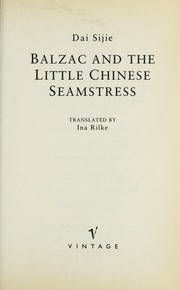
Balzac and the Little Chinese Seamstress (French: Balzac et la petite tailleuse chinoise) is a semi-autobiographical novella written by Dai Sijie, and published in 2000 in French and in English in 2001. It has been translated into more than 25 languages. A film based on his novel directed by Dai was released in 2002.
Plot summary
The novel, written by Dai Sijie, is about two teenage boys during the Chinese Cultural Revolution, Luo, described as having "a genius for storytelling", and the unnamed narrator, "a fine musician". They are assigned to re-education through labor and are sent to a mountain called "Phoenix of the Sky" near Tibet to work in the coal mines and with the rice crop, because their doctor parents have been declared enemies of the state by the government. The two boys fall in love with the Little Seamstress, the daughter of the local tailor and "the region's reigning beauty". Residents of the small farming village are delighted by the stories the two teenagers retell from classic literature and movies that they have seen. They are even excused from work for a few days to see The Flower Girl at a nearby town and later retell the story to the townspeople, through a process known as "oral cinema".
Luo and the narrator meet Four-Eyes, the son of a poet, who is also being re-educated. Although he is succeeding in re-education, he is also hiding a secret set of foreign novels that are forbidden by Chinese law. The boys convince Four-Eyes to let them borrow the book Ursule Mirouët by Honoré de Balzac. After staying up all night reading the book, Luo gives the book to the narrator and leaves the village in order to tell the story to the Little Seamstress. Luo returns carrying leaves from a tree near where he and the Little Seamstress had sex.
The village headman, who has just had an unsuccessful dental surgery, threatens to arrest Luo and the narrator for harboring forbidden ideas from The Count of Monte Cristo if they don't agree to find a solution to the headman's dental problems. The pair find a solution and turn the drill "slowly... to punish him". Later, the headman allows Luo to go home to look after his sick mother. While Luo is gone, the Little Seamstress finds out that she is pregnant, which she confides to the narrator. However, since the revolutionary society does not permit having children out of wedlock, and she and Luo are too young, the narrator must set up a secret abortion for her. Luo comes back to the village three months after this unexpected event.
The Little Seamstress learns about the outside world by reading the foreign books with Luo's help. She eventually leaves the mountain and everything that she has known without saying goodbye, to start a new life in the city. Luo becomes inebriated and incinerates all of the foreign books "in [a] frenzy", ending the novel.
Characters
Narrator, Teenage boy named Ma with a talent for the violin.
Luo, the narrator's best friend, son of two famous dentists and talented in storytelling.
The Little Seamstress, the daughter of a famous local tailor, is a rare beauty with no formal education who cannot read well, so Luo and the narrator read to her.
The Village Headman, the leader of the village to which the narrator and Luo are sent for re-education, is a 50-year-old "ex-opium farmer turned Communist cadre." One day, he blackmails Luo to fix his teeth in return for not sending the narrator to jail.
Four-Eyes, the son of a writer and a poet, must wear thick glasses to compensate for his nearsightedness. He possesses a suitcase full of forbidden "reactionary" Western novels that the Narrator and Luo covet and eventually steal. He is referred to as a character who is accustomed to humiliation. He ends up leaving the mountain when his mother convinces the government to end his re-education early and gets Four-Eyes a job at a newspaper.
The Miller is an old man who lives alone and is a repository of local folk songs. The Miller narrates one part of the novel and provides songs to the boys, who then relate them to Four-Eyes. He is one of the characters who chooses not to be involved with the revolution.
The Tailor, the father of the Little Seamstress and the only tailor on the mountain, is a rich and popular man. He is old but energetic and widely travelled. At one point in the story, the narrator recounts The Count of Monte Cristo to him while he spends the night with the narrator and Luo. Through this experience, he gains a slight air of sophistication, and the story begins to influence the clothes that he makes.
The Gynaecologist, a man around forty, with "grizzled lanky hair [and] sharp features," performs the Little Seamstress's illegal abortion in return for a book by Balzac, but ends up getting two books, Ursule Mirouet and Jean Christophe, due to the main character's generosity.
Major themes
Power of education and literature
Critics have noted that the novel deals with the strength of education and literature. Jeff Zaleski of Publishers Weekly said that the novel "emphasize[s] the power of literature to free the mind." A book review by Brooke Allen in The New York Times addresses the themes, such as the "potency of imaginative literature and why it is hated and feared by those who wish to control others." This reviewer addresses the evil and ultimate failure of "any system that fears knowledge and education... and closes the mind to moral and intellectual truth" as well.
The narrator mentions that western literature is banned and many forms of books and music have been altered to support Mao, with the novel showing how storytelling and censorship stand in opposition to each other, and how storytelling gives individuals power and knowledge despite censorship.
Friendship and lost innocence
The major themes of Balzac and the Little Chinese Seamstress include friendship and lost innocence.
Cultural superiority
Balzac and the Little Chinese Seamstress deals with the theme of cultural superiority and balance between varying cultural influences.
以上文字摘自英文维基百科「Balzac and the Little Chinese Seamstress」(有删节,去掉了参考文献等尾部小节),按 CC BY-SA 4.0 使用,作者为维基百科的各位编者。
资料卡
- 原题
- Balzac et la Petite Tailleuse chinoise
- 原作语言
- 法语
- 首次出版
- 2001 年
- 体裁
- 半自传小说、历史小说
- 首版出版社
- 兰登书屋
- 主题
- 西部小说、文化大革命
- 故事发生地
- 四川省
- 故事年代
- 1974年
资料卡来自 Wikidata Q805878(CC0),众包数据,个别字段可能不全。
改编作品
电影1
- 《巴尔扎克与小裁缝》Balzac and the Little Chinese Seamstress
名单来自 Wikidata(CC0):只列条目里写明「改编自 / 取材于」这本书的作品,不按名字猜;众包数据,可能不全。