书单
百科
这个词条暂时没有中文维基百科条目,下面是英文维基百科的内容(英文原文):
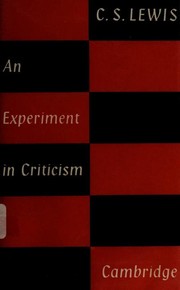
An Experiment in Criticism is a 1961 book by C. S. Lewis in which he proposes that the quality of books should be measured not by how they are written, but by how often they are re-read. To do this, the author describes two kinds of readers. The "unliterary" reader tends not to reread the same book, while the "literary" reader does. He suggests the categorization of books as either "highbrow" or "lowbrow" is deficient in that it fails to appreciate those qualities which have merited re-reading.
Outline
In the book, Lewis outlines some of the differences between his two types of readers. For example, one characteristic of a unliterary reader is the argument "I've read it before", which is a conclusive reason not to read a book. In contrast, literary readers reread books many times, savouring certain passages, and attempting to glean more from subsequent readings.
Lewis also argues that judging books by whether they are "lowbrow" or "highbrow" is not necessarily fruitful; many "lowbrow" books prove to be valuable to a literary reader willing to approach without prejudgment. He posits that books classified as "lowbrow", such as science fiction, are also capable of inducing a passion to re-read and imparting experience which changes a reader's worldview. Lewis suggests that books which are capable of doing this may prove to have enduring merit regardless of their genre. He encourages readers to avoid judging the literary merit of books based on traditional criteria.
以上文字摘自英文维基百科「An Experiment in Criticism」(去掉了参考文献等尾部小节),按 CC BY-SA 4.0 使用,作者为维基百科的各位编者。
资料卡
- 原题
- An Experiment in Criticism
- 原作语言
- 英语
- 首次出版
- 1961 年
- 首版出版社
- 剑桥大学出版社
- 主题
- 批评
资料卡来自 Wikidata Q4749991(CC0),众包数据,个别字段可能不全。