书单
百科
这个词条暂时没有中文维基百科条目,下面是英文维基百科的内容(英文原文):
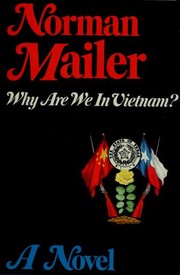
Why Are We In Vietnam? (WWVN) is a 1967 novel by the American author Norman Mailer. It focuses on a hunting trip to the Brooks Range in Alaska where a young man is brought by his father, a wealthy businessman who works for a company that makes cigarette filters and is obsessed with killing a grizzly bear. As the novel progresses, the protagonist is increasingly disillusioned that his father resorts to hunting tactics that seem dishonest and weak, including the use of a helicopter and taking credit for killing a bear. At the end of the novel, the protagonist tells the reader that he is soon going to serve in the Vietnam War as a soldier.
WWVN contains vivid descriptions of Alaska; polarizing, obscene, and stream-of-consciousness narration; and shifting points of view. Mailer uses the narrative to implicitly answer the question the novel's title asks: it demonstrates the attitudes and actions of the United States that landed it in Vietnam. Its experimental style alienated many readers, but earned the novel a nomination for the National Book Award.
Background
During the spring of 1966 in Provincetown, Mailer initially intended to write a novel about a gang of bikers and their girlfriends who lived in the scrub thickets of Provincetown's sand dunes. To bring "such literary horrors" to Provincetown would be a sin, so instead, he chose to write a prelude about two Texas boys hunting in Alaska, similar to Mailer's own recent trip up north. His characters would be based on members of the U.S. Army's 112th Cavalry out of San Antonio, in which Mailer served in World War II. After writing about the hunt in Alaska he planned for the story to focus on Provincetown, but by the time he finished writing the story of the hunt, he realized he had a complete story. Mailer later said of WWVN: "Sometimes I think it's the best 200 pages I've yet done. The most American, certainly the 200 pages least alienated from genius".
Publication
While Mailer had parted ways with Putnam's, he was contractually obligated to write them another book—the all-American "big one" he had talked about writing since The Naked and the Dead. He wrote WWVN quickly, in about half the time of An American Dream which is comparable in size. Yet, Walter Minton his editor at Putnam's, dismissed the book as too short to satisfy his commitment to Putnam's, but published it nevertheless since Mailer had already spent their advance. Since the book is highly metaphorical, Mailer suggested to Minton that he include a statement that explained as much in a press release: "Norman Mailer is saying, 'This perhaps is what we Americans are like, and this may be one of the reasons we're engaged in such a war.' "
Characters
Randy D.J. Jethroe—The narrator and protagonist of the novel, he recalls the trip to Alaska while at a dinner for him in Dallas, Texas, the night before he is shipped off to Vietnam.
Tex Hyde—D.J.'s best friend, who represents the conservative Texan. He and D.J. are hyper-masculine, crude and unrefined together, but the story shows the depths of their friendship.
Rusty Jethroe—Rusty's father and an executive of a cigarette filter company. He organizes the hunting trip in order to ensure his dominance among other men. He is "the cream of corporation corporateness" and the embodiment of all that has led the United States into the Vietnam War.
M.A. Pete and M.A. Bill—"Medium Assholes", or yes-men, as opposed to Rusty who is a "High-Grade Asshole". Rusty brings them along to help with the hunt and as witnesses to his masculine power.
Big Luke Fellinka—The hunting expedition's guide, he has a lot of knowledge of Alaska's Brooks Range and dictates when and what they hunt. He is also a conformist and capitalist conservative.
Summary
Why Are We in Vietnam? is set on the evening before its protagonist and narrator D.J. leaves for the war in Vietnam. The bulk of the narrative follows Ranald "D.J." Jethroe, his friend Tex Hyde, and his father Rusty on a hunting trip in Alaska that had happened two years previously.
The book begins by introducing the families of D.J. and Tex before the hunt. Both families have deep Texas bloodlines and both characters possess gritty and dogged appearances and mannerisms. Soon they reach the Brooks Mountain Range, where they will hunt for several days, hoping to bag a prize grizzly bear. Using a massive assortment of guns, they bring down Dall rams, wolves, and caribou. They finally shoot a pair of bears, but the following day Rusty convinces his son, D.J., to go hunting on their own to ensure a higher chance of killing a bear. Filled with terror they follow a grizzly track and have intimate father-son conversations when suddenly a bear comes out of nowhere and nearly kills D.J. before they both shoot it and it darts off. Finally tracking the bear, Rusty steals his son's kill of the grizzly.
The following morning Tex and D.J. wake up before the rest of the group and go into the wilderness without any supplies, in order to have a different, more enthralling experience with nature. Without a compass, sleeping bag, or defense except their wit and hands, they hike through the mountain range, observing the wonders of nature and stalking wild packs of animals. Even encountering a bear, they feel as close as brothers and are brought to a primal existence many only dream to obtain. The novel ends, knowing the two would be sent to Vietnam the following morning.
以上文字摘自英文维基百科「Why Are We in Vietnam?」(有删节,去掉了参考文献等尾部小节),按 CC BY-SA 4.0 使用,作者为维基百科的各位编者。
资料卡
- 原题
- Why Are We in Vietnam?
- 原作语言
- 英语
- 首次出版
- 1967 年
- 作品形式
- 长篇小说
- 首版出版社
- G·P·帕特南之子
- 前作
- An American Dream
- 续作
- The Armies of the Night
资料卡来自 Wikidata Q7997721(CC0),众包数据,个别字段可能不全。