书单
百科
这个词条暂时没有中文维基百科条目,下面是英文维基百科的内容(英文原文):
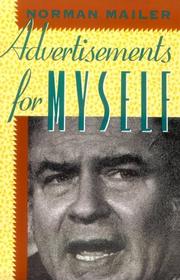
Advertisements for Myself is an omnibus collection of fiction, essays, verse, and fragments by Norman Mailer, with autobiographical commentaries that he calls "advertisements." Advertisements was published by G.P. Putnam's Sons in 1959 after Mailer secured his reputation with The Naked and the Dead, then endured setbacks with the less-enthusiastic reception of Barbary Shore (1951) and The Deer Park (1955).
Advertisements, though chaotic, unapologetically defiant, and often funny, marks the beginning of Mailer's mature style.
Advertisements, with its new interest in counterculture, politics, and sexual liberation, is a key book among the dozens that Mailer produced and helped to create his persona as a swaggering, anti-establishment writer and explore "the web of relations between personal valor and virtue and literary growth and mastery" and serving as Mailer's "announcement that he was king of the literary hill." While initial sales were modest, Advertisements received many strong reviews, notably from Alfred Kazin and Irving Howe, and the New York Times Book Review, Partisan Review, and the Village Voice.
A Note to the Reader
This section explains the book's two tables of contents. The first lists the contents of the book in chronological order, while the second table of contents categorizes the pieces based on genre, such as fiction, essays, and interviews. Mailer lists what he believes are his best pieces in the book, which are: The Man Who Studied Yoga, "The White Negro", "The Time of Her Time", "Dead Ends", and "Advertisements for Myself on the Way Out".
First Advertisement for Myself
Mailer gives readers his perspective, at age 36, on his writing, other writers, and the state of the nation. He believes his work, present and future, will be a key influence on those practicing his craft. In pulling together this collection of short novels, short stories, essays and advertisements, he's making his case and showing how he's matured as a writer over the years. Though at times in his career he was influenced by Ernest Hemingway, he points to the author as a writer who didn't grow. "Hemingway has always been afraid to think, afraid of losing even a little popularity… and his words excite no thought in the best of my rebel generation". It's a generation that he believes has grown up in a world "more in decay than the worst of the Roman Empire." Still, he gives Hemingway credit for knowing the value of his own work and fighting to make his personality enrich his books. A writer's personality, Mailer observes, can determine how much attention readers give his work. "The way to save your work and reach more readers is to advertise yourself."
Part One: Beginnings
This section includes Mailer's earliest works, written when he was a student at Harvard. Mailer admits that he is not particularly proud of the pieces in this section, but has included them for the readers who are interested in his early works. The pieces in this section are:
Advertisement for A Calculus at Heaven - The author writes that A Calculus at Heaven is his attempt, as a young writer, to imagine what war might really be like.
A Calculus at Heaven (short novel) - Set in the Pacific theater during World War II, five American soldiers - greatly outnumbered by enemy forces - have orders to maintain control of the nearby coastal road at all cost.
Advertisement for "The Greatest Thing in the World" - In his explanation of this short story, Mailer writes that it won first place in a Story magazine contest in 1941. Still, he was embarrassed to read it in later years. The only redeeming quality he can find in the story, in hindsight, is its sense of pace.
"The Greatest Thing in the World" (short story) - Al Groot, a broke and hungry drifter, tries to out-maneuver a couple of hustlers he meets at a diner on a rainy night.
Advertisement for "Maybe Next Year" - The author describes the prose in "Maybe Next Year" as Salinger-ish, but said the inspiration was really Faulkner. Just a month or so before the story's writing, Mailer had read The Sound and the Fury.
"Maybe Next Year" (short story) - Set during the Great Depression, a 9-year-old boy retreats into the woods and meadows near his home during his parents’ frequent fights over money.
Part Two: Middles
The second section features the short stories Mailer wrote hoping to keep up with the fame and notoriety that followed his best selling novel, The Naked and the Dead.
"Second Advertisement for Myself" - After his stint in the Army, Mailer spent all his time working on The Naked and the Dead. The novel was a bigger success than he would have ever imagined. But it led to questions about whether he ever would be able to repeat that success. In a sense, he writes, he may have been trying to evade that question by writing Barbary Shore.
Excerpts from Barbary Shore - Michael Lovett, a WWII vet, moves into a boarding house in Brooklyn, where he plans to write a novel. At the boarding house, he observes and interacts with the other characters who live there.
"Third Advertisement for Myself" - The timing was right for The Naked and the Dead, Mailer writes. It came out when everyone was ready for a long war novel. The timing was wrong for Barbary Shore. The media at the time seemed interested in getting America back to chastity, regularity, the safe, he writes. Mailer includes a number of bad reviews the novel received. The criticisms lead the author to turn his attention to short stories.
Advertisement for "Three War Stories" - Mailer describes writing ten short stories in a few weeks, using the same method: He'd start in the morning, finish the same day or give up on the idea. He writes that he takes no great pride in the stories.
"The Paper House" - World War II is over, and Nicholson and his pseudo-friend Hayes are stationed with a company of men in a small Japanese city. The two take frequent trips to a geisha house, where Nicholson longs for the company of Hayes’ regular geisha.
以上文字摘自英文维基百科「Advertisements for Myself」(有删节,去掉了参考文献等尾部小节),按 CC BY-SA 4.0 使用,作者为维基百科的各位编者。
资料卡
- 原题
- Advertisements for Myself
- 原作语言
- 英语
- 首次出版
- 1959 年
资料卡来自 Wikidata Q4686730(CC0),众包数据,个别字段可能不全。