 书单
百科
这个词条暂时没有中文维基百科条目,下面是英文维基百科的内容(英文原文):
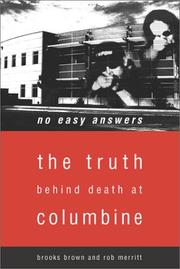
No Easy Answers: The Truth Behind Death at Columbine is a 2002 non-fiction book by Brooks Brown and Rob Merritt about the Columbine High School massacre. Brown was a student at Columbine High School at the time of the shooting and a friend of the perpetrators, Eric Harris and Dylan Klebold. The book recounts Brown's experiences growing up as close friends with Klebold, his time as a student at Columbine, and his experiences with media, police, and school authorities following the shooting.
No Easy Answers tells Brown's personal story of growing up with Klebold, befriending and falling out with Harris, and surviving the massacre. The book does not offer a definitive explanation for the shooting, but rather reflects on its impact and implications. Throughout the book, Brown portrays both himself and Klebold as the subjects of extreme bullying from other students, and this as a widespread phenomenon at Columbine. He also portrays Harris as violent and refers in particular to death threats Harris made against him online, which his family reported to the police, but which were never followed up on. The second part of the book focuses on Brown's life following the massacre, including false accusations against him by John Stone, then the sheriff of Jefferson County, Colorado, of being an accomplice to it and the impact they had on his life.
Brown felt coverage of the shooting underrecognized the role which bullying played and that others at Columbine were downplaying the hostility present at the school. No Easy Answers focuses on bullying as the proximate cause of Columbine, criticising other common hypotheses such as media violence or anti-religious sentiment. The book depicts the school's social environment as antagonistic to atypical or nonconformist students, in particular those who were non-athletic or perceived as gay. It focuses more on reflective and emotional recollection than on strictly-factual reporting, alternating between Brown's personal narrative and more factual sections by its co-author Merritt.
No Easy Answers was co-written by Brown and Rob Merritt, then the editor of Marshalltown, Iowa's local newspaper. It was published in October 2002 through the nonprofit organization and publisher Lantern Books. One of the first works to analyze Columbine, No Easy Answers has been considered an influence on later works and a significant publication in and of itself. Its status as a memoir by the friend of a mass murderer is the subject of much of its critical analysis, which recognizes it as a substantial addition to the corpus of Columbine-related literature, but criticises its prose and its focus on bullying to the exclusion of other explanations.
Background and publication
The Columbine High School massacre was a school shooting and attempted bombing committed by two Columbine students, Eric Harris and Dylan Klebold, on April 20, 1999. After smuggling a number of improvised explosives onto campus, most of which failed to operate, Harris and Klebold shot and killed twelve students and one teacher before turning the guns on themselves. At the time, it was the deadliest school shooting in American history. The Columbine shooting had significant effects on education, policy, copycat crime, and media and cultural portrayals of school violence. Columbine affected decision-making around school security, active shooter response protocols, anti-bullying policy, and religion in schools.
Brooks Brown, a fellow student at Columbine, had been close friends with Klebold since elementary school. Brown was the son of a real estate agent who had purchased a house in the Jefferson County Public Schools district (which housed Columbine High School) due to its good reputation. He and Klebold met in the first grade; the Brown and Klebold families became close, and both boys spent much of their time with one another both in and out of school. Brown and Harris became friends in their first year of high school, but their relationship was more chaotic; a temporary falling-out led to Harris making death threats towards Brown. They repaired their friendship a short time before the shootings.
Brown faced pervasive bullying throughout his school years. He felt coverage of the shooting underrecognized the role which bullying played and that others at Columbine were attempting to "rewrite history" by downplaying the hostility present at the school. Brown also believed that the shooting was preventable, and that authorities had ignored warning signs. A year prior to the massacre, Brown's parents had reported threats made by Harris against their son to the Jefferson County sheriff's office. Though these threats were not investigated during Harris's lifetime, they were used as grounds to obtain a search warrant of his home following the shooting.
No Easy Answers was co-written by Brown and Rob Merritt, then the editor of Marshalltown, Iowa's local newspaper. Merritt, who focused on education-related reporting, met Brown online after becoming "fascinated" with the Columbine shooting. It was published in October 2002 through the nonprofit organization and publisher Lantern Books.
Synopsis
No Easy Answers is divided into two sections of eleven and twelve chapters respectively. The first section, "Columbine", revolves around the background to the shooting. The second, "Aftermath", focuses on the event itself and the following investigation. Within chapters, the book switches between Brown's first-person narrative and Merritt's factual reporting; the latter sequences are in italics.
以上文字摘自英文维基百科「No Easy Answers」(有删节,去掉了参考文献等尾部小节),按 CC BY-SA 4.0 使用,作者为维基百科的各位编者。
资料卡
- 原题
- No Easy Answers
- 原作语言
- 英语
- 首次出版
- 2002 年 10 月
- 主题
- 科伦拜校园事件
资料卡来自 Wikidata Q123458816(CC0),众包数据,个别字段可能不全。