 书单
百科
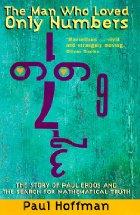
《数字情种:埃尔德什传》(英语:The Man Who Loved Only Numbers: The Story of Paul Erdos and the Search for Mathematical Truth)是一本由美国作家保罗·霍夫曼创作的匈牙利数学家埃尔德什·帕尔传记,获得1999年的英国皇家学会科学图书奖。
以上文字摘自维基百科「数字情种」(去掉了参考文献等尾部小节),按 CC BY-SA 4.0 使用,作者为维基百科的各位编者。
中文维基百科的条目比较短,下面附上英文维基百科的内容(英文原文):
The Man Who Loved Only Numbers is a biography of mathematician Paul Erdős written by Paul Hoffman. The book was first published on July 15, 1998, by Hyperion Books as a hardcover edition. A paperback edition appeared in 1999. The book is, in the words of the author, "a work in oral history based on the recollections of Erdős, his collaborators and their spouses". The book was a bestseller in the United Kingdom and has been published in 15 different languages. The book won the 1999 Rhône-Poulenc Prize, beating many distinguished and established writers, including E. O. Wilson.
How the book came about
Hoffman received an assignment by The Atlantic Monthly in 1987 to profile Erdős, which won the National Magazine Award for feature writing. After this, Hoffman followed Erdős on his travels for the last 10 years of his life learning about his exceedingly unusual life and interviewing his numerous collaborators in the process of writing this book.
Content
A large part of the book concerns Erdős, but a lot of it is about other mathematicians, past and present, including Ronald Graham, Carl Friedrich Gauss, Srinivasa Ramanujan, and G.H. Hardy. In the book, Erdős enjoys listening to Hardy when he speaks about Ramanujan. Hoffman also tries to give examples of what mathematics is and why he views it as important, and why many mathematicians such as Erdős devote their whole lives to mathematics. It also contains some history of Europe and the United States during Erdős's time.
The book overall portrays Erdős in a favorable light, pointing out his many endearing qualities, like his childlike simplicity, his generosity and altruistic nature, and his kindness and gentleness towards children. However, it also attempts to illustrate his helplessness in doing mundane tasks, the difficulties faced by those close to him because of his eccentricities, and his stubborn and frustrating behavior.
Erdős's nursing of Jon Folkman
Hoffman reports the following anecdote, which displays Erdős's single-minded devotion to his friends and mathematics. In the late 1960s, the young mathematician Jon Folkman was diagnosed as having advanced brain cancer. During Folkman's hospitalization, he was visited repeatedly by Ronald Graham and Paul Erdős. After his brain surgery, Folkman was despairing that he had lost his mathematical skills. As soon as Folkman received Graham and Erdős at the hospital, Erdős challenged Folkman with mathematical problems, helping to rebuild his confidence.
Hoffman notes that Folkman's recovery was short-lived. Notwithstanding his ability to solve the problems posed by Erdős, Folkman purchased a gun and killed himself. Folkman's supervisor at RAND, Delbert Ray Fulkerson, blamed himself for failing to notice suicidal behaviors in Folkman. Years later Fulkerson also killed himself.
Writing style
The book is mostly written without much technical detail and can be read by anyone without a mathematical background. Hoffman does give some relatively simple examples of mathematical problems throughout the book (like Cantor's diagonal argument) to illustrate some of the ideas in modern mathematics.
以上文字摘自英文维基百科「The Man Who Loved Only Numbers」(去掉了参考文献等尾部小节),按 CC BY-SA 4.0 使用,作者为维基百科的各位编者。
资料卡
- 原题
- The Man Who Loved Only Numbers
- 原作语言
- 英语
- 首次出版
- 1998 年 7 月 15 日
- 体裁
- 随笔
- 首版出版社
- 桦榭图书集团
- 主题
- 传记、埃尔德什·帕尔
- 故事发生地
- 匈牙利
资料卡来自 Wikidata Q3819967(CC0),众包数据,个别字段可能不全。