书单
百科
这个词条暂时没有中文维基百科条目,下面是英文维基百科的内容(英文原文):
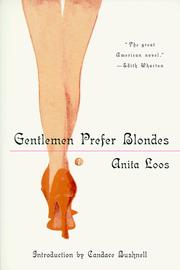
Gentlemen Prefer Blondes: The Intimate Diary of a Professional Lady is a 1925 comic novel written by American author Anita Loos. The story follows the dalliances of a young blonde gold-digger and flapper named Lorelei Lee during "the bathtub-gin era of American history." Published the same year as F. Scott Fitzgerald's The Great Gatsby and Carl Van Vechten's Firecrackers, the lighthearted work is one of several notable 1925 American novels focusing on the carefree hedonism of the Jazz Age.
Originally serialized as sketches in Harper's Bazaar during the spring and summer of 1925, Boni & Liveright republished Loos's sketches in book form in November 1925. Although dismissed by critics as "too light in texture to be very enduring", the book garnered the praise of many writers, including F. Scott Fitzgerald, James Joyce, William Faulkner, and H. G. Wells. Edith Wharton hailed Loos's satirical work as "the great American novel" as the character of Lorelei Lee embodied the avarice and self-indulgence that characterized 1920s America during the presidencies of Warren G. Harding and Calvin Coolidge.
Loos's book became the second-best selling title of 1926 in the United States and a runaway international bestseller. It was printed worldwide in over 13 languages, including Russian and Chinese. By the time Loos died of a heart attack in 1981 at the age of 93, the work had been printed in over 85 editions and adapted into a 1926 comic strip, a 1926 Broadway play, a 1928 silent comedy, a 1949 Broadway musical, and a 1953 film adaptation of the musical.
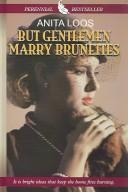
Loos wrote a sequel, But Gentlemen Marry Brunettes, in 1927.
Background
Over the years, Anita Loos told differing origin stories for Gentlemen Prefer Blondes, although each of the different origin stories involves an incident aboard a train. While working as a screenwriter in Hollywood, California, a 40-year-old Loos boarded a train either alone or with actor Douglas Fairbanks. Aboard the train, she encountered littérateur H. L. Mencken, the gruff editor of The Smart Set, in the company of an attractive young blonde, often identified as either actress Mae Davis or Mae Clarke.
As Loos lugged her heavy suitcases from their overhead racks while nearby men failed to offer any assistance whatsoever, the young blonde dropped her book, and several male bystanders jumped to retrieve it. As an attractive young brunette, Loos observed this stark contrast in the men's behavior and surmised that the difference stemmed from the other woman being a blonde.
During the train ride, Mencken, a close friend to whom Loos felt sexually attracted, continued focusing his attention on the young blonde and behaving like a love-struck simpleton. "Prompted by a flirtation that Henry Mencken was having with a stupid little blonde," Loos recalled, "I wrote a skit poking fun at his romance. I had no thought of it ever being printed". A jealous Loos jotted down the short story in the persona of a young blonde flapper recounting her dalliances in an intimate diary.
Upon arriving at her home, Loos forgot about the story, but she rediscovered the manuscript after unpacking her suitcases. Piqued at Mencken, she placed the manuscript in an envelope and mailed it to him. Mencken enjoyed the deprecatory piece and forwarded the manuscript to Henry Sell, the editor of Harper's Bazaar. Sell accepted the story for publication, and he urged Loos to continue writing about the blonde flapper's escapades. Due to the popularity of Loos's stories, the magazine's circulation skyrocketed, and Boni & Liveright published the stories in book form in November 1925.
Plot summary
A kiss on the hand may make you feel very nice, but a diamond and sapphire bracelet lasts forever.
Born in Arkansas, a blonde flapper named Lorelei Lee meets Gus Eisman, a Chicago businessman whom she calls "Daddy". He installs her in a New York City apartment and "educates" her. He pays for jewelry from Cartier, dinners at the Ritz, and tickets to the Ziegfeld Follies. During this time, she meets novelist Gerry Lamson. He wishes to "save" her from Eisman and asks her to marry him. Not wishing to forgo a trip to Europe paid for by Eisman, Lorelei spurns Lamson. Meanwhile, Lorelei criticizes her friend Dorothy Shaw for wasting her time with a poor writer named Mencken, the editor of a dull magazine, instead of pursuing wealthy men.
Sailing for Europe with Dorothy on the RMS Majestic, Lorelei learns that Bartlett, a former district attorney who is now a senator, is aboard the ship. She recounts a dubious backstory in which a lawyer employed her as a stenographer, and she shot him to defend her virtue. During the trial, which Bartlett prosecuted, Lorelei gave such "compelling" testimony that the all-male jury acquitted her. The judge bought her a ticket to Hollywood so that she could use her acting talents to become a star. Due to her siren-like personality, he nicknamed her "Lorelei". Lorelei exacts revenge on Bartlett by seducing him and revealing secrets about his senatorial activities.
Arriving in England, the Tower of London fails to impress Dorothy and Lorelei as it is smaller than "the Hickox building in Little Rock". Invited to a soirée where English aristocrats sell counterfeit jewels to naive tourists, Lorelei encounters an elderly matron who is selling a diamond tiara. Lorelei casts her eye around the room for a wealthy man to buy it for her and settles on Sir Francis Beekman, whom she calls "Piggie". With flattery and the promise of discretion due to his matrimonial status, she persuades him to buy the tiara.
以上文字摘自英文维基百科「Gentlemen Prefer Blondes (novel)」(有删节,去掉了参考文献等尾部小节),按 CC BY-SA 4.0 使用,作者为维基百科的各位编者。
资料卡
- 原题
- Gentlemen Prefer Blondes
- 插图
- Ralph Barton
- 原作语言
- 美国英语
- 首次出版
- 1925 年
- 作品形式
- 长篇小说
- 体裁
- 书信体小说、喜剧
- 首版出版社
- 波尼与李佛莱特
- 续作
- But Gentlemen Marry Brunettes
资料卡来自 Wikidata Q1248760(CC0),众包数据,个别字段可能不全。
改编作品
舞台剧 / 歌剧 / 芭蕾1
- 《绅士爱美人》Gentlemen Prefer Blondes
取材于它的书1
名单来自 Wikidata(CC0):只列条目里写明「改编自 / 取材于」这本书的作品,不按名字猜;众包数据,可能不全。