 书单
百科
这个词条暂时没有中文维基百科条目,下面是英文维基百科的内容(英文原文):
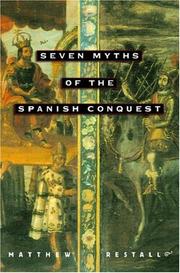
Seven Myths of the Spanish Conquest is a 2003 work by ethnohistorian Matthew Restall in which he posits that there are seven myths about the Spanish colonization of the Americas that have come to be widely believed to be true. Working within the tradition of New Philology, Restall questions several notions which he claims are widely held myths about how the Spanish achieved military and cultural hegemony in Hispanic America. The book grew from undergraduate lectures at Penn State University. The book has been published in Spanish and Portuguese translations.
Chapters
Chapter 1 deals with what Restall calls "the Myth of exceptional men" — the idea that the Spanish Conquest was enabled by certain outstanding individuals such as Columbus, Cortés, and Pizarro and their personal courage and innovative strategies. The myth of Columbus developed in North America in the 1800s, when historians generated interest in Columbus among readers. Over time, the celebration of Columbus grew into Columbus Day, and the truth of his journey, that he had lied to the Queen of Spain about his Route and ended up being stripped of his title and banned from the Indies, was buried. The glorification of Cortes resulted from his success in Mexico and the publication of his letters to the King. Additionally, many of Cortes's associates wrote biographies on him that portrayed him as a larger-than-life character, contributing to his glorification. Restall shows that the success of the conquest was not due to these few exceptional men, but that the techniques of conquest and colonization used by the early Spanish explorers had been developed throughout at least a century of colonial expansion by Spain and Portugal and were in fact mostly standard procedure. These techniques of conquest include acquiring a native ally and interpreter, the use of display violence, and the public seizure of a native ruler. Restall draws on scholars' published work for this conclusion.
Chapter 2 deals with what Restall calls "the Myth of the King's Army" — the belief that the Spanish conquest was undertaken at the behest of the King of Spain and that the conquistadors were Spanish soldiers. Restall claims that in fact the conquistadors did not necessarily see themselves as Spanish but rather viewed themselves as Andalusians, Castilians, Aragonese, Basques, Portuguese, Galicians, and even Genoese, Flemish, Greek, and Moorish. Nor were they acting under the command of the Holy Roman Emperor who was also the king of the Spanish realms. And they were not soldiers in a formal military sense of the word but rather a group of feudal lords with their respective footmen, servants, pages, and mercenaries. These groups acted independently with their own agendas. Spanish military technology is also greatly exaggerated as, at the time of the conquest, the musket had yet to be invented and regularly used, along with several other significant military inventions that would occur in the later half of the sixteenth century.
Chapter 3 deals with what Restall calls "the Myth of the White Conquistador" — the belief that the Spanish conquest was accomplished by a small number of Spaniards. Restall claims that much of the actual military operations were undertaken by the indigenous allies of the Conquistadors (such as the Tlaxcalans), outnumbering the actual Spanish forces by many hundreds to one. When Cortés made his way to Tenochtitlán, the Aztec capital, he arrived with 6,000 of these allies and only 250 Spaniards. The final assault on the capital was carried out with 200,000 native allies, most of whom have gone unrecognized in accounts. He also shows that there were several conquistadors of African and Moorish descent — dispelling the idea of the conquest as a victory of the "white Europeans" over the "red Indians". The number of people of African descent, free or enslaved, equaled or exceeded the Spanish conquistadors in number. These groups are almost completely left out of accounts of the Spanish conquest although they played a massive part. Restall hypothesises that the Spaniards motivated the Africans to fight by offering freedom if their contribution to the conquest were impactful.
Chapter 4 deals with what Restall calls "the Myth of Completion" — the belief that all of the Americas were under Spanish control within a few years after the initial contact. The Spaniards created this myth to support the Spanish system of patronage, contact, and reward, and to justify the conquest as divine intervention. Restall claims that contrary to this belief pockets of indigenous peoples living without having been conquered subsisted for several centuries after the conquest - and arguably to this day. For example, Tayasal, the last independent city of the Maya, did not fall under Spanish sway until 1697. In other areas of Hispanic America, Spanish control was never complete and rebellions were continuous. He shows that the colonization of the Americas did not happen in one fell swoop, but rather as a historical process starting centuries before the magic years of 1492 and 1521 and ending several centuries after. With lots of evidence to the contrary of Spanish completion of the America's, Mexican descendants were left with an identity crisis, divided over the issue of recognizing Cortés as a hero or the last rulers of Mexica as the heroes. An aspect of this myth that is left out in accounts is the level of autonomy granted to Natives after the conquests. The Spanish wished to let Native communities self-govern to produce agriculture as the Spanish settlers were not farmers and were dependent on the work of the Natives. Therefore, there was a level of cooperation between the two groups, not total control of the Natives by the Spanish. This myth also overlooks the everyday resistance by the natives.
以上文字摘自英文维基百科「Seven Myths of the Spanish Conquest」(有删节,去掉了参考文献等尾部小节),按 CC BY-SA 4.0 使用,作者为维基百科的各位编者。
资料卡
- 首次出版
- 2003 年
- 体裁
- 非虚构作品
资料卡来自 Wikidata Q9077209(CC0),众包数据,个别字段可能不全。