书单
百科
这个词条暂时没有中文维基百科条目,下面是英文维基百科的内容(英文原文):
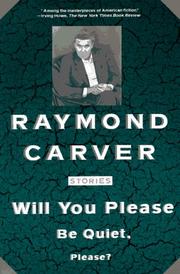
Will You Please Be Quiet, Please? (1976) was the first major-press short-story collection by American writer Raymond Carver. Described by contemporary critics as a foundational text of minimalist fiction, its stories offered an incisive and influential telling of disenchantment in the mid-century American working class.
Publication history
Unlike his later collections, the stories collected in Will You Please Be Quiet, Please? were written during a period Carver termed his "first life" or "Bad Raymond days", prior to his near-death from alcoholism and subsequent sobriety. The earliest compositions date from around 1960, the time of his study under John Gardner at Chico State in English 20A: Creative Writing.
In the decade and a half following, Carver struggled to make space for bursts of creativity between teaching jobs and raising his two young children, and later, near-constant drinking. The compositions of Will You Please... can be grouped roughly into the following periods:
1960–1961 – "The Father"
1960–1963 – "The Ducks", "What Do You Do in San Francisco?"
1964 – "Will You Please Be Quiet, Please?", "The Student's Wife", "Sixty Acres"
1967 – "How About This?", "Signals", "Jerry and Molly and Sam"
1970 – "Neighbors", "Fat", "Night School", "The Idea", "Why, Honey?", "Nobody Said Anything", "Are You a Doctor?"
1971 – "What Is It?" ("Are These Actual Miles?"), "What's In Alaska?", "Bicycles, Muscles, Cigarettes", "They're Not Your Husband", "Put Yourself in My Shoes"
1974 – "Collectors"
Although several of the stories had appeared previously in prominent publications (the Foley Collection had published the story "Will You Please Be Quiet, Please?" in 1967 and Esquire had accepted "Neighbors" in 1971), as the first author to be collected in the new McGraw-Hill imprint for fiction, this marked the first major commercial success of Carver's career. The title for the collection was originally proposed by Frederic W. Hills, editor at McGraw-Hill, as Put Yourself in My Shoes, and Gordon Lish, Carver's editor, agreed. However, after polling friends, Carver made a stand for the eventual title, under which Lish selected 22 of the more than 30 Carver had published to that date.
Critical reception
Following the success of experimental literary works by short story writers such as John Barth and Donald Barthelme in the early 1970s, Will You Please... was noted for its flat, understated incision in contemporary reviews. Publishers Weekly included in its first issue of 1976 a notice of the new collection, calling it "Downbeat but perceptive writing about the inarticulate worlds of Americans..." Later critical analysis oriented the collection in relation to the later editing conflicts with Gordon Lish in What We Talk About When We Talk About Love (1981), and the "expansiveness" of Cathedral (1983). Bethea's analysis of the collection focuses on the unreliability of the narrators in Will You Please..., finding humour and fraught realism in their dramas. The collection was chosen as one of five finalists for the 1977 National Book Award.
Plot summaries
"Fat"
A waitress recounts a story to her friend, about "the fattest person I have ever seen," who comes into the diner where she works and orders a procession of dishes in a polite and self-deprecatory manner. The waitress notices his strange manner of speaking, commenting positively on every aspect of the massive meal. She describes the physical struggle of the fat man, his "puffing" and overheating. After recounting the events at the dinner, the waitress tells her friend how she tried to explain to her partner, Rudy, that "he is fat... but that is not the whole story". When they had sex that night, the waitress felt that she was "terrifically fat", and Rudy was "hardly there at all". The story ends on a note of anticipation, with the waitress thinking to herself: "It is August./ My life is going to change. I feel it."
"Neighbors"
A "happy couple" who feel life has passed by are asked to feed their neighbors' cat while they are away. As he is in the apartment across the hall, the husband (Bill) begins to enjoy the voyeuristic experience of exploring his neighbors' things, sampling the food in the fridge, and even trying on their clothes. After the wife (Arlene) spends an absent-minded hour in her neighbors' home, she returns to tell Bill that she has found some pictures he should see. "Maybe they won't come back", she says, as they cross the hall together. Before they can enter the apartment, however, Arlene realises that she has left the key inside their flat, and the door handle will now not turn: locked.
"The Idea"
After supper, a couple watch through the window as their neighbor walks round the side of his house to spy on his own wife as she undresses. They seem puzzled at the incident, that has been happening "one out of every two to three nights" for the last three months. The man showers, as the woman prepares food for a late-night snack, telling her partner that would call the cops on anyone who looked in at her while she was undressing. As she scrapes waste food into the garbage, she sees a stream of ants coming from underneath the sink, which she sprays with bug killer. When she goes to bed, the man is asleep already, and she imagines the ants again. She gets up, turns all the lights on, sprays all over the house, and looks out the window, aghast, saying "...things I can't repeat."
"They're Not Your Husband"
Earl, a salesman between jobs, stops by one night at the 24-hour coffee shop where his wife, Doreen, works as a waitress. She is surprised to see him, but he reassures her and orders a coffee and sandwich. While he drinks his coffee, Earl overhears two men in business suits making crass comments about his wife. As she bends over to scoop ice cream, her skirt rides up and shows her thighs and girdle. Earl leaves and doesn't turn round when Doreen calls his name.
以上文字摘自英文维基百科「Will You Please Be Quiet, Please?」(有删节,去掉了参考文献等尾部小节),按 CC BY-SA 4.0 使用,作者为维基百科的各位编者。
资料卡
- 原题
- "Will You Please Be Quiet, Please?" 等 2 项
- 原作语言
- 英语
- 首次出版
- 1976 年 2 月 22 日
- 作品形式
- 选集、短篇小说集
- 首版出版社
- 标普全球、麦格罗希尔
资料卡来自 Wikidata Q3794374(CC0),众包数据,个别字段可能不全。