 书单
百科
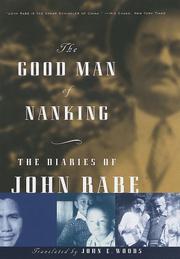
《拉贝日记》,指南京安全区国际委员会主席约翰·拉贝(John H. D. Rabe)从1937年9月到1938年2月间记录的日记,是其亲身目击南京大屠杀所作的记录,是南京大屠杀的重要史料。
1996年12月12日,拉贝的外孙女莱茵哈特在美国纽约向世人首次公布。1997年8月,美国克诺夫出版社以《The Good Man of Nanking: The Diaries of John Rabe》为名将其出版。
拉贝其人
拉贝自1911年起受雇于西门子中国公司;南京大屠杀发生时是德国西门子公司驻中国公司员工,他以外国人(德日当时有同盟关系,双方有签反共协定)的特殊身份,在中国南京建立南京战时安全区保护了一些中国平民,不过当时拉贝的行为纯属个人行为,并不代表西门子公司。拉贝是南京安全区的发起人之一,并担任安全区国际委员会主席。他是德国纳粹党南京小组代理,这特殊身份使他的记述具有别人难以代替的作用。
在写作日记之外,拉贝还保存了80多张现场拍摄的照片,并对这些照片作了详实说明。
出版
英译《The Good Man of Nanking: The Diaries of John Rabe》,ISBN 0375701974, Vintage Books出版
评价
因为拉贝当时活动的范围主要在南京安全区内,《拉贝日记》不可能对南京大屠杀的全过程作出完整的系统的论断和估计。但《拉贝日记》仍然被认为具有很重要的史料价值。
后续
2017年1月20日,由于日本APA酒店摆放否认南京大屠杀的书籍,中华人民共和国浙江省台州市某五星级酒店采购首批共200本《拉贝日记》,并放置在部分客房的床头柜上。该酒店预计会在每个客房都放置《拉贝日记》,部分客房还会放置英文版的《拉贝日记》,以表示抗议。
以上文字摘自维基百科「拉贝日记」(去掉了参考文献等尾部小节),按 CC BY-SA 4.0 使用,作者为维基百科的各位编者。
中文维基百科的条目比较短,下面附上英文维基百科的内容(英文原文):
The Good Man of Nanking: The Diaries of John Rabe is a collection of the personal journals of John Rabe, a German businessman who lived in Nanjing at the time of the Nanjing Massacre in 1937–1938. The book contains the diaries that Rabe kept during the Nanjing Massacre, writing from his personal experience and observation of the events that took place. It also excerpts Rabe's experience in immediate post-war Berlin, then occupied by Soviet troops. Rabe's diaries were made known and quoted by author Iris Chang during the research for her book, The Rape of Nanking; they were subsequently translated from German to English by John E. Woods and published in the United States in 1998. The diaries of Rabe could only provide witnesses of a small corner of the Nanjing Massacre, because of the limitation of his activity in the safe zone.
Diary entries
In his diary kept during the aggression to the city and its occupation by the Imperial Japanese Army, John Rabe wrote many comments about Japanese atrocities. For example, on 13 December 1937, he wrote:
"It is not until we tour the city that we learn the extent of destruction. We come across corpses every 100 to 200 yards. The bodies of civilians that I examined had bullet holes in their backs. These people had presumably been fleeing and were shot from behind. The Japanese march through the city in groups of ten to twenty soldiers and loot the shops ... I watched with my own eyes as they looted the café of our German baker Herr Kiessling. Hempel's hotel was broken into as well, as almost every shop on Chung Shang and Taiping Road."
For 17 December:
"Two Japanese soldiers have climbed over the garden wall and are about to break into our house. When I appear they give the excuse that they saw two Chinese soldiers climb over the wall. When I show them my party badge, they return the same way. In one of the houses in the narrow street behind my garden wall, a woman was raped, and then wounded in the neck with a bayonet. I managed to get an ambulance so we can take her to Kulou Hospital. ... Last night up to 1,000 women and girls are said to have been raped, about 100 girls at Ginling Girls' College alone. You hear nothing but rape. If husbands or brothers intervene, they're shot. What you hear and see on all sides is the brutality and bestiality of the Japanese soldiers."
While, on the next day of the fall of Nanjing, Rabe handed a letter of thanks to the Japanese army commander concerning that the people in the Safety Zone could stay without one fire and were all safe. The following is a part of his letter of thanks.
"Dec. 14, 1937,
Dear commander of the Japanese army in Nanking,
We appreciate that the artillerymen of your army didn't attack the Safety Zone. And we hope to contact with you to make a plan to protect Chinese citizens who are staying in the Safety Zone... We will be pleased to cooperate with you in anyway to protect citizens in this city.
--Chairman of the Nanking International Committee, John H. D. Rabe--"
On 17 December, Rabe however wrote a letter as chairman to Kiyoshi Fukui, second secretary of the Japanese Embassy, in a very different tone. The following is an excerpt:
"In other words, on the 13th when your troops entered the city, we had nearly all the civilian population gathered in a Zone in which there had been very little destruction by stray shells and no looting by soldiers even in full retreat. ... All 27 Occidentals in the city at that time and our Chinese population were totally surprised by the reign of robbery, raping and killing initiated by your soldiers on the 14th. All we are asking in our protest is that you restore order among your troops and get the city living normally as soon as possible. In the latter process we are glad to cooperate in any way we can. But even last night between 8 and 9 p.m. when five Occidental members of our staff and Committee toured the Zone to observe conditions, we did not find a single Japanese patrol either in the Zone or at the entrances!"
以上文字摘自英文维基百科「The Good Man of Nanking」(有删节,去掉了参考文献等尾部小节),按 CC BY-SA 4.0 使用,作者为维基百科的各位编者。
资料卡
- 原题
- The Good Man of Nanking
- 原作语言
- 德语
- 作品形式
- 日记
- 体裁
- 自传
- 主题
- 南京大屠杀
资料卡来自 Wikidata Q7737245(CC0),众包数据,个别字段可能不全。