书单
百科
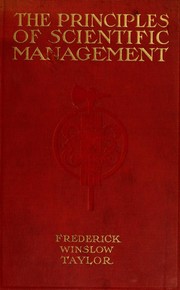
《科学管理原则》(英语:The Principles of Scientific Management,或称《科学管理原理》)是弗雷德里克·温斯洛·泰勒(Frederick Winslow Taylor)于1911年所出版的专著,他在其中阐述了他对科学管理原则或工业时代组织和决策理论的看法。泰勒是美国机械工程师,并在晚年时担任管理顾问。而“科学管理”一词是指为了每个人的利益而协调企业,包括即便违背现有观念而增加工人的工资等,因此他的方法也经常被称为“泰勒主义”。该专著由三个部分组成:导言、第一章:科学管理基础、第二章:科学管理原则。
以上文字摘自维基百科「科學管理原則」(去掉了参考文献等尾部小节),按 CC BY-SA 4.0 使用,作者为维基百科的各位编者。
中文维基百科的条目比较短,下面附上英文维基百科的内容(英文原文):
The Principles of Scientific Management (1911) is a monograph published by Frederick Winslow Taylor where he laid out his views on principles of scientific management, or industrial era organization and decision theory. Taylor was an American manufacturing manager, mechanical engineer, and then a management consultant in his later years. The term scientific management refers to coordinating the enterprise for everyone's benefit including increased wages for laborers although the approach is "directly antagonistic to the old idea that each workman can best regulate his own way of doing the work." His approach is also often referred to as Taylor's Principles, or Taylorism.
In 2001, Fellows of the Academy of Management voted the most influential management book of the twentieth century.
Contents
The monograph consisted of three sections: Introduction, Chapter 1: Fundamentals of Scientific Management, and Chapter 2: The Principles of Scientific Management.
Introduction
Taylor started this paper by quoting U.S. President Theodore Roosevelt: "The conservation of our national resources is only preliminary to the larger question of national efficiency". Taylor pointed out that while a large movement had started to conserve material resources, the less visible and less tangible effects of the wasted human effort were only vaguely appreciated. He argues the necessity of focusing on training rather than finding the "right man", stating "In the past, the man has been first; in the future, the system must be first", and the first goal of all good systems should be developing first-class men. He listed three goals for the work:
First. To point out, through a series of simple illustrations, the great loss which the whole country is suffering through inefficiency in almost all of our daily acts.
Second. To try to convince the reader that the remedy for this inefficiency lies in systematic management, rather than in searching for some unusual or extraordinary man.
Third. To prove that the best management is true science, resting upon clearly defined laws, rules, and principles, as a foundation. And further to show that the fundamental principles of scientific management are applicable to all kinds of human activities, from our simplest individual acts to the work of our great corporations, which call for the most elaborate cooperation. And, briefly, through a series of illustrations, to convince the reader that whenever these principles are correctly applied, results must follow which are truly astounding.
Lastly, Taylor noted that while the examples were chosen to appeal to engineers and managers, his principles could be applied to the management of any social enterprise, such as homes, farms, small businesses, churches, philanthropic institutions, universities, and government.
Chapter 1: Fundamentals of scientific management
Taylor argued that the principle object of management should be to secure the maximum prosperity for the employer, coupled with the maximum prosperity for each employee. He argued that the most important object of both the employee and the management should be the training and development of each individual in the establishment, so that he can do the highest class of work for which his natural abilities fit him. Taylor demonstrated that maximum prosperity can exist only as the result of maximum productivity, both for the shop and individual, and rebuked the idea that the fundamental interests of employees and employers are necessarily antagonistic.
Taylor described how workers deliberately work slowly, or “soldier”, to protect their interests. According to Taylor, there were three reasons for the inefficiency:
First. The fallacy, which has from time immemorial been almost universal among workmen, that a material increase in the output of each man or each machine in the trade would result in the end in throwing a large number of men out of work.
以上文字摘自英文维基百科「The Principles of Scientific Management」(有删节,去掉了参考文献等尾部小节),按 CC BY-SA 4.0 使用,作者为维基百科的各位编者。
资料卡
- 原题
- The Principles of Scientific Management
- 原作语言
- 英语
- 首次出版
- 1911 年
- 体裁
- 随笔
资料卡来自 Wikidata Q267727(CC0),众包数据,个别字段可能不全。