书单
百科
这个词条暂时没有中文维基百科条目,下面是英文维基百科的内容(英文原文):
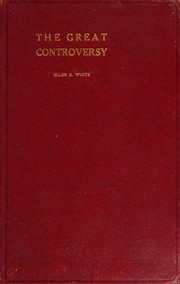
The Great Controversy is a book by Ellen G. White, one of the founders of the Seventh-day Adventist Church, and held in esteem as a prophetess or messenger of God among Seventh-day Adventist members. In it, White describes the "Great Controversy theme" between Jesus Christ and Satan, as played out over the millennia from its start in heaven, to its final end when the remnant who are faithful to God will be taken to heaven at the Second Advent of Christ, and the world is destroyed and recreated. Regarding the reason for writing the book, the author reported, "In this vision at Lovett's Grove (in 1858), most of the matter of the Great Controversy which I had seen ten years before, was repeated, and I was shown that I must write it out."
The name "Great Controversy" first applied to volume 1 of the 4 volume set "Spiritual Gifts" published in 1858. That single volume was then expanded to a 4 volume set entitled "The Spirit of Prophecy" subtitled "The Great Controversy" with the volumes published separately from 1870 to 1884. The last volume was also subtitled, "From the Destruction of Jerusalem, to the End of the Controversy". The 4 volume set was then expanded to 5 volumes entitled "the Conflict of the Ages Series" with the last volume given the name "The Great Controversy Between Christ and Satan During the Christian Dispensation" published in 1888. Volume 5 was again expanded and published in 1911. The 1884, 1888, and 1911 books incorporate historical data from other authors.
Synopsis
This synopsis is of the 1911 edition and its predecessor, the 1888 edition. While the original 1858 edition covered the entire history of sin from its beginning in heaven until it is eradicated in the new earth, these two editions cover just the Christian dispensation.
The book begins with a historical overview, which starts with the destruction of Jerusalem in AD 70, covers the Reformation and Advent movement in detail, and culminates with a lengthy description of the end times. It also outlines several key Seventh-day Adventist doctrines, including the heavenly sanctuary, the investigative judgment and the state of the dead.
Much of the first half of the book is devoted to the historical conflict between Roman Catholicism and Protestantism. White writes that the Papacy propagated a corrupt form of Christianity from the time of Constantine I onwards, and during the Middle Ages was opposed only by the Waldensians and other small groups, who preserved an authentic form of Christianity. Beginning with John Wycliffe and Jan Huss and continuing with Martin Luther, Huldrych Zwingli, and others, the Reformation led to a partial recovery of biblical truth. In the early 19th century William Miller began to preach that Jesus was about to return to earth; his movement eventually resulted in the formation of the Adventist Church.
The second half of the book is prophetic, looking to a resurgence in papal supremacy. The civil government of the United States will form a union with the Roman Catholic Church as well as with apostate Protestantism, leading to enforcement of a universal Sunday law (the mark of the beast), and a great persecution of Sabbath-keepers immediately prior to the second coming of Jesus. And these will be part of the end time remnant of believers who are faithful to God, which will be sealed and manifested just prior to the second coming of Jesus.
The official Ellen G. White Estate web site views the 1888 version as the original "Great Controversy," with the 1911 edition being the only revision.
While working to complete the book in 1884, White wrote, "I want to get it out as soon as possible, for our people need it so much... . I have been unable to sleep nights, for thinking of the important things to take place... . Great things are before us, and we want to call the people from their indifference to get ready."
In the 1911 edition preface, the author states the primary purpose of the book to be "to trace the history of the controversy in past ages, and especially so to present it as to shed a light on the fast approaching struggle of the future."
Publishing and distribution
There are four major editions of the book commonly called The Great Controversy. While currently all editions printed by Seventh-day Adventist publishing houses are based on the 1911 edition, the first three editions have also been reprinted by Seventh-day Adventist publishing houses as facsimile reproductions, and several Seventh-day Adventist laymembers have reprinted them in various formats, with various titles also.
Publication history:
The 1858 edition
In 1858, at Lovett's Grove, Ohio, Sunday, 14 March, a funeral was held in a schoolhouse where Ellen and James White were holding meetings, James was asked to speak and Ellen was moved to bear her testimony. Part way through her talk, she went into a two-hour vision in front of the congregation. The vision mostly concerned the matter of the "great controversy," which she had seen ten years before (1848). She was told that she must write it out. The next day on a train they began arranging plans for writing and publishing the future book immediately on their return home. At a stopover, Ellen experienced a stroke of paralysis, which made writing virtually impossible.
For several weeks afterward, Ellen could not feel pressure on her hand or cold water poured on her head. At first, she wrote but one page in a day and then rested for three. But as she progressed, her strength increased, and by the time she finished the book, all effects of the stroke were gone. The book was completed by mid-August and subsequently published as Spiritual Gifts, Vol. 1,: The Great Controversy Between Christ and His Angels, and Satan and His Angels.
以上文字摘自英文维基百科「The Great Controversy (book)」(有删节,去掉了参考文献等尾部小节),按 CC BY-SA 4.0 使用,作者为维基百科的各位编者。
资料卡
- 原题
- The Great Controversy
- 原作语言
- 美国英语
- 首次出版
- 1858 年
- 所属系列
- Conflict of the Ages
- 主题
- 基督教历史、宗教改革、先知、安息日会的末世观
资料卡来自 Wikidata Q5236491(CC0),众包数据,个别字段可能不全。