书单
百科
这个词条暂时没有中文维基百科条目,下面是英文维基百科的内容(英文原文):
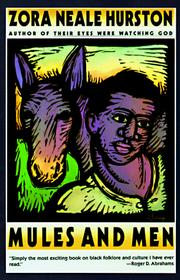
Mules and Men is a 1935 autoethnographical collection of African-American folklore collected and written by anthropologist Zora Neale Hurston. The book explores stories she collected in two trips: one in Eatonville and Polk County, Florida, and one in New Orleans.
Hurston's decision to focus her research on Florida came from a desire to record the cross-section of black traditions in the state. In her introduction to Mules and Men, she wrote: "Florida is a place that draws people—white people from all over the world, and Negroes from every Southern state surely and some from the North and West." Hurston documented 70 folktales during the Florida trip, while the New Orleans trip yielded a number of stories about Marie Laveau, voodoo and Hoodoo traditions. Many of the folktales are told in vernacular eye dialect, attempting to portray the dialect and diction of the Black communities that Hurston studied.
The book embraces both her own re-immersion in the folklore of her childhood, and a desire to document those traditions as part of the emergent anthropological sciences. Subsequently, the book has been described as an important text for the canonization of Hurston in both American and African-American literature, and in developing fields such as ethnography and critical race theory.
Summary
Frame stories
Hurston adopts a semi-autobiographical narration of someone who is sent out to collect Black folklore from Hurston's real home town of Eatonville, Florida. Hurston chose Eatonville as the location for her folklore collection because she knew the people there would not consider her diploma or credentials and instead would treat her as another local. Her frame story persona records both the folktales themselves and the context in which she supposedly heard the stories. She describes life in the Eatonville township and the daily life of its Black population as they play games such as "Florida-Flip", go to work in the local saw mill, fall in love, and have other ordinary experiences. The dialogue and the stories are written in vernacular eye dialect, presumably attempting to record the way people spoke in Eatonville at the time. For example, when B. Mosely asks Hurston if she's going to stay awhile, Hurston records the question as "You gointer stay awhile, Zora?"
Hurston's frame stories are often broken up by folktales, as the characters in Eatonville stop what they are doing to tell a folktale that is applicable to the situation at the time. Black men on the way to work in the difficult conditions of a sawmill tell stories about John, an enslaved man who outwitted the devil, his white master, and tried to trick God himself. This is the central narrative conceit of Mules and Men and forms the basis of the work.
In part two of Mules and Men, Hurston travels to New Orleans to collect folk tales, learning from various practitioners of hoodoo, each with their own specialties. Unlike part one of the book, the second part does not flip back and forth between frame stories and independent folk tales. Instead, this section is seen entirely through the Hurston's authorial persona, recounting the events of each hoodoo ritual with a first-person perspective. Often, Hurston will help or participate in the ritual itself.
Folklore
Mules and Men contains more than seventy different folktales from across the Black tradition. Most of them concern racism, slavery, or oppression, and feature weaker characters who trick stronger characters. Some of these stories concern personified animals such as Brer Rabbit, or Brer Gator, and attempt to explain why something in nature is the way that it is. Others are part of the oral tradition of enslaved people in the United States and offer a look at the forms of resistance and culture developed in the antebellum south. The folktales presented in Mules and Men are short, only a few pages long at most. Several of the most prominent stories in the book are listed below.
"Ole Massa and John Who Wanted to Go to Heaven"
John is an enslaved man who features in several stories in Mules and Men. He is always known for his trickery and intelligence. In one story, John prays to God for deliverance from slavery. His master overhears him, and decides to dress up in a sheet to trick John into running away. The master goes to John's cabin and says that he is God, and is going to take John away to heaven in a fiery chariot. John realizes the trick, and when his master comes to his door, tells "God" that he is too dirty to be in the presence of God and he needs to change his pants and his shirt. Then he tells "God" that "yo' countenance is so bright Ah can't come out to you." "God" agrees to take several steps backwards, away from the front door. When "God" does this, John runs away.
"How the Gator Got Black"
This is one of a number of folktales in Mules and Men that concern Brer animals and various creation myths. This story explaining why the gator is colored the way that he is, begins with Brer Gator lounging in the sun, with white skin and coal-colored eyes. Brer Rabbit comes out of the bush in a hurry, and tracks mud all over Brer Gator's albino skin. When Brer Gator gets mad, Brer Rabbit tells him to wait for a moment and he will show Brer Gator what real trouble is. Brer Gator agrees to this, and Brer Rabbit lights a fire all around Brer Gator. The smoke blackens Brer Gator's skin, and reddens his eyes, and this is why alligators are colored the way that they are.
"'You Think I'm Gointer Pay You But I Ain't'"
A Black man is employed in a lumberyard, but is too lazy to do his work. Whenever his employer comes by, he says: "Klunk, Klunk, you think Ah'm workin' but Ah ain't." When the Black man goes to collect his money, his employer says: "Clink, Clink you think I'm gointer pay you, but I ain't.”
以上文字摘自英文维基百科「Mules and Men」(有删节,去掉了参考文献等尾部小节),按 CC BY-SA 4.0 使用,作者为维基百科的各位编者。
资料卡
- 首次出版
- 1935 年
- 主题
- 民俗、巫毒娃娃、奥比巫术
- 故事发生地
- 伊顿维尔、新奥尔良
资料卡来自 Wikidata Q24255909(CC0),众包数据,个别字段可能不全。