 书单
百科
这个词条暂时没有中文维基百科条目,下面是英文维基百科的内容(英文原文):
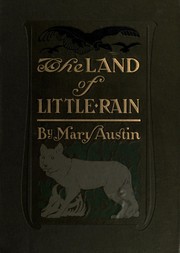
The Land of Little Rain is a book written by American writer Mary Hunter Austin. First published in 1903, it contains a series of interrelated lyrical essays about the inhabitants, both human and otherwise, and the arid landscape of the Owens Valley and the Mojave Desert of California. It is number two on the Zamorano Eighty list of significant early Californiana.
Publication history
The Land of Little Rain has been published six times. The first publication was in 1903 by Houghton Mifflin. Subsequent publications include a 1950 abridged version with photographs by Ansel Adams (also by Houghton Mifflin), a 1974 illustrated version by E. Boyd Smith published by University of New Mexico Press, a 1988 edition with an introduction by Edward Abbey published as part of the Penguin Nature Library by Penguin Books, and a 1997 edition published with an introduction by Terry Tempest Williams, also published by Penguin Books, and a 2014 edition with photography by Mojave Desert photographer Walter Feller, publisher by Counterpoint Press. In 2019, Silver Hollow Audio published the first audiobook edition, narrated by Ellen Parker.
Plot summary
The Land of Little Rain is a collection of short stories and essays detailing the landscape and inhabitants of the American Southwest. A message of environmental conservation and a philosophy of cultural and sociopolitical regionalism loosely links the stories together.
"The Land of Little Rain"
The opening essay describes the "Country of Lost Borders," an area of land between Death Valley and the High Sierras. The image created of the land at the beginning of the story is one of almost unbearable heat and dryness, punctuated by violent storms. Despite the description of how inhospitable the landscape is, at the end Austin proposes that the costs the land imposes upon a man are worth it because it provides man with peace of mind and body that cannot be achieved any other way.
"Water Trails of the Ceriso"
The section's title refers to the trails made by wild animals moving towards sources of water across the landscape of an area known as the Ceriso. The Ceriso is not defined in the text, but in "The Last Antelope," Austin says that it "rises steeply from the tilted mesa overlooked by Black Mountain, darkly red as the red cattle that graze among the honey colored hills," and that it is "not properly mesa nor valley, but a long healed crater miles wide, rimmed about with the jagged edge of the old cone." The essay provides descriptions of the many animals that travel along the trails, including coyotes, rabbits, and quails. Their ability to find water where there seems to be none is extolled by Austin, a skill which she believes no human is able to match.
"The Scavengers"
This essay describes the various animals that live in the desert that feed upon carrion—most notably, the buzzards and the carrion crows. This scavenging is portrayed as a natural part of the desert, with a multitude of the scavengers working together to find food. The end of the story criticizes the actions of man with regard to the desert. The unnatural trash he leaves cannot be used by the scavengers in the story, and as such serves as a stark contrast to the desert's natural processes for recycling waste.
"The Pocket Hunter"
A pocket hunter is a type of miner who hunts for pockets of ore deposits. In the story, the pocket hunter described by Mary Austin lives off of the land with minimal interactions with the civilized world. This harmony with nature, Austin argues, is essential to the pocket hunter's simple happiness. Despite Austin's muted praise, the pocket hunter wants to strike it rich in order to move to Europe and mingle with the landed elite, a goal he accomplishes. However, by the end of the story, the pocket hunter returns to the desert since it is his "destiny".
"Shoshone Land"
"Shoshone Land" narrates the experiences of Winnenap', an American Indian medicine man originally from Shoshone Land who was captured by the Paiute tribe. The story initially revolves around Winnenap', but quickly changes to a detailed description of the environment and wildlife of Shoshone Land to form an intimate tie between Winnenap' and the land he formerly inhabited.
"Jimville—a Bret Harte Town"
In the beginning of the section, Jimville is touted as a better source of inspiration for Bret Harte than he found during his own travels. Jimville's inhabitants are likened to the fictional characters that were present in some of Harte's short stories. Austin portrays Jimville as a small town set in a harsh environment and inhabited by simple yet endearing toughs. Although the inhabitants endure many hardships, Austin claims that there is an almost unexplainable pull which keeps them in town and encourages new travelers to stay.
"My Neighbor's Field"
The story is about a plot of land which changes hands many times—Austin characterizes this plot of land as an ideal field. She criticizes the owners of the field, the Indians and shepherds, because their habits and lifestyle scar the land. At the end of the episode, it is revealed that the field is destined to develop into an urban area. Austin claims that while the field may at that point serve a greater human use, it will not be better for the land and all life.
"The Mesa Trail"
This section describes one of the trails that runs through the American Southwest. It contains several passages detailing the damage human activity has done to the land. She criticizes the "unsightly scars" left by the Paiute Indians in the form of abandoned campoodies and the damaged plant life left by domesticated animals such as sheep.
"The Basket Maker"
以上文字摘自英文维基百科「The Land of Little Rain」(有删节,去掉了参考文献等尾部小节),按 CC BY-SA 4.0 使用,作者为维基百科的各位编者。
资料卡
- 原题
- The Land of Little Rain
- 原作语言
- 英语
- 首次出版
- 1903 年
- 体裁
- 自然写作
- 首版出版社
- 霍顿-米夫林-哈考特出版社
资料卡来自 Wikidata Q7745380(CC0),众包数据,个别字段可能不全。