书单
百科
这个词条暂时没有中文维基百科条目,下面是英文维基百科的内容(英文原文):
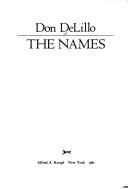
The Names is the seventh novel by American novelist Don DeLillo, published in 1982. The novel, set mostly in Greece, is primarily a series of character studies, interwoven with a plot about a mysterious "language cult" that is behind a number of unexplained murders. Among the many themes explored throughout the work is the intersection of language and culture, the perception of American culture from both within and outside its borders, and the impact that narration has on the facts of a story.
While some initial reviewers found The Names intellectually rich but unsuccessful, it became regarded in subsequent years as one of DeLillo's best works.
Plot summary
Various business people, government agents, and corporate statisticians gather in Athens, crossing paths, before departing, elsewhere. One estranged couple, a businessman and his archaeologist wife, are there with their son, a precocious child novelist. Infidelity and cryptic remarks are part of the network of the global economy. Meanwhile, murders are discovered, committed by a cult attempting to align the initials of the victim's names to carved letters on an ancient stone. The businessmen await the arrival of a colleague, an obsessively ambitious filmmaker, who lays out an extravagant plan to film the cultists performing their bizarre ritualistic killings.
Themes
Language
At the core of the book is the problem of language. Language is the way we connect with the world, and as such, it is a means of opening the world or controlling it. It is these two concepts of language, which struggle against each other, throughout the book, that are major themes, within the novel. The latter concept (language as a means of control) is embodied in the character of the archeologist Owen Brademas.
Religion
One character says, "It is religion that carries language. Language is the river of God." If language is the means of relating to the world, or even making the world, then, religion, in turn, circumscribes or frames language. Language, for DeLillo, arises in awe, towards the things of the world. That awe is religion. Religion is, thus, in some sense, a surrender, a concession that things are fundamentally outside of one's control.
Writing
As a manifestation of language, the written word is the most susceptible to control. Letters are static, while spoken words are elusive. Writing can, thus, be a desire for a full presence "a lost language, free from ambiguity."
It is this aspect of writing that appeals to Owen Brademas. He is seeking a language that has been "subdued and codified,” simplified into parallel structures. But writing can also be a recovery or articulation of "ancient things, secret, reshapable." In this second type of writing, the mystery of the world is retained. In The Names, it is a child, the narrator's son, Tap, who, most purely, practices this type of writing. Unlike Owen, for whom "correctness" in speech is very important, Tap's writing is full of lively misspellings, prompting his father to look at objects in a new way.
Politics
The theme of control is also visible, in the discussion of politics carried on throughout the book. Politics is where the element of control reveals itself, most visibly, as in Empire, in the United States' relations with other countries, in the activities of corporations, in the relationship between men and women, and in the behavior of terrorists. Nonetheless, the relationship between the "stronger" and the "weaker" is not simply reducible to "oppressor" and "oppressed.” Sometimes, the weaker force is complicit with, or distorts the nature of, the stronger.
Reception
In The New York Times, Michael Wood dubbed DeLillo an author of “extraordinary verve and wit” and described The Names as "a powerful, haunting book, formidably intelligent and agile” but wrote that "it also feels a little blurred, its insights scattered, rather than collected." Wood argued, "It is true that American fiction is full of people stranded between plotlessness and paranoia, between making no sense of their lives and making too much, and it would be a good defense of Mr. DeLillo to say that he has dramatized this dilemma strongly. But it would only be a defense, and 'The Names' is, still, a hard book to hold, in the mind.”
Jonathan Yardley of The Washington Post strongly praised the depiction of the community of Americans in Athens, writing that "his portraits of individual members of the community are sharp and true, his depiction of a world on the brink is wittily clinical, his dialogue is crisp and interesting.” However, Yardley also wrote that the novel "takes on too many themes and wanders in too many directions to find a coherent shape,” describing Axton's observation about language on the Parthenon as appealing but also arrived at "by so circuitous a route that many readers probably will lose patience, along the way." Yardley referred to The Names as "the work of a writer of clear if chilly brilliance” and argued that the moments when the author "thinks as keenly as he writes [...] are concentrated in the first of the book’s three principal sections".
A reviewer for Kirkus Reviews expressed similar reservations. The reviewer praised the scene in which Axton seduces the corporate wife, stating that "as long as DeLillo stays within [the] class of the edgy and expatriate, bis [sic] novel is fine--gritty and adhesive” and argued that "the larger theme is, as usual with DeLillo, the foulness of modern life--its sullying, cheapening progress." But the reviewer also wrote that "while other DeLillo books (even the weaker ones) have presented that theme with an insistent, disturbing blade of glittering scorn, this time, there is more somber meditation . . . while only a few scenes flare."
以上文字摘自英文维基百科「The Names (DeLillo novel)」(有删节,去掉了参考文献等尾部小节),按 CC BY-SA 4.0 使用,作者为维基百科的各位编者。
资料卡
- 原题
- The Names
- 原作语言
- 英语、泰米尔语
- 首次出版
- 1982 年 9 月 12 日
- 作品形式
- 长篇小说
- 首版出版社
- 阿尔佛雷德·A·克诺夫
资料卡来自 Wikidata Q7753069(CC0),众包数据,个别字段可能不全。