书单
百科
这个词条暂时没有中文维基百科条目,下面是英文维基百科的内容(英文原文):
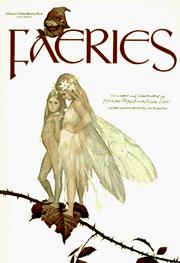
Faeries is a book written and illustrated by English artists Brian Froud and Alan Lee. An illustrated compendium of faerie mythology, legends and folklore, the book explores the history, customs and habitat of faeries in the manner of a field guide, complete with hand annotations.
The book was first published in 1978 by Harry N. Abrams, Inc. in the United States and Souvenir Press in the United Kingdom. It reached number four on the New York Times Best Seller list. Faeries has since been translated into at least nine other languages, and in 1981 was adapted into an animated television special of the same name. As of 2003, the book had sold more than five million copies.
The book received a mixed critical reception from news sources and library trade publications. Reviewers praised the authors' illustrations and depth of research, while some criticized the book's writing style for not clearly specifying facts regarding the book's mythical subject matter.
Overview
Spelled in the archaic fashion, the title faeries refers not just to fairies, but encompasses a wide range of mythological creatures including goblins, dwarves, pixies, elves, leprechauns, ogres, boggarts, banshees, mermaids and selkies.
The book's contents include information about faerie archaeology, history, characteristics and customs, a geography of Faerieland, and a catalogue of faerie types. It also gives in-universe advice on where faeries are most likely to be found, how to ward off faerie spells, when it is especially dangerous to come across faeries, and the ecology of faery-plant interactions. Although the book's historical information covers folklore from around the world, most of the facts, poetry and literature of faeries come from France, England, Scotland and Ireland. Included amongst Lee and Froud's text are Celtic legends and ballads about faeries, as well as excerpts from poems about faeries by poets such as William Butler Yeats and Christina Rossetti.
In total, the book contains 185 illustrations, 147 in full colour. It is published unpaginated.
Development
The idea for the book came from New York publisher Ian Ballantine. Inspired by the success of the 1977 Dutch-authored book Gnomes, Ballentine recruited the two British illustrators Brian Froud and Alan Lee to produce a similar tome about fairies as a follow up to Gnomes (a third book, Giants, was published following Faeries).
Sharing lodging in Chagford on the edge of Dartmoor, Lee and Froud spent nine months researching, illustrating and writing the book. They referred to the work of leading British folklorist Katharine Briggs as one of their main sources for information about faeries. Other sources include 19th-century folklorists such as Robert Hunt's Popular Romances of the West of England (1865) and Lady Wilde's Ancient Legends of Ireland (1887), as well as stories from the Middle Ages such as those told by Gerald of Wales. According to Froud, Ballantine had "expected a fun, jolly book with fluffy faeries, and what he got were all these green horrible creatures with nasty teeth that bit your ankles, and he was horrified. But our research was based on folklore and on what faeries were really like."
Froud stated that while planning the book, he and Lee intended to make their artwork indistinguishable from the other's, and to "actually draw on top of each other's art." Due to time constraints, however, they were unable to do it in such a way. Instead, they each chose what they wanted to illustrate and divided the work between them, taking into account one another's artistic strengths and weaknesses. Froud said, "We also made sure there were a few images that were absolutely a crossover, so I was partly in his style and he was partly in my style."
Style
Faeries features watercolours and pencil drawings. Comparing the two authors' illustrative styles, writer James Clarke remarked that Lee's images "skew slightly more towards a sense of realism" while Froud's style "is slightly more heightened and his fairy faces are immediately identifiable." Writing for Library Journal, M. L. del Mastro described the illustrations as a mix of "Maxfield Parrish delicates with Disney/Hildebrandt grotesques." The Washington Post identified the book's "stylistic debts" as being to Arthur Rackham, Richard Dadd, Willy Pogany, and the pre-Raphaelite painters John William Waterhouse, John Everett Millais and Edward Burne-Jones. The Atlantic Monthly also likened the illustrative style to the painters Arnold Böcklin and Hieronymus Bosch. Fantasy literature scholar Dimitra Fimi wrote that Lee's illustration for the entry "Faerie Rades", depicting the procession of the Irish fairies as "splendidly dressed men and women in medieval style, most of them riding decorated horses and one of them holding an unfolding banner," took a strong influence from John Duncan's 1911 painting The Riders of the Sidhe.
Publication and reception
Faeries was first published by Harry N. Abrams, Inc. in November 1978. The book reached number four on the New York Times Best Seller list. By January 1979, it had sold out its first printing of 180,000 copies.
Considered a fantasy classic, Faeries had sold in excess of five million copies by 2003. A 25th-anniversary edition of Faeries was published in 2002, containing eight new pages and 20 new pieces of art by Froud and Lee, as well as new introductions by the artists. The anniversary edition sold more than 100,000 copies within six months of release. The "Deluxe Collector's Edition" published in 2010 includes an additional eight new pieces of art by Froud and Lee as well as essays by the artists and a foreword by Jane Yolen.
以上文字摘自英文维基百科「Faeries (book)」(有删节,去掉了参考文献等尾部小节),按 CC BY-SA 4.0 使用,作者为维基百科的各位编者。
资料卡
- 原题
- Faeries
- 插图
- Brian Froud、阿兰·李
- 原作语言
- 英语
- 首次出版
- 1978 年 11 月
资料卡来自 Wikidata Q100400762(CC0),众包数据,个别字段可能不全。