书单
百科
这个词条暂时没有中文维基百科条目,下面是英文维基百科的内容(英文原文):
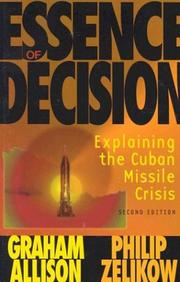
Essence of Decision: Explaining the Cuban Missile Crisis is a book by political scientist Graham T. Allison analyzing the 1962 Cuban Missile Crisis. Allison used the crisis as a case study for future studies into governmental decision-making. The book became the founding study of the John F. Kennedy School of Government, and in doing so revolutionized the field of international relations.
Allison originally published the book in 1971. In 1999, because of new materials available (including tape recordings of the U.S. government's proceedings), he rewrote the book with Philip Zelikow.
The title is based on a speech by John F. Kennedy, in which he said, "The essence of ultimate decision remains impenetrable to the observer - often, indeed, to the decider himself."
Thesis
When he first wrote the book, Allison contended that political science and the study of international relations were saturated with rational expectations theories inherited from the field of economics. Under such a view, the actions of states are analyzed by assuming that nations consider all options and act rationally to maximize their utility.
Allison attributes such viewpoints to the dominance of economists such as Milton Friedman, statesmen such as Robert McNamara and Henry Kissinger, disciplines such as game theory, and organizations such as the RAND Corporation. However, as he puts it:
It must be noted, however, that an imaginative analyst can construct an account of value-maximizing choice for any action or set of actions performed by a government.
Or, to put it bluntly, this approach (which Allison terms the "Rational Actor Model") violates the principle of falsifiability. Also, Allison notes that "rational" analysts must ignore a lot of facts in order to make their analysis fit their models.
In response, Allison constructed three different ways (or "lenses") through which analysts can examine events: the "Rational Actor" model, the "Organizational Behavior" model, and the "Governmental Politics" model.
To illustrate the models, Allison poses the following three questions in each section:
Why did the Soviet Union decide to place offensive missiles in Cuba?
Why did the United States respond to the missile deployment with a blockade?
Why did the Soviet Union withdraw the missiles?
Models
The "Rational Actor" Model
The origin of Allison's first model is explained above. Basically, under this theory:
Governments are treated as the primary actor.
The government examines a set of goals, evaluates them according to their utility, then picks the one that has the highest "payoff."
Under this theory, Allison explains the crisis like this:
John F. Kennedy, in 1961, revealed that the Soviet Union, despite rhetoric, had far fewer ICBMs than it claimed. In response, Nikita Khrushchev ordered nuclear missiles with shorter ranges installed in Cuba. In one move, the Soviets bridged the "missile gap" while scoring points in the Cold War. Based on Kennedy's failure to back up the Bay of Pigs Invasion, they believed the U.S. wouldn't respond harshly.
Kennedy and his advisors (EXCOMM) evaluated a number of options, ranging from doing nothing to a full invasion of Cuba. A blockade of Cuba was chosen because it wouldn't necessarily escalate into war, and because it forced the Soviets to make the next move.
Because of mutually assured destruction by a nuclear war, the Soviets had no choice but to bow to U.S. demands and remove the weapons.
Allison guessed that Kennedy must have made an "under the table" agreement concerning American nuclear missiles in Turkey. The American tapes released following 1993 confirmed this and the missiles were quietly removed from Turkey a few years after the crisis.
The "Organizational Process" Model
Allison noted there were many facts that the rational model had to ignore, such as why the Soviets failed to camouflage the nuclear sites during construction, but did so only after U-2 flights pinpointed their locations.
He cited work by James G. March and Herbert A. Simon, which argue that existing governmental bureaucracy places limits on a nation's actions, and often dictates the outcome. He then proposed the following "organizational process" model propositions:
When faced with a crisis, government leaders don't look at it as a whole, but break it down and assign it according to pre-established organizational lines.
Because of time and resource limitations, rather than evaluating all possible courses of action to see which one is most likely to work, leaders settle on the first proposal that adequately addresses the issue, which Simon termed "satisficing."
Leaders gravitate towards solutions that limit short-term uncertainty (emphasis on "short-term").
Organizations follow set "repertoires" and procedures when taking actions.
Because of the large resources and time required to fully plan and mobilize actions within a large organization (or government), leaders are effectively limited to pre-existing plans.
Under this theory, the crisis is explained thus:
Because the Soviets never established nuclear missile bases outside of their country at the time, they assigned the tasks to established departments, which in turn followed their own set procedures. However, their procedures were not adapted to Cuban conditions, and as a result, mistakes were made that allowed the U.S. to quite easily learn of the program's existence. Such mistakes included such gaffes as supposedly undercover Soviet troops decorating their barracks with Red Army Stars viewable from above. Alternatively, the secrecy may have been the gaffe, stoking American fears unnecessarily.
以上文字摘自英文维基百科「Essence of Decision」(有删节,去掉了参考文献等尾部小节),按 CC BY-SA 4.0 使用,作者为维基百科的各位编者。
资料卡
- 原题
- Essence of Decision 等 2 项
- 原作语言
- 美国英语
- 首次出版
- 1971 年
- 主题
- 古巴导弹危机、商业决策
资料卡来自 Wikidata Q604873(CC0),众包数据,个别字段可能不全。