书单
百科
这个词条暂时没有中文维基百科条目,下面是英文维基百科的内容(英文原文):
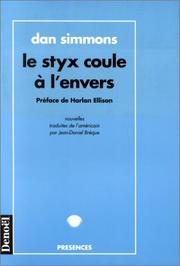
Prayers to Broken Stones is a short story collection by American author Dan Simmons. It includes 13 of his earlier works, along with an introduction by Harlan Ellison in which the latter relates how he "discovered" Dan Simmons at the Colorado Mountain College's "Writers' Conference in the Rockies" in 1981. The title is a borrowed line from T. S. Eliot's "The Hollow Men".
Contents
History
"The River Styx Runs Upstream" was Dan Simmons's first published work, and the short story that brought him to Ellison's attention in August 1979. Simmons relates the tale in his introduction, noting that Ellison's initial reaction was this (possibly a little tongue in cheek):
"Who is this Simmons?" bellowed Ellison. "Stand up, wave your hand, show yourself, goddamnit. What egomaniacal monstrosity has the fucking gall, the unmitigated hubris to inflict a story of five thousand fucking words on this workshop? Show yourself, Simmons!"
Simmons survived Ellison's critique, and Ellison pushed Simmons into submitting it to Twilight Zone Magazine "for their first annual contest for unpublished writers" (page 16, introduction to "The River Styx Runs Upstream"). Out of around 7000 submissions, it tied for first place and was published 15 February 1982 (according to PtBS's copyright page, in April, not February).
Plot summary
The actual story is classic Simmons in its literary allusions, with epigraphs from Ezra Pound's Cantos; the protagonist's father is a Pound scholar with an especial interest in the Cantos (reading from it to his children), and the premise can be seen as deriving from a line in the Cantos as well.
The mother of the family has died of some unspecified illness. Stricken by grief, the father bargains (heedless of the prospect of financial ruin) with the "Resurrectionists" to have his wife's corpse technologically revived. The resurrection is a hollow one, as all higher cognitive functions are irreparably damaged, although it does function somewhat autonomously. Their family is stigmatized, and the father slowly breaks down and his classes become less and less popular until he takes a sabbatical to write his long-planned work on the Cantos. He spends most of it drunk. Simon, the protagonist's brother, eventually commits suicide. A few years later, while the protagonist is at university (sponsored by the Resurrectionists, whom he has joined) the father commits suicide as well. He graduates and begins working for them and helping to spread the living dead. He does little but work, spending his free time with his resurrected family.
History
"Eyes I Dare Not Meet in Dreams" was first published in OMNI Magazine in September 1987. It was inspired by his 1969 experiences in Germantown, Pennsylvania, when he worked with children with physical and mental disabilities, as a teacher's aide in the Upsal Day School for the Blind. The story forms the seed, the original form, of Simmons's later novel, The Hollow Man.
Plot summary
The two central characters are the Americans Bremen and Gail. Both are telepaths, the only other telepaths that either has ever known. Inevitably, they fall in love. When Gail dies of illness, Bremen is devastated. He gives up his career in mathematics and becomes a drifter. At the commencement of the action, he has ended up at a facility for disabled minors. He becomes sort of fond of one named Robby, who had been blinded and mentally crippled before birth by his mother's drug abuse habits, and resolves that before he leaves the facility (for he feels he has been there too long), he will use his telepathic power to give Robby a gift of sorts: images and sounds of the outside world.
Bremen succeeds in penetrating Robby's mental defenses, but is unexpectedly sucked into Robby's mind, where Gail manifests. The fusion between Gail and Bremen was deep and profound enough. Unfortunately, the strain of holding Bremen and Gail in his mind and in comprehending what the show up pushes Robby's obese body to the brink and over. Bremen leaves Robby's mind, taking Gail and Robby with him while Robby's body dies.
"Vanni Fucci is Alive and Well and Living in Hell"
This story, and the following one, are both darkly humorous and deal with televangelists. It was first published in Dark Harvest's "Night Visions 5" in 1988.
The events concern a day when a major and unscrupulous televangelist (Brother Freddy) sees a scheduled appearance by Dale Evans go seriously wrong when an exotic Italian-looking fellow strolls on stage. He announces that he is Vanni Fucci (a character from Dante Alighieri's Divine Comedy) and that "for the last seven hundred years I have lived in hell." (pg 72) Each Bolgia of Dante's Hell is allowed to send one of its inhabitants (Fucci was of the Seventh Bolgia of the Eighth Circle of Hell) back to Earth for a brief period of time, and Fucci happened to be chosen. Unlike most such returnees, he is not indulging in as many worldly pleasures as he can, however, but has returned in order to remedy a distressing problem. He recounts that Hell and even gods are created and uncreated by the strength of people's beliefs, and unfortunately Fucci was condemned to eternal suffering simply because he had gotten politically cross-wise of Dante and Dante's Hell was the most popular version (and so, the real one).
By this point, it is clear that a supernatural force is at work: Security is being prevented from getting onto the stage by an invisible and extremely resilient wall, and the cameras are physically disassembled but are still transmitting over the air.
From Fucci's perspective, the torments of Hell are quite bad enough, but the colossal and cosmic injustice of being condemned to Hell for his politics aggravates him sufficiently that he "gives God the fig"; to punish Fucci for his blasphemy, every thief "within a hundred yards" becomes "Chelidrids, jaculi, phareans, cenchriads" and "two-headed amphisbands" (pg 80), who then attack him and rend him limb from limb in a painful orgy of violence. This punishment of course aggravates Fucci even more.
以上文字摘自英文维基百科「Prayers to Broken Stones」(有删节,去掉了参考文献等尾部小节),按 CC BY-SA 4.0 使用,作者为维基百科的各位编者。
资料卡
- 原题
- Prayers to Broken Stones
- 原作语言
- 英语
- 首次出版
- 1990 年
- 作品形式
- 短篇小说集
- 体裁
- 恐怖作品
- 首版出版社
- 矮脚鸡图书出版公司
资料卡来自 Wikidata Q7239067(CC0),众包数据,个别字段可能不全。