 书单
百科
这个词条暂时没有中文维基百科条目,下面是英文维基百科的内容(英文原文):
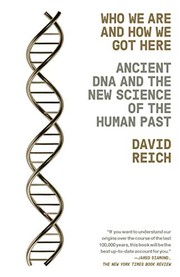
Who We Are and How We Got Here is a 2018 book on the contribution of genome-wide ancient DNA research to human population genetics by the geneticist David Reich. He describes discoveries made by his group and others, based on analysis and comparison of ancient and modern DNA from human populations around the world. Central to these is the finding that almost all human populations are mixtures resulting from multiple population migrations and gene flow.
Several reviewers have praised the book for clearly describing pioneering work in a cutting-edge field of study. It has been criticized by numerous scientists and scholars for its handling of race, while others argue that nothing in the book supports racist conclusions.
Context
David Reich is a geneticist who has studied ancient human genomes, comparing their patterns of mutations to discover which populations migrated and mixed throughout prehistory. He was mentored by the population geneticist Luca Cavalli-Sforza, who from 1960 pioneered the attempt to match the study of human prehistory by archaeology and linguistics, using the limited genetic data available at that time.
Publication
The book was published by Oxford University Press in 2018. Although it is credited to David Reich alone, he explains in the acknowledgements that the book grew from a detailed collaboration with his wife Eugenie Reich.
The book is illustrated with monochrome maps, diagrams, and timelines. There are no photographs.
Summary
Since 2010, population geneticists have been able to sequence ancient human DNA, recovering complete genomes, in contrast to earlier approaches which relied on the far more abundant (and hence more easily recovered) mitochondrial DNA, which is present in many copies in each cell, and transmitted only via the maternal line. That early work gave what Reich calls the "exciting" result that all modern humans are related to "Mitochondrial Eve", a woman who lived in Africa only about 160,000 years ago.
The whole genome recovery technique, using the especially hard bone from the inner ear of ancient skeletons — along with the genomes of modern people from different parts of the world, including especially some isolated human populations — has made it possible to reconstruct prehistoric migrations and mixing of populations in the past 5,000 years, and to make reliable inferences about mixtures from much further back in time. Reich's laboratory at Harvard Medical School has led to an industrialisation of ancient genome recovery and this new knowledge from genomics has overthrown many old assumptions about human origins.
The book is in three parts, the first dealing with the background to what he calls the ancient DNA revolution as well as the interbreeding between archaic and modern humans, the second dealing with the role that this revolution has in illuminating the constituents of various current major populations and a final section looking at the implications of the new techniques.
Human Migrations
The second section of the book focusses on various large human migrations. Reich observes that migrations and population mixtures similar to the spread of Indo-European languages characterise human prehistory on all continents.
Much of the work has focused on Western Eurasia, where in 1786 Sir William Jones discovered that Sanskrit and ancient Greek were related languages. Linguists came to recognise the Indo-European family of languages, spanning Germanic, Celtic, Italic, Iranian and northern Indian languages, but without explaining how these came to be. Reich showed that modern populations in Europe and north India derive from mixing of native populations with Yamnaya people from the steppes north of the Black Sea and the Caspian Sea some 5,000 years ago, in separate migrations to the west and the east. The Corded ware culture, an archaeological horizon dated to c.3000-2350 BC and spanning most of Central and Eastern Europe, corresponds to a stage in the westward migration. In the book, Reich disputed the idea that Indo-European languages originated in Anatolia due to a lack of genetic similarity with the steppe Yamnaya culture, instead suggesting the languages may have originated south of the Caucasus, in present-day Iran or Armenia and spit into two branches with one going to the steppe and one to Anatolia.
Reich shows that people in Japan and Korea share some 80% of their DNA, implying migration; Polynesians migrated relatively recently, in just the past few thousand years, from the region of Taiwan. The evidence can upset long-held beliefs: Native American skeletons from 10,000 years ago do not appear to be related to the tribes living in those regions today who have been asking for the ancient bones to be returned to them for burial.
Reich argues that genetic evidence showed that West Asian geneflow into modern populations in Ethiopia and Somalia, particularly speakers of Afroasiatic languages, could support a diffusion of these languages from the Middle East.
The anthropologist John Hawks, writing in the Wall Street Journal, observes that Reich was surprised that the "concordance of near-mythological history with genetic fact" in the migrations in India was "a potential political bombshell"; he notes that Reich avoided it by not talking about "Indo-European invaders at all", writing only that "No group in India can claim genetic purity".
Reception
The author and intellectual Jared Diamond, in the New York Times, notes that geneticists can now go far beyond studying the personal ancestries of participants in National Geographic's Genographic Project, which looked at small sections of their parents' DNA, namely their mother's mitochondrial DNA and their father's Y chromosome. By looking at DNA from ancient bones, Reich can recover whole genomes. Diamond warns readers not to expect an oversimplified story:
以上文字摘自英文维基百科「Who We Are and How We Got Here」(有删节,去掉了参考文献等尾部小节),按 CC BY-SA 4.0 使用,作者为维基百科的各位编者。
资料卡
- 原题
- Who We Are and How We Got Here
- 原作语言
- 英语
- 首次出版
- 2018 年
- 体裁
- 大众科学
- 主题
- 群体遗传学
资料卡来自 Wikidata Q54489223(CC0),众包数据,个别字段可能不全。