书单
百科
这个词条暂时没有中文维基百科条目,下面是英文维基百科的内容(英文原文):
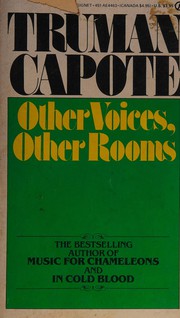
Other Voices, Other Rooms is a 1948 novel by Truman Capote. It is written in the Southern Gothic style and is notable for its atmosphere of isolation and decadence.
Other Voices, Other Rooms is significant because it is both Capote's first published novel and semi-autobiographical. It is also noteworthy due to its erotically charged photograph of the author, risqué content, and debut at number nine on The New York Times Best Seller list, remaining on the list for nine weeks.
Conception
Truman Capote spent two years writing Other Voices, Other Rooms. He began the manuscript after an inspiring walk in the woods while he was living in Monroeville, Alabama. He immediately cast aside his rough manuscript for Summer Crossing and took up the new idea. He left Alabama and continued work in New Orleans. His budding literary fame put him in touch with fellow southerner and writer Carson McCullers. Capote joined McCullers at the artists' community, Yaddo, in Saratoga Springs, New York, and McCullers helped Capote locate an agent (Marion Ives) and a publisher (Random House) for his project. Capote continued work in North Carolina, and eventually completed the novel in a rented cottage in Nantucket, Massachusetts.
Plot
After his mother's death, 13-year-old Joel Harrison Knox, a lonely, effeminate boy, is sent from New Orleans to live with his father, who abandoned him at birth. Arriving at Skully's Landing, a vast, decaying mansion on an isolated plantation in Mississippi, Joel meets his sullen stepmother Amy; her cousin Randolph, a gay man and dandy; the defiant tomboy Idabel, a girl who becomes his friend; and Jesus and Zoo, the two black caretakers of the home. He also sees a spectral "queer lady" with "fat dribbling curls" watching him from a top window.
Despite Joel's queries, the whereabouts of his father remains a mystery. When he finally is allowed to see his father, Joel is stunned to find he is a mute quadriplegic, having tumbled down a flight of stairs after being accidentally shot by Randolph and nearly dying. Joel runs away with Idabel to a carnival and meets a woman with dwarfism; on a Ferris wheel, Joel rebuffs her when she attempts to touch Joel in a sexual manner. Looking for Idabel in a storm, Joel catches pneumonia and eventually returns to the Landing, where he is nursed back to health by Randolph. The implication in the final paragraph is that the "queer lady" beckoning from the window had actually been Randolph, dressed in an old Mardi Gras costume.
Characters
Joel Harrison Knox: The 13-year-old protagonist of the story. Joel is a portrait of Truman Capote in his own youth, notably being delicate, fair-skinned and a natural teller of outrageous tales.
Mr. Edward R. Sansom: Joel's paralyzed father, a former boxing manager.
Miss Amy Skully: Joel's sharp-tongued stepmother, in her late forties and shorter than Joel. Miss Amy's character is reminiscent of Callie Faulk, an older cousin with whom Truman Capote lived in Alabama. She is also reminiscent of Capote's maternal grandmother, Mabel Knox, who always wore a glove on her left hand to cover an unknown malady and was known for her Southern aristocratic ways.
Randolph: Miss Amy's first cousin and owner of Skully's Landing. Randolph is in his mid-30s and is effeminate, narcissistic, and openly homosexual. Randolph's character is largely imaginary, but is a faint shadow of Capote's older cousin Bud Faulk, a single man, likely homosexual, and role model for Capote while he was growing up in Alabama.
Idabel Thompkins: A gloomy, cantankerous tomboy who befriends Joel. Idabel's character is an exaggeration of Capote's childhood friend, Nelle Harper Lee, later the author of To Kill a Mockingbird.
Florabel Thompkins: Idabel's feminine and prissy sister.
Jesus Fever: A centenarian, pygmyish, African American mule-driver at Skully's Landing, where he had been enslaved 70 years before.
Missouri Fever (Zoo): Jesus' granddaughter who is in her mid-20s. She wears a scarf on her elongated neck to hide a large scar inflicted by Keg Brown, who was sentenced to a chain gang for his crime. Missouri Fever's character is based on a cook named Little Bit who lived and worked in the Alabama home where Capote lived, as a child, with his older cousins.
Pepe Alvarez: A Latin professional boxer who is Randolph's original obsession and muse, and the prototype that led to Randolph's obsession with young Joel, as it is implied that Joel resembles Pepe.
Ellen Kendall: Joel's kind, genteel aunt who sends him from New Orleans to live with his father.
Little Sunshine: A short, bald, ugly, African American hermit who lives at The Cloud Hotel.
Miss Wisteria: A blond midget who befriends Joel and Idabel at a fair traveling through Noon City.
Major themes
On more than one occasion Capote himself asserts that the central theme of Other Voices, Other Rooms is a son's search for his father. In Capote's own words, his father Arch Persons was "a father who, in the deepest sense, was nonexistent." Also: "the central theme of Other Voices, Other Rooms was my search for the existence of this essentially imaginary person."
Another theme is self-acceptance as part of coming of age. Deborah Davis points out that Joel's thorny and psychological voyage while living with eccentric Southern relatives involves maturing "from an uncertain boy into a young man with a strong sense of self and acceptance of his homosexuality." Gerald Clarke describes the conclusion of the novel, "Finally, when he goes to join the queer lady in the window, Joel accepts his destiny, which is to be homosexual, to always hear other voices and live in other rooms. Yet acceptance is not a surrender; it is a liberation. "I am me," he whoops. "I am Joel, we are the same people." So, in a sense, had Truman rejoiced when he made peace with his own identity."
以上文字摘自英文维基百科「Other Voices, Other Rooms (novel)」(有删节,去掉了参考文献等尾部小节),按 CC BY-SA 4.0 使用,作者为维基百科的各位编者。
资料卡
- 原题
- "Other Voices, Other Rooms"
- 原作语言
- 英语
- 首次出版
- 1948 年 1 月
- 体裁
- 南方歌德、教育小说
- 首版出版社
- 兰登书屋
- 故事发生地
- 亚拉巴马州
资料卡来自 Wikidata Q646231(CC0),众包数据,个别字段可能不全。