书单
百科
这个词条暂时没有中文维基百科条目,下面是英文维基百科的内容(英文原文):
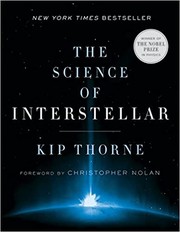
The Science of Interstellar is a non-fiction book by American theoretical physicist and Nobel laureate Kip Thorne, with a foreword by Christopher Nolan. The book was initially published on November 7, 2014 by W. W. Norton & Company. This is his second full-size book for non-scientists after Black Holes and Time Warps, released in 1994. The Science of Interstellar is a follow-up text for Nolan's 2014 film Interstellar, starring Matthew McConaughey, Anne Hathaway, and Jessica Chastain.
Overview
Kip Thorne was the scientific consultant and an executive producer for the movie. In this book he explains the scientific concepts behind the film's cosmological ideas. The book is composed of seven parts with a foreword by Christopher Nolan and one additional chapter discussing the inception of Interstellar. Thorne starts by laying out introductory information about the universe, spacetime, physical laws, relativity, tidal forces, and black holes. The next section covers the supermassive black hole Gargantua, explaining its appearance and how it was created via CGI, as well as gravitational slingshots and a scientifically inaccurate statement by a character in the film. Thorne then shifts to Earth, discussing the crop-destroying blight, development of interstellar travel technologies, and another scientifically inaccurate statement in the film. The next part discusses the wormhole, explaining the basics of how wormholes work, how Interstellar's wormhole was rendered via CGI, and a method by which the wormhole could have been discovered in Interstellar's universe via the detection of gravitational waves. Thorne then explores the development of planets orbiting a supermassive black hole and how the planets depicted in the film could form in real life. The next section discusses some of the more advanced and extreme physics depicted in the film, including large extra dimensions, warping the gravitational constant, and the different types of singularities inside a black hole, including the BKL, mass-inflation, and shock singularities. The final part discusses the climax of the film, including Cooper's plunge into the black hole Gargantua, the tesseract scene and four-dimensional space, and getting colonies of people off of the Earth.
以上文字摘自英文维基百科「The Science of Interstellar」(去掉了参考文献等尾部小节),按 CC BY-SA 4.0 使用,作者为维基百科的各位编者。
资料卡
- 原题
- The Science of Interstellar
- 原作语言
- 英语
- 首次出版
- 2014 年 11 月 7 日
- 体裁
- 非虚构作品、科普文学
- 首版出版社
- 威廉·沃德尔·诺顿公司
- 页数
- 336
- 前作
- 黑洞与时间弯曲
- 主题
- 星际穿越
资料卡来自 Wikidata Q19961406(CC0),众包数据,个别字段可能不全。